

intrusion into organic-rich sedimentary rocks led to
formation of large volumes of greenhouse gases that
were vented to the atmosphere in explosive gas
eruptions forming several thousand hydrothermal
vent complexes along the Norwegian margin.
The mid-Norwegian margin experienced regional
subsidence and modest sedimentation since Middle
Eocene time and developed into a passive rifted margin bordering the oceanic Norwegian-Greenland Sea.
Mid-Cenozoic compressional deformation (including
domes/anticlines, reverse faults and broad-scale inversion) is well documented on the Vøring margin, but its
timing and significance are debated. The main phase
of deformation is clearly Miocene in age but some of
the structures were probably initiated earlier in Late
Eocene–Oligocene times.
There is increasing evidence on the Norwegian
margin for Late Miocene outbuilding on the inner
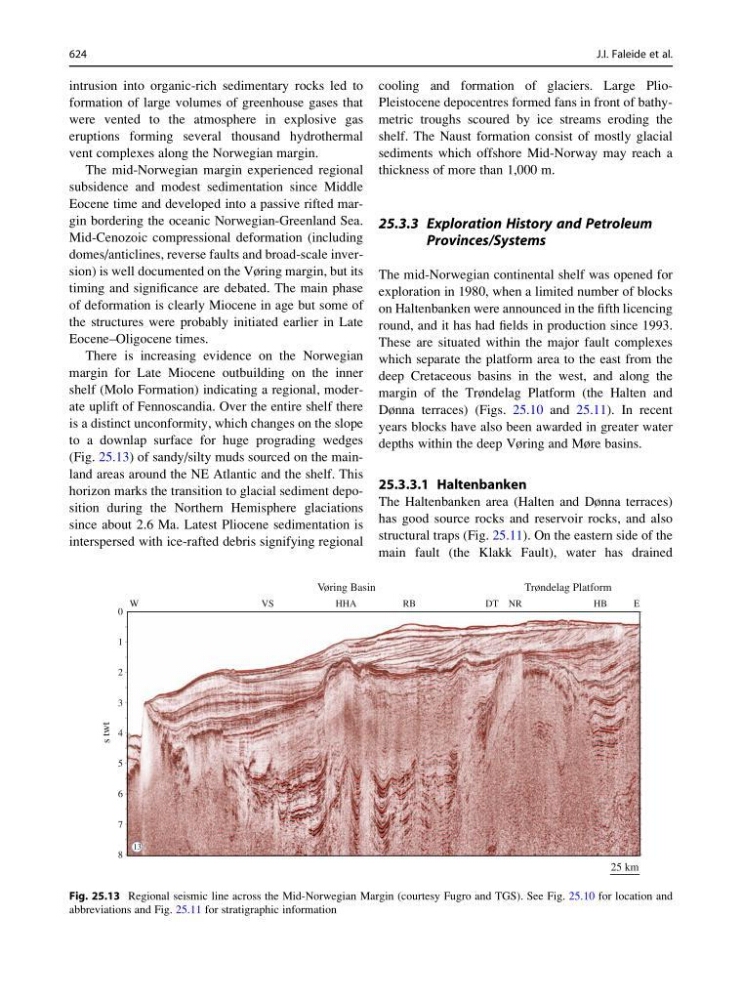
shelf (Molo Formation) indicating a regional, moderate uplift of Fennoscandia. Over the entire shelf there
is a distinct unconformity, which changes on the slope
to a downlap surface for huge prograding wedges
(Fig. 25.13) of sandy/silty muds sourced on the mainland areas around the NE Atlantic and the shelf. This
horizon marks the transition to glacial sediment deposition during the Northern Hemisphere glaciations
since about 2.6 Ma. Latest Pliocene sedimentation is
interspersed with ice-rafted debris signifying regional
cooling and formation of glaciers. Large PlioPleistocene depocentres formed fans in front of bathymetric troughs scoured by ice streams eroding the
shelf. The Naust formation consist of mostly glacial
sediments which offshore Mid-Norway may reach a
thickness of more than 1,000 m.
25.3.3 Exploration History and Petroleum
Provinces/Systems
The mid-Norwegian continental shelf was opened for
exploration in 1980, when a limited number of blocks
on Haltenbanken were announced in the fifth licencing
round, and it has had fields in production since 1993.
These are situated within the major fault complexes
which separate the platform area to the east from the
deep Cretaceous basins in the west, and along the
margin of the Trøndelag Platform (the Halten and
Dønna terraces) (Figs. 25.10 and 25.11). In recent
years blocks have also been awarded in greater water
depths within the deep Vøring and Møre basins.
25.3.3.1 Haltenbanken
The Haltenbanken area (Halten and Dønna terraces)
has good source rocks and reservoir rocks, and also
structural traps (Fig. 25.11). On the eastern side of the
main fault (the Klakk Fault), water has drained
0
1
2
3
4
5
6
7
8
25 km
s
twt
W
E
Trøndelag Platform
Vøring Basin
NR
HB
HHA
DT
RB
VS
13
Fig. 25.13 Regional seismic line across the Mid-Norwegian Margin (courtesy Fugro and TGS). See Fig. 25.10 for location and
abbreviations and Fig. 25.11 for stratigraphic information
624
J.I. Faleide et al.