

Cretaceous basins such as the Møre and Vøring basins
off mid-Norway, and the deep basins in the SW
Barents Sea (Fig. 25.3). Prior to that, Late Palaeozoic
rift basins formed between Norway and Greenland and
in the western Barents Sea along the NE-SW
Caledonian trend. It has been suggested that the main
Late Palaeozoic–Early Mesozoic rift episodes took
place in mid-Carboniferous, Carboniferous–Permian
and Permian–Early Triassic times. Sediment packages
associated with these movements are poorly resolved,
mainly because of overprint by younger tectonism and
burial by thick sedimentary strata.
On the mid-Norwegian margin, the Trøndelag Platform (Froan Basin) and Vestfjorden Basin record significant fault activity in Permian–Early Triassic time.
Permian–Triassic extension is generally poorly dated,
but is best constrained onshore East Greenland where
a major phase of normal faulting culminated in the
mid-Permian and further block faulting took place in
the Early Triassic. The later Triassic basin evolution
was characterised by regional subsidence and deposition of large sediment volumes. The Lower-Middle
Jurassic strata (mainly sandstones) reflect shallow
marine deposition prior to the onset of the next major
rift phase.
A shift in the extensional stress field vector to NWSE is recorded by the prominent NE Atlantic-Arctic
late Middle Jurassic–earliest Cretaceous rift episode,
an event associated with northward propagation of
Atlantic rifting. Considerable crustal extension and
thinning led to the development of major Cretaceous
basins off mid-Norway (Møre and Vøring basins) and
East Greenland, and in the SW Barents Sea (Harstad,
Tromsø, Bjørnøya and Sørvestsnaget basins). These
basins underwent rapid differential subsidence and
segmentation into sub-basins and highs.
By mid-Cretaceous time, most of the structural
relief within the Møre and Vøring basins had been
filled in and thick Upper Cretaceous strata, mainly
fine-grained clastics, were deposited in wide basins.
?
?
?
?
?
?
?
10 km
10 km
10 km
10 km
NW
SE
UR
RiB
VfB
LR
Plio-Pleistocene
Glacial Sediments
Cenozoic
Upper Cretaceous
Lower Cretaceous
Intrusion
Jurassic-TriassicUpper Palaeozoic
Breakup Lava
0
2
NW
4
6
8
10
SE
s twt
VE
HG
NH
UH
NS
?
?
?
?
0
2
4
6
8
10
s twt
0
2
4
6
8
10
s twt
0
2
4
6
8
s twt
Trøndelag Platform
Vøring Basin
TB
Vøring Marginal High
NR
HB
VE
SE
Vøring Basin
Vøring Marginal High
Halten Terrace
NW
Møre Basin
Møre Marginal High
NW
SE
7
8
9
10
Trøndelag Platform
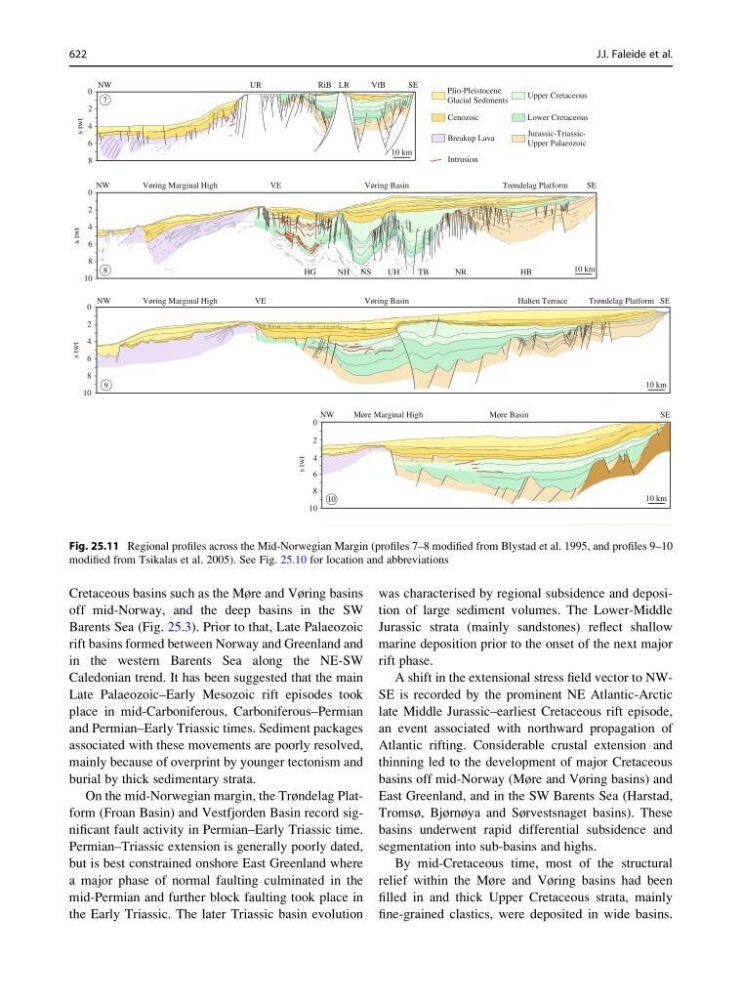
Fig. 25.11 Regional profiles across the Mid-Norwegian Margin (profiles 7–8 modified from Blystad et al. 1995, and profiles 9–10
modified from Tsikalas et al. 2005). See Fig. 25.10 for location and abbreviations
622
J.I. Faleide et al.