

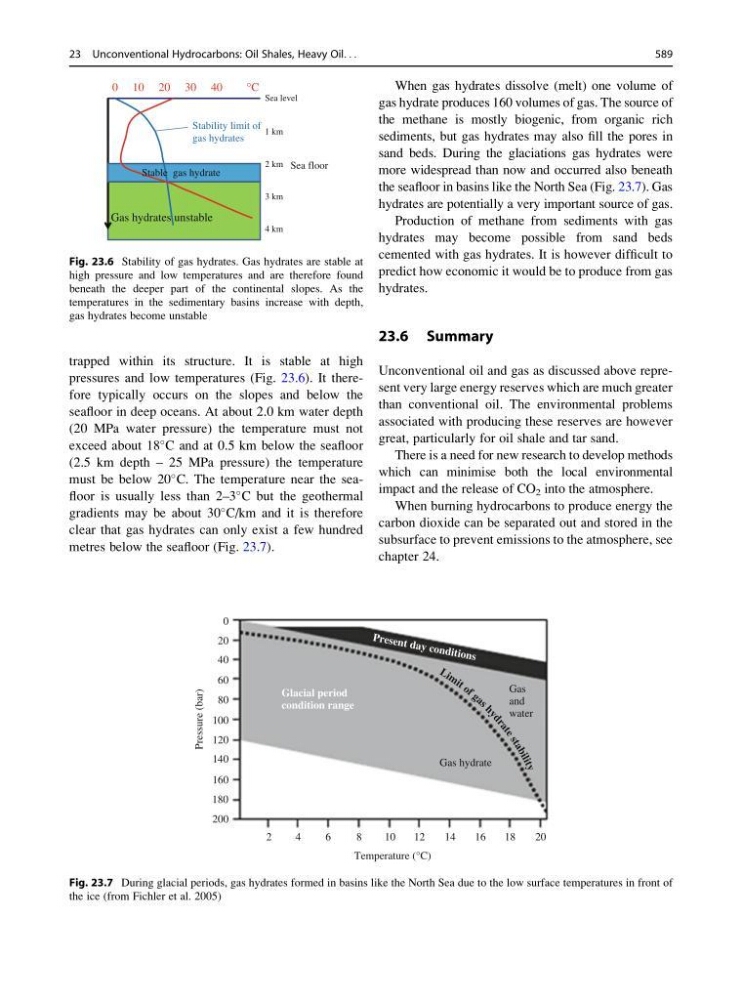
trapped within its structure. It is stable at high
pressures and low temperatures (Fig. 23.6). It therefore typically occurs on the slopes and below the
seafloor in deep oceans. At about 2.0 km water depth
(20 MPa water pressure) the temperature must not
exceed about 18
C and at 0.5 km below the seafloor
(2.5 km depth – 25 MPa pressure) the temperature
must be below 20
C. The temperature near the seafloor is usually less than 2–3
C but the geothermal
gradients may be about 30
C/km and it is therefore
clear that gas hydrates can only exist a few hundred
metres below the seafloor (Fig. 23.7).
When gas hydrates dissolve (melt) one volume of
gas hydrate produces 160 volumes of gas. The source of
the methane is mostly biogenic, from organic rich
sediments, but gas hydrates may also fill the pores in
sand beds. During the glaciations gas hydrates were
more widespread than now and occurred also beneath
the seafloor in basins like the North Sea (Fig. 23.7). Gas
hydrates are potentially a very important source of gas.
Production of methane from sediments with gas
hydrates may become possible from sand beds
cemented with gas hydrates. It is however difficult to
predict how economic it would be to produce from gas
hydrates.
23.6 Summary
Unconventional oil and gas as discussed above represent very large energy reserves which are much greater
than conventional oil. The environmental problems
associated with producing these reserves are however
great, particularly for oil shale and tar sand.
There is a need for new research to develop methods
which can minimise both the local environmental
impact and the release of CO 2 into the atmosphere.
When burning hydrocarbons to produce energy the
carbon dioxide can be separated out and stored in the
subsurface to prevent emissions to the atmosphere, see
chapter 24.
200
2
Pressure (bar)
4
6
8
Gas hydrate
Gas
and
water
Pr es en t da y co nd iti on s
Glacial period
condition range
10
12
14
16
18
20
Temperature (°C)
180
160
140
120
100
80
60
40
20
0
L i m i t o f g a s
h
y
d
r
a
t
e
s
t
a
b
i
l
i
t
y
Fig. 23.7 During glacial periods, gas hydrates formed in basins like the North Sea due to the low surface temperatures in front of
the ice (from Fichler et al. 2005)
Sea level
1 km
2 km
3 km
4 km
0 10 20 30 40
°C
Sea floor
Stable gas hydrate
Gas hydrates unstable
Stability limit of
gas hydrates
Fig. 23.6 Stability of gas hydrates. Gas hydrates are stable at
high pressure and low temperatures and are therefore found
beneath the deeper part of the continental slopes. As the
temperatures in the sedimentary basins increase with depth,
gas hydrates become unstable
23 Unconventional Hydrocarbons: Oil Shales, Heavy Oil. . .
589
pressures and low temperatures (Fig. 23.6). It therefore typically occurs on the slopes and below the
seafloor in deep oceans. At about 2.0 km water depth
(20 MPa water pressure) the temperature must not
exceed about 18
C and at 0.5 km below the seafloor
(2.5 km depth – 25 MPa pressure) the temperature
must be below 20
C. The temperature near the seafloor is usually less than 2–3
C but the geothermal
gradients may be about 30
C/km and it is therefore
clear that gas hydrates can only exist a few hundred
metres below the seafloor (Fig. 23.7).
When gas hydrates dissolve (melt) one volume of
gas hydrate produces 160 volumes of gas. The source of
the methane is mostly biogenic, from organic rich
sediments, but gas hydrates may also fill the pores in
sand beds. During the glaciations gas hydrates were
more widespread than now and occurred also beneath
the seafloor in basins like the North Sea (Fig. 23.7). Gas
hydrates are potentially a very important source of gas.
Production of methane from sediments with gas
hydrates may become possible from sand beds
cemented with gas hydrates. It is however difficult to
predict how economic it would be to produce from gas
hydrates.
23.6 Summary
Unconventional oil and gas as discussed above represent very large energy reserves which are much greater
than conventional oil. The environmental problems
associated with producing these reserves are however
great, particularly for oil shale and tar sand.
There is a need for new research to develop methods
which can minimise both the local environmental
impact and the release of CO 2 into the atmosphere.
When burning hydrocarbons to produce energy the
carbon dioxide can be separated out and stored in the
subsurface to prevent emissions to the atmosphere, see
chapter 24.
200
2
Pressure (bar)
4
6
8
Gas hydrate
Gas
and
water
Pr es en t da y co nd iti on s
Glacial period
condition range
10
12
14
16
18
20
Temperature (°C)
180
160
140
120
100
80
60
40
20
0
L i m i t o f g a s
h
y
d
r
a
t
e
s
t
a
b
i
l
i
t
y
Fig. 23.7 During glacial periods, gas hydrates formed in basins like the North Sea due to the low surface temperatures in front of
the ice (from Fichler et al. 2005)
Sea level
1 km
2 km
3 km
4 km
0 10 20 30 40
°C
Sea floor
Stable gas hydrate
Gas hydrates unstable
Stability limit of
gas hydrates
Fig. 23.6 Stability of gas hydrates. Gas hydrates are stable at
high pressure and low temperatures and are therefore found
beneath the deeper part of the continental slopes. As the
temperatures in the sedimentary basins increase with depth,
gas hydrates become unstable
23 Unconventional Hydrocarbons: Oil Shales, Heavy Oil. . .
589