

fine material in this layer, so there is poor sorting. An
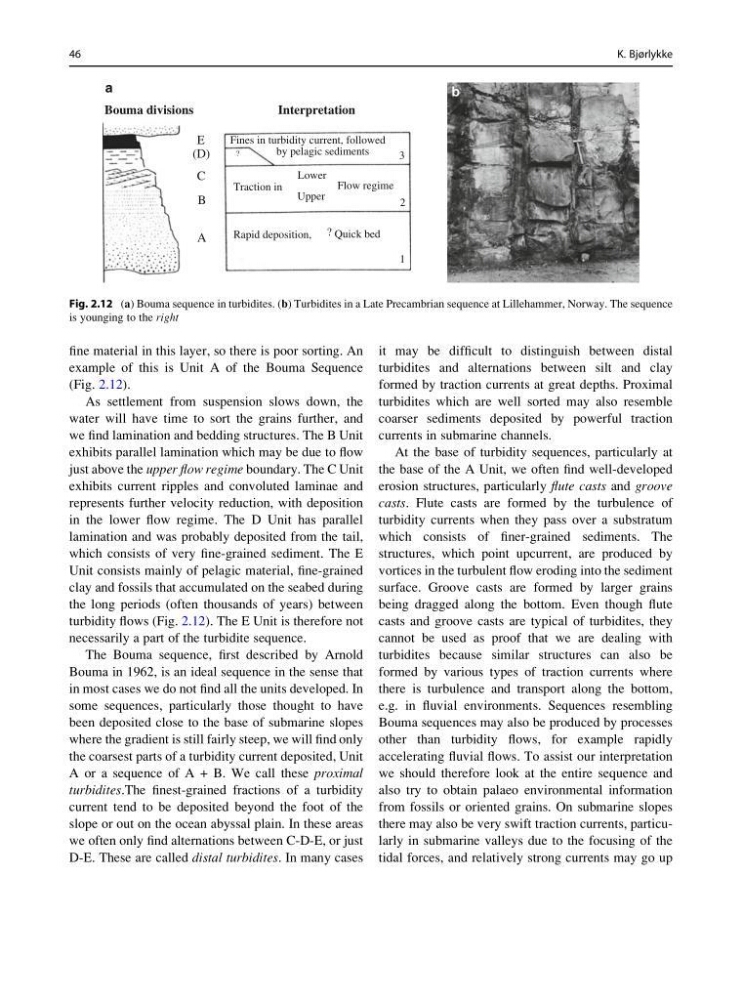
example of this is Unit A of the Bouma Sequence
(Fig. 2.12).
As settlement from suspension slows down, the
water will have time to sort the grains further, and
we find lamination and bedding structures. The B Unit
exhibits parallel lamination which may be due to flow
just above the upper flow regime boundary. The C Unit
exhibits current ripples and convoluted laminae and
represents further velocity reduction, with deposition
in the lower flow regime. The D Unit has parallel
lamination and was probably deposited from the tail,
which consists of very fine-grained sediment. The E
Unit consists mainly of pelagic material, fine-grained
clay and fossils that accumulated on the seabed during
the long periods (often thousands of years) between
turbidity flows (Fig. 2.12). The E Unit is therefore not
necessarily a part of the turbidite sequence.
The Bouma sequence, first described by Arnold
Bouma in 1962, is an ideal sequence in the sense that
in most cases we do not find all the units developed. In
some sequences, particularly those thought to have
been deposited close to the base of submarine slopes
where the gradient is still fairly steep, we will find only
the coarsest parts of a turbidity current deposited, Unit
A or a sequence of A + B. We call these proximal
turbidites.The finest-grained fractions of a turbidity
current tend to be deposited beyond the foot of the
slope or out on the ocean abyssal plain. In these areas
we often only find alternations between C-D-E, or just
D-E. These are called distal turbidites. In many cases
it may be difficult to distinguish between distal
turbidites and alternations between silt and clay
formed by traction currents at great depths. Proximal
turbidites which are well sorted may also resemble
coarser sediments deposited by powerful traction
currents in submarine channels.
At the base of turbidity sequences, particularly at
the base of the A Unit, we often find well-developed
erosion structures, particularly flute casts and groove
casts. Flute casts are formed by the turbulence of
turbidity currents when they pass over a substratum
which consists of finer-grained sediments. The
structures, which point upcurrent, are produced by
vortices in the turbulent flow eroding into the sediment
surface. Groove casts are formed by larger grains
being dragged along the bottom. Even though flute
casts and groove casts are typical of turbidites, they
cannot be used as proof that we are dealing with
turbidites because similar structures can also be
formed by various types of traction currents where
there is turbulence and transport along the bottom,
e.g. in fluvial environments. Sequences resembling
Bouma sequences may also be produced by processes
other than turbidity flows, for example rapidly
accelerating fluvial flows. To assist our interpretation
we should therefore look at the entire sequence and
also try to obtain palaeo environmental information
from fossils or oriented grains. On submarine slopes
there may also be very swift traction currents, particularly in submarine valleys due to the focusing of the
tidal forces, and relatively strong currents may go up
a
Bouma divisions
E
Fines in turbidity current, followed
by pelagic sediments
Traction in
Upper
Flow regime
Rapid deposition, ? Quick bed
Lower
3
2
1
?
(D)
C
B
A
Interpretation
b
Fig. 2.12 (a) Bouma sequence in turbidites. (b) Turbidites in a Late Precambrian sequence at Lillehammer, Norway. The sequence
is younging to the right
46
K. Bjørlykke
example of this is Unit A of the Bouma Sequence
(Fig. 2.12).
As settlement from suspension slows down, the
water will have time to sort the grains further, and
we find lamination and bedding structures. The B Unit
exhibits parallel lamination which may be due to flow
just above the upper flow regime boundary. The C Unit
exhibits current ripples and convoluted laminae and
represents further velocity reduction, with deposition
in the lower flow regime. The D Unit has parallel
lamination and was probably deposited from the tail,
which consists of very fine-grained sediment. The E
Unit consists mainly of pelagic material, fine-grained
clay and fossils that accumulated on the seabed during
the long periods (often thousands of years) between
turbidity flows (Fig. 2.12). The E Unit is therefore not
necessarily a part of the turbidite sequence.
The Bouma sequence, first described by Arnold
Bouma in 1962, is an ideal sequence in the sense that
in most cases we do not find all the units developed. In
some sequences, particularly those thought to have
been deposited close to the base of submarine slopes
where the gradient is still fairly steep, we will find only
the coarsest parts of a turbidity current deposited, Unit
A or a sequence of A + B. We call these proximal
turbidites.The finest-grained fractions of a turbidity
current tend to be deposited beyond the foot of the
slope or out on the ocean abyssal plain. In these areas
we often only find alternations between C-D-E, or just
D-E. These are called distal turbidites. In many cases
it may be difficult to distinguish between distal
turbidites and alternations between silt and clay
formed by traction currents at great depths. Proximal
turbidites which are well sorted may also resemble
coarser sediments deposited by powerful traction
currents in submarine channels.
At the base of turbidity sequences, particularly at
the base of the A Unit, we often find well-developed
erosion structures, particularly flute casts and groove
casts. Flute casts are formed by the turbulence of
turbidity currents when they pass over a substratum
which consists of finer-grained sediments. The
structures, which point upcurrent, are produced by
vortices in the turbulent flow eroding into the sediment
surface. Groove casts are formed by larger grains
being dragged along the bottom. Even though flute
casts and groove casts are typical of turbidites, they
cannot be used as proof that we are dealing with
turbidites because similar structures can also be
formed by various types of traction currents where
there is turbulence and transport along the bottom,
e.g. in fluvial environments. Sequences resembling
Bouma sequences may also be produced by processes
other than turbidity flows, for example rapidly
accelerating fluvial flows. To assist our interpretation
we should therefore look at the entire sequence and
also try to obtain palaeo environmental information
from fossils or oriented grains. On submarine slopes
there may also be very swift traction currents, particularly in submarine valleys due to the focusing of the
tidal forces, and relatively strong currents may go up
a
Bouma divisions
E
Fines in turbidity current, followed
by pelagic sediments
Traction in
Upper
Flow regime
Rapid deposition, ? Quick bed
Lower
3
2
1
?
(D)
C
B
A
Interpretation
b
Fig. 2.12 (a) Bouma sequence in turbidites. (b) Turbidites in a Late Precambrian sequence at Lillehammer, Norway. The sequence
is younging to the right
46
K. Bjørlykke