

such as magnetic, electromagnetic or gravity analysis
are currently of less importance. Data from seismic
surveys includes:
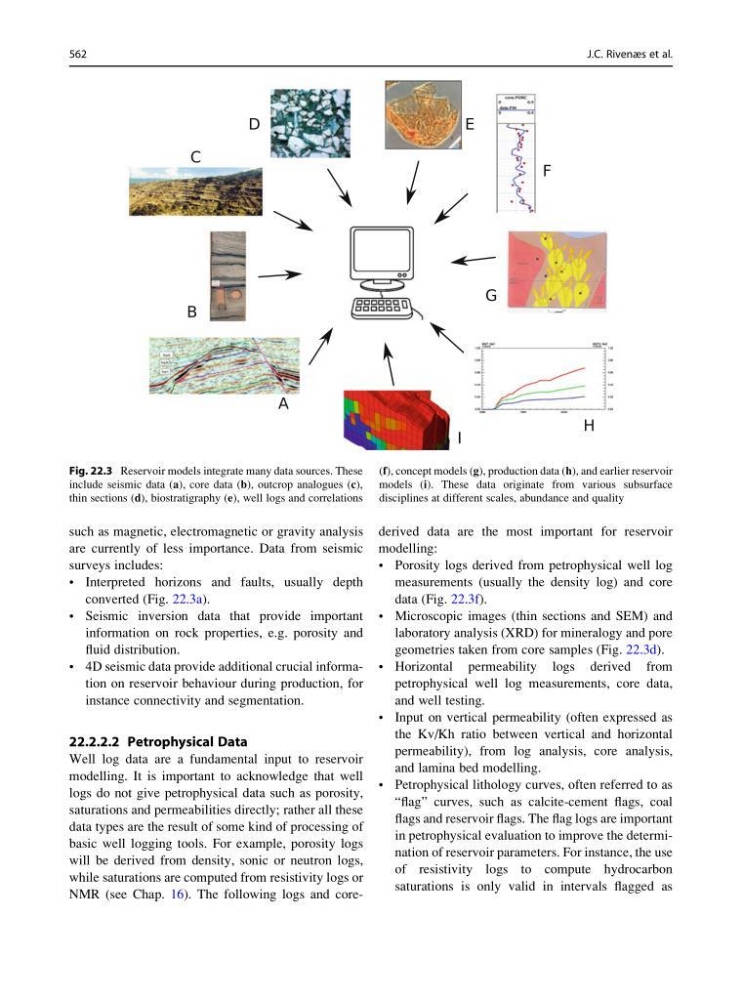
• Interpreted horizons and faults, usually depth
converted (Fig. 22.3a).
• Seismic inversion data that provide important
information on rock properties, e.g. porosity and
fluid distribution.
• 4D seismic data provide additional crucial information on reservoir behaviour during production, for
instance connectivity and segmentation.
22.2.2.2 Petrophysical Data
Well log data are a fundamental input to reservoir
modelling. It is important to acknowledge that well
logs do not give petrophysical data such as porosity,
saturations and permeabilities directly; rather all these
data types are the result of some kind of processing of
basic well logging tools. For example, porosity logs
will be derived from density, sonic or neutron logs,
while saturations are computed from resistivity logs or
NMR (see Chap. 16). The following logs and corederived data are the most important for reservoir
modelling:
• Porosity logs derived from petrophysical well log
measurements (usually the density log) and core
data (Fig. 22.3f).
• Microscopic images (thin sections and SEM) and
laboratory analysis (XRD) for mineralogy and pore
geometries taken from core samples (Fig. 22.3d).
• Horizontal permeability logs derived from
petrophysical well log measurements, core data,
and well testing.
• Input on vertical permeability (often expressed as
the Kv/Kh ratio between vertical and horizontal
permeability), from log analysis, core analysis,
and lamina bed modelling.
• Petrophysical lithology curves, often referred to as
“flag” curves, such as calcite-cement flags, coal
flags and reservoir flags. The flag logs are important
in petrophysical evaluation to improve the determination of reservoir parameters. For instance, the use
of resistivity logs to compute hydrocarbon
saturations is only valid in intervals flagged as
Fig. 22.3 Reservoir models integrate many data sources. These
include seismic data (a), core data (b), outcrop analogues (c),
thin sections (d), biostratigraphy (e), well logs and correlations
(f), concept models (g), production data (h), and earlier reservoir
models (i). These data originate from various subsurface
disciplines at different scales, abundance and quality
562
J.C. Rivenæs et al.
are currently of less importance. Data from seismic
surveys includes:
• Interpreted horizons and faults, usually depth
converted (Fig. 22.3a).
• Seismic inversion data that provide important
information on rock properties, e.g. porosity and
fluid distribution.
• 4D seismic data provide additional crucial information on reservoir behaviour during production, for
instance connectivity and segmentation.
22.2.2.2 Petrophysical Data
Well log data are a fundamental input to reservoir
modelling. It is important to acknowledge that well
logs do not give petrophysical data such as porosity,
saturations and permeabilities directly; rather all these
data types are the result of some kind of processing of
basic well logging tools. For example, porosity logs
will be derived from density, sonic or neutron logs,
while saturations are computed from resistivity logs or
NMR (see Chap. 16). The following logs and corederived data are the most important for reservoir
modelling:
• Porosity logs derived from petrophysical well log
measurements (usually the density log) and core
data (Fig. 22.3f).
• Microscopic images (thin sections and SEM) and
laboratory analysis (XRD) for mineralogy and pore
geometries taken from core samples (Fig. 22.3d).
• Horizontal permeability logs derived from
petrophysical well log measurements, core data,
and well testing.
• Input on vertical permeability (often expressed as
the Kv/Kh ratio between vertical and horizontal
permeability), from log analysis, core analysis,
and lamina bed modelling.
• Petrophysical lithology curves, often referred to as
“flag” curves, such as calcite-cement flags, coal
flags and reservoir flags. The flag logs are important
in petrophysical evaluation to improve the determination of reservoir parameters. For instance, the use
of resistivity logs to compute hydrocarbon
saturations is only valid in intervals flagged as
Fig. 22.3 Reservoir models integrate many data sources. These
include seismic data (a), core data (b), outcrop analogues (c),
thin sections (d), biostratigraphy (e), well logs and correlations
(f), concept models (g), production data (h), and earlier reservoir
models (i). These data originate from various subsurface
disciplines at different scales, abundance and quality
562
J.C. Rivenæs et al.