

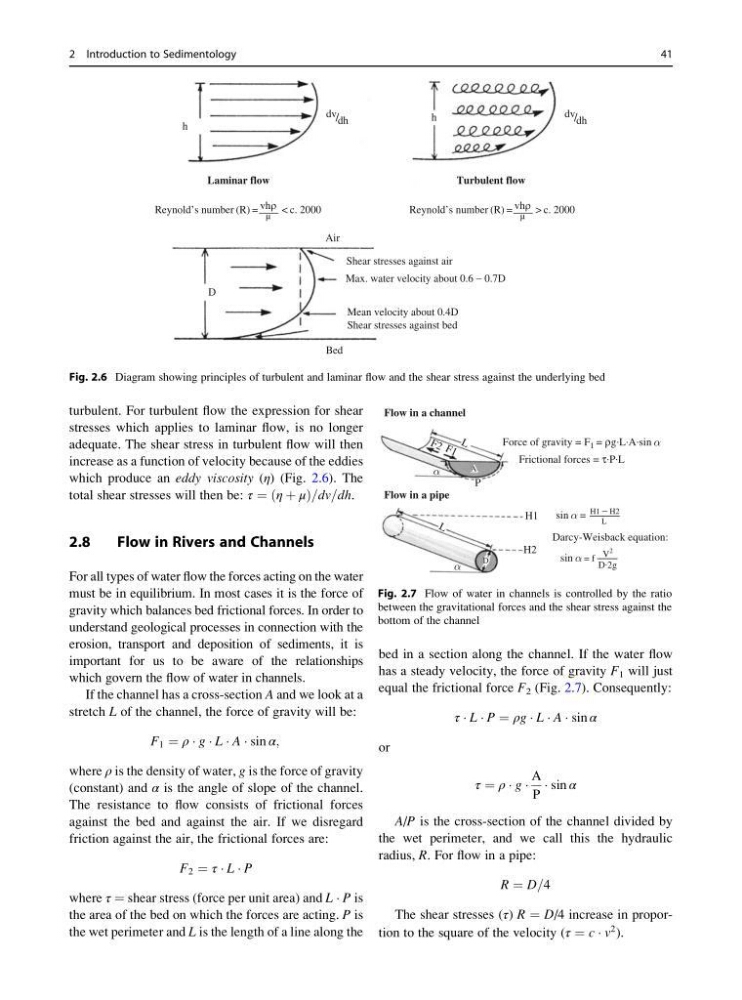
turbulent. For turbulent flow the expression for shear
stresses which applies to laminar flow, is no longer
adequate. The shear stress in turbulent flow will then
increase as a function of velocity because of the eddies
which produce an eddy viscosity (η) (Fig. 2.6). The
total shear stresses will then be: τ ¼ η þ μ
ð
Þ=dv=dh.
2.8
Flow in Rivers and Channels
For all types of water flow the forces acting on the water
must be in equilibrium. In most cases it is the force of
gravity which balances bed frictional forces. In order to
understand geological processes in connection with the
erosion, transport and deposition of sediments, it is
important for us to be aware of the relationships
which govern the flow of water in channels.
If the channel has a cross-section A and we look at a
stretch L of the channel, the force of gravity will be:
F 1 ¼ ρ Á g Á L Á A Á sin α;
where ρ is the density of water, g is the force of gravity
(constant) and α is the angle of slope of the channel.
The resistance to flow consists of frictional forces
against the bed and against the air. If we disregard
friction against the air, the frictional forces are:
F 2 ¼ τ Á L Á P
where τ ¼ shear stress (force per unit area) and L Á P is
the area of the bed on which the forces are acting. P is
the wet perimeter and L is the length of a line along the
bed in a section along the channel. If the water flow
has a steady velocity, the force of gravity F 1 will just
equal the frictional force F 2 (Fig. 2.7). Consequently:
τ Á L Á P ¼ ρg Á L Á A Á sin α
or
τ ¼ ρ Á g Á
A
P
Á sin α
A/P is the cross-section of the channel divided by
the wet perimeter, and we call this the hydraulic
radius, R. For flow in a pipe:
R ¼ D=4
The shear stresses (τ) R ¼ D/4 increase in proportion to the square of the velocity (τ ¼ c Á v
2 ).
Reynold’s number (R) = vhρ < c. 2000
µ
Reynold’s number (R) = vhρ > c. 2000
µ
Laminar flow
Air
Shear stresses against air
Max. water velocity about 0.6 − 0.7D
Mean velocity about 0.4D
Shear stresses against bed
Bed
dv / dh
dv / dh
Turbulent flow
h
h
D
Fig. 2.6 Diagram showing principles of turbulent and laminar flow and the shear stress against the underlying bed
Flow in a channel
Flow in a pipe
H1
H2
Darcy-Weisback equation:
F 2
L
L
A
D
P
F 1
Force of gravity = F 1 = ρg . L . A . sin
Frictional forces = τ . P . L
sin =
H1 – H2
L
D . 2g
sin = f V
2
Fig. 2.7 Flow of water in channels is controlled by the ratio
between the gravitational forces and the shear stress against the
bottom of the channel
2 Introduction to Sedimentology
41
stresses which applies to laminar flow, is no longer
adequate. The shear stress in turbulent flow will then
increase as a function of velocity because of the eddies
which produce an eddy viscosity (η) (Fig. 2.6). The
total shear stresses will then be: τ ¼ η þ μ
ð
Þ=dv=dh.
2.8
Flow in Rivers and Channels
For all types of water flow the forces acting on the water
must be in equilibrium. In most cases it is the force of
gravity which balances bed frictional forces. In order to
understand geological processes in connection with the
erosion, transport and deposition of sediments, it is
important for us to be aware of the relationships
which govern the flow of water in channels.
If the channel has a cross-section A and we look at a
stretch L of the channel, the force of gravity will be:
F 1 ¼ ρ Á g Á L Á A Á sin α;
where ρ is the density of water, g is the force of gravity
(constant) and α is the angle of slope of the channel.
The resistance to flow consists of frictional forces
against the bed and against the air. If we disregard
friction against the air, the frictional forces are:
F 2 ¼ τ Á L Á P
where τ ¼ shear stress (force per unit area) and L Á P is
the area of the bed on which the forces are acting. P is
the wet perimeter and L is the length of a line along the
bed in a section along the channel. If the water flow
has a steady velocity, the force of gravity F 1 will just
equal the frictional force F 2 (Fig. 2.7). Consequently:
τ Á L Á P ¼ ρg Á L Á A Á sin α
or
τ ¼ ρ Á g Á
A
P
Á sin α
A/P is the cross-section of the channel divided by
the wet perimeter, and we call this the hydraulic
radius, R. For flow in a pipe:
R ¼ D=4
The shear stresses (τ) R ¼ D/4 increase in proportion to the square of the velocity (τ ¼ c Á v
2 ).
Reynold’s number (R) = vhρ < c. 2000
µ
Reynold’s number (R) = vhρ > c. 2000
µ
Laminar flow
Air
Shear stresses against air
Max. water velocity about 0.6 − 0.7D
Mean velocity about 0.4D
Shear stresses against bed
Bed
dv / dh
dv / dh
Turbulent flow
h
h
D
Fig. 2.6 Diagram showing principles of turbulent and laminar flow and the shear stress against the underlying bed
Flow in a channel
Flow in a pipe
H1
H2
Darcy-Weisback equation:
F 2
L
L
A
D
P
F 1
Force of gravity = F 1 = ρg . L . A . sin
Frictional forces = τ . P . L
sin =
H1 – H2
L
D . 2g
sin = f V
2
Fig. 2.7 Flow of water in channels is controlled by the ratio
between the gravitational forces and the shear stress against the
bottom of the channel
2 Introduction to Sedimentology
41