

form, despite the fact that there is a reduction in
volume from ice to water, rather than an expansion.
Source rocks may include thin layers of siltstones
or sandstones that can serve as pathways for the migration of the petroleum fluids generated from the kerogen. If, however, these more permeable layers are
absent, the permeability of the shale matrix is in
most cases low enough for the fluid pressure to build
up where petroleum is generated until fracture pressure is reached. Should the source rock consist of
kerogen in a fine-grained clay-rich matrix, the flow
of oil out of the source rock is resisted both by very
high capillary pressures and the low permeability. In
such cases oil can not migrate out of source rocks
through the matrix. Very thin open fractures allowing
the expulsion of petroleum will develop when the fluid
pressure in the source rock has reached fracture pressure. The fracture pressure is controlled by the horizontal stress (σ h ) which is in most cases lower than the
overburden stress (σ v ).
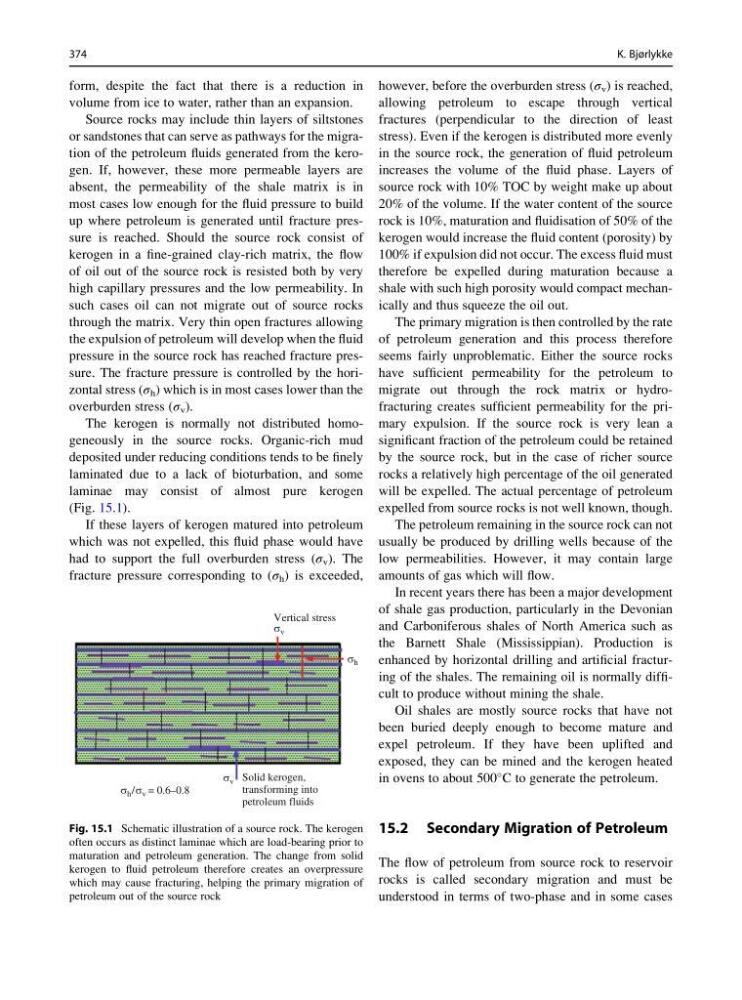
The kerogen is normally not distributed homogeneously in the source rocks. Organic-rich mud
deposited under reducing conditions tends to be finely
laminated due to a lack of bioturbation, and some
laminae may consist of almost pure kerogen
(Fig. 15.1).
If these layers of kerogen matured into petroleum
which was not expelled, this fluid phase would have
had to support the full overburden stress (σ v ). The
fracture pressure corresponding to (σ h ) is exceeded,
however, before the overburden stress (σ v ) is reached,
allowing petroleum to escape through vertical
fractures (perpendicular to the direction of least
stress). Even if the kerogen is distributed more evenly
in the source rock, the generation of fluid petroleum
increases the volume of the fluid phase. Layers of
source rock with 10% TOC by weight make up about
20% of the volume. If the water content of the source
rock is 10%, maturation and fluidisation of 50% of the
kerogen would increase the fluid content (porosity) by
100% if expulsion did not occur. The excess fluid must
therefore be expelled during maturation because a
shale with such high porosity would compact mechanically and thus squeeze the oil out.
The primary migration is then controlled by the rate
of petroleum generation and this process therefore
seems fairly unproblematic. Either the source rocks
have sufficient permeability for the petroleum to
migrate out through the rock matrix or hydrofracturing creates sufficient permeability for the primary expulsion. If the source rock is very lean a
significant fraction of the petroleum could be retained
by the source rock, but in the case of richer source
rocks a relatively high percentage of the oil generated
will be expelled. The actual percentage of petroleum
expelled from source rocks is not well known, though.
The petroleum remaining in the source rock can not
usually be produced by drilling wells because of the
low permeabilities. However, it may contain large
amounts of gas which will flow.
In recent years there has been a major development
of shale gas production, particularly in the Devonian
and Carboniferous shales of North America such as
the Barnett Shale (Mississippian). Production is
enhanced by horizontal drilling and artificial fracturing of the shales. The remaining oil is normally difficult to produce without mining the shale.
Oil shales are mostly source rocks that have not
been buried deeply enough to become mature and
expel petroleum. If they have been uplifted and
exposed, they can be mined and the kerogen heated
in ovens to about 500
C to generate the petroleum.
15.2 Secondary Migration of Petroleum
The flow of petroleum from source rock to reservoir
rocks is called secondary migration and must be
understood in terms of two-phase and in some cases
Solid kerogen,
transforming into
petroleum fluids
σ v
σ h
σ h / σ v = 0.6–0.8
Vertical stress
σ v
Fig. 15.1 Schematic illustration of a source rock. The kerogen
often occurs as distinct laminae which are load-bearing prior to
maturation and petroleum generation. The change from solid
kerogen to fluid petroleum therefore creates an overpressure
which may cause fracturing, helping the primary migration of
petroleum out of the source rock
374
K. Bjørlykke
volume from ice to water, rather than an expansion.
Source rocks may include thin layers of siltstones
or sandstones that can serve as pathways for the migration of the petroleum fluids generated from the kerogen. If, however, these more permeable layers are
absent, the permeability of the shale matrix is in
most cases low enough for the fluid pressure to build
up where petroleum is generated until fracture pressure is reached. Should the source rock consist of
kerogen in a fine-grained clay-rich matrix, the flow
of oil out of the source rock is resisted both by very
high capillary pressures and the low permeability. In
such cases oil can not migrate out of source rocks
through the matrix. Very thin open fractures allowing
the expulsion of petroleum will develop when the fluid
pressure in the source rock has reached fracture pressure. The fracture pressure is controlled by the horizontal stress (σ h ) which is in most cases lower than the
overburden stress (σ v ).
The kerogen is normally not distributed homogeneously in the source rocks. Organic-rich mud
deposited under reducing conditions tends to be finely
laminated due to a lack of bioturbation, and some
laminae may consist of almost pure kerogen
(Fig. 15.1).
If these layers of kerogen matured into petroleum
which was not expelled, this fluid phase would have
had to support the full overburden stress (σ v ). The
fracture pressure corresponding to (σ h ) is exceeded,
however, before the overburden stress (σ v ) is reached,
allowing petroleum to escape through vertical
fractures (perpendicular to the direction of least
stress). Even if the kerogen is distributed more evenly
in the source rock, the generation of fluid petroleum
increases the volume of the fluid phase. Layers of
source rock with 10% TOC by weight make up about
20% of the volume. If the water content of the source
rock is 10%, maturation and fluidisation of 50% of the
kerogen would increase the fluid content (porosity) by
100% if expulsion did not occur. The excess fluid must
therefore be expelled during maturation because a
shale with such high porosity would compact mechanically and thus squeeze the oil out.
The primary migration is then controlled by the rate
of petroleum generation and this process therefore
seems fairly unproblematic. Either the source rocks
have sufficient permeability for the petroleum to
migrate out through the rock matrix or hydrofracturing creates sufficient permeability for the primary expulsion. If the source rock is very lean a
significant fraction of the petroleum could be retained
by the source rock, but in the case of richer source
rocks a relatively high percentage of the oil generated
will be expelled. The actual percentage of petroleum
expelled from source rocks is not well known, though.
The petroleum remaining in the source rock can not
usually be produced by drilling wells because of the
low permeabilities. However, it may contain large
amounts of gas which will flow.
In recent years there has been a major development
of shale gas production, particularly in the Devonian
and Carboniferous shales of North America such as
the Barnett Shale (Mississippian). Production is
enhanced by horizontal drilling and artificial fracturing of the shales. The remaining oil is normally difficult to produce without mining the shale.
Oil shales are mostly source rocks that have not
been buried deeply enough to become mature and
expel petroleum. If they have been uplifted and
exposed, they can be mined and the kerogen heated
in ovens to about 500
C to generate the petroleum.
15.2 Secondary Migration of Petroleum
The flow of petroleum from source rock to reservoir
rocks is called secondary migration and must be
understood in terms of two-phase and in some cases
Solid kerogen,
transforming into
petroleum fluids
σ v
σ h
σ h / σ v = 0.6–0.8
Vertical stress
σ v
Fig. 15.1 Schematic illustration of a source rock. The kerogen
often occurs as distinct laminae which are load-bearing prior to
maturation and petroleum generation. The change from solid
kerogen to fluid petroleum therefore creates an overpressure
which may cause fracturing, helping the primary migration of
petroleum out of the source rock
374
K. Bjørlykke