

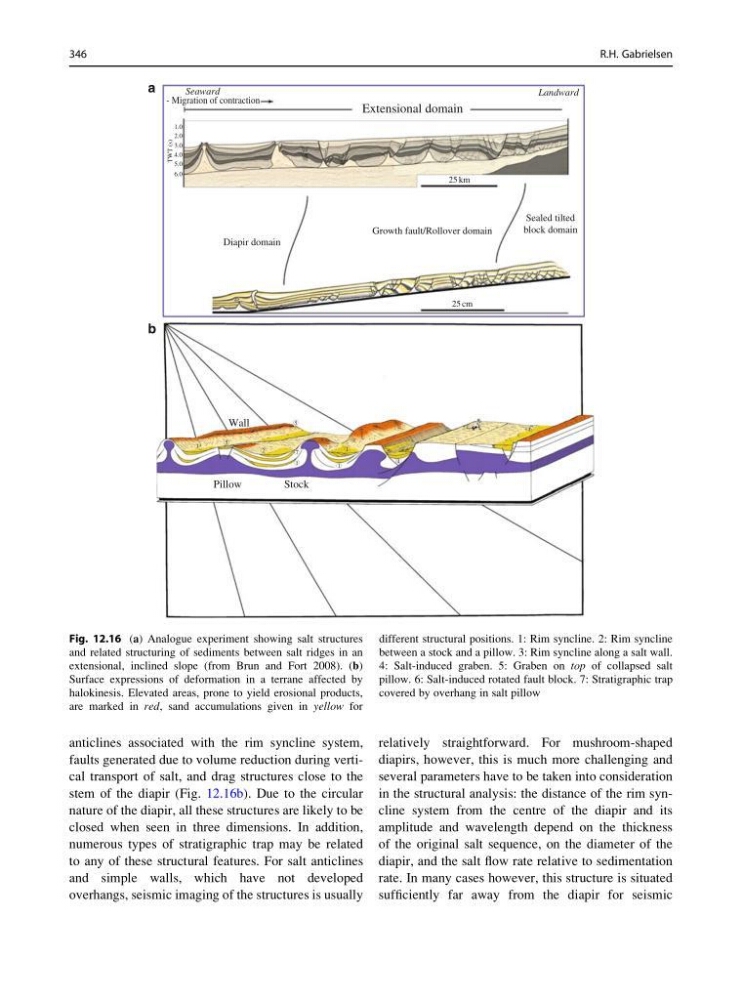
anticlines associated with the rim syncline system,
faults generated due to volume reduction during vertical transport of salt, and drag structures close to the
stem of the diapir (Fig. 12.16b). Due to the circular
nature of the diapir, all these structures are likely to be
closed when seen in three dimensions. In addition,
numerous types of stratigraphic trap may be related
to any of these structural features. For salt anticlines
and simple walls, which have not developed
overhangs, seismic imaging of the structures is usually
relatively straightforward. For mushroom-shaped
diapirs, however, this is much more challenging and
several parameters have to be taken into consideration
in the structural analysis: the distance of the rim syncline system from the centre of the diapir and its
amplitude and wavelength depend on the thickness
of the original salt sequence, on the diameter of the
diapir, and the salt flow rate relative to sedimentation
rate. In many cases however, this structure is situated
sufficiently far away from the diapir for seismic
Pillow
Wall
3
5
2
5
7
1
1
1
4
6
Stock
Diapir domain
Growth fault/Rollover domain
a
25 cm
25 km
Extensional domain
Seaward
Landward
- Migration of contraction
1.0
2.0
3.0
4.0
5.0
6.0
TWT (s)
Sealed tilted
block domain
b
Fig. 12.16 (a) Analogue experiment showing salt structures
and related structuring of sediments between salt ridges in an
extensional, inclined slope (from Brun and Fort 2008). (b)
Surface expressions of deformation in a terrane affected by
halokinesis. Elevated areas, prone to yield erosional products,
are marked in red, sand accumulations given in yellow for
different structural positions. 1: Rim syncline. 2: Rim syncline
between a stock and a pillow. 3: Rim syncline along a salt wall.
4: Salt-induced graben. 5: Graben on top of collapsed salt
pillow. 6: Salt-induced rotated fault block. 7: Stratigraphic trap
covered by overhang in salt pillow
346
R.H. Gabrielsen
faults generated due to volume reduction during vertical transport of salt, and drag structures close to the
stem of the diapir (Fig. 12.16b). Due to the circular
nature of the diapir, all these structures are likely to be
closed when seen in three dimensions. In addition,
numerous types of stratigraphic trap may be related
to any of these structural features. For salt anticlines
and simple walls, which have not developed
overhangs, seismic imaging of the structures is usually
relatively straightforward. For mushroom-shaped
diapirs, however, this is much more challenging and
several parameters have to be taken into consideration
in the structural analysis: the distance of the rim syncline system from the centre of the diapir and its
amplitude and wavelength depend on the thickness
of the original salt sequence, on the diameter of the
diapir, and the salt flow rate relative to sedimentation
rate. In many cases however, this structure is situated
sufficiently far away from the diapir for seismic
Pillow
Wall
3
5
2
5
7
1
1
1
4
6
Stock
Diapir domain
Growth fault/Rollover domain
a
25 cm
25 km
Extensional domain
Seaward
Landward
- Migration of contraction
1.0
2.0
3.0
4.0
5.0
6.0
TWT (s)
Sealed tilted
block domain
b
Fig. 12.16 (a) Analogue experiment showing salt structures
and related structuring of sediments between salt ridges in an
extensional, inclined slope (from Brun and Fort 2008). (b)
Surface expressions of deformation in a terrane affected by
halokinesis. Elevated areas, prone to yield erosional products,
are marked in red, sand accumulations given in yellow for
different structural positions. 1: Rim syncline. 2: Rim syncline
between a stock and a pillow. 3: Rim syncline along a salt wall.
4: Salt-induced graben. 5: Graben on top of collapsed salt
pillow. 6: Salt-induced rotated fault block. 7: Stratigraphic trap
covered by overhang in salt pillow
346
R.H. Gabrielsen