

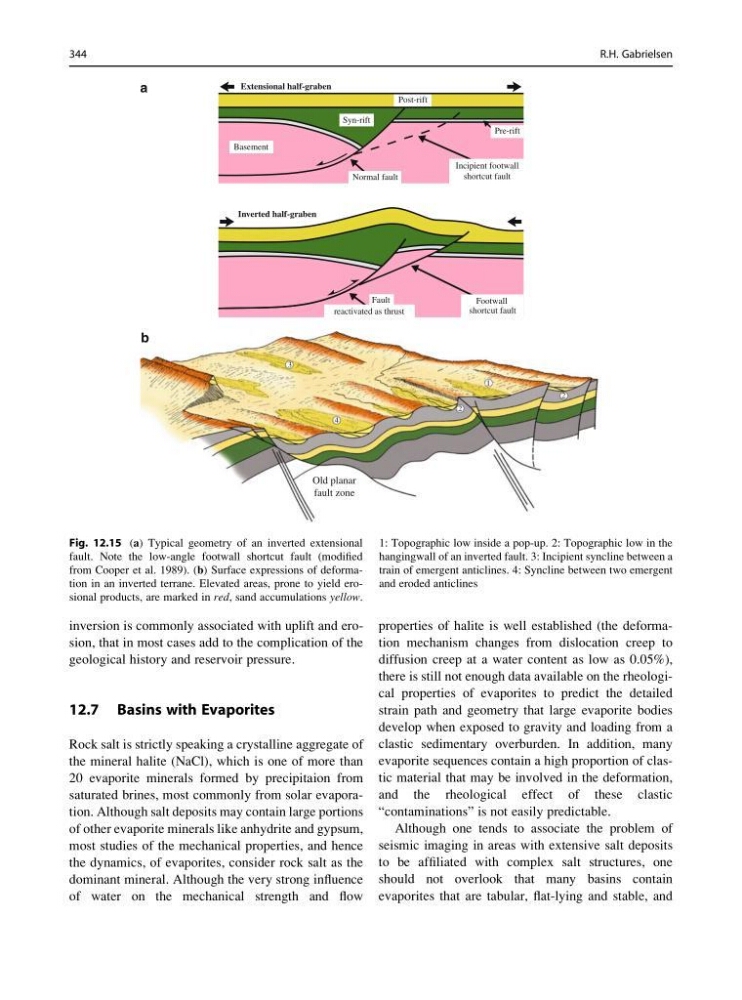
inversion is commonly associated with uplift and erosion, that in most cases add to the complication of the
geological history and reservoir pressure.
12.7 Basins with Evaporites
Rock salt is strictly speaking a crystalline aggregate of
the mineral halite (NaCl), which is one of more than
20 evaporite minerals formed by precipitaion from
saturated brines, most commonly from solar evaporation. Although salt deposits may contain large portions
of other evaporite minerals like anhydrite and gypsum,
most studies of the mechanical properties, and hence
the dynamics, of evaporites, consider rock salt as the
dominant mineral. Although the very strong influence
of water on the mechanical strength and flow
properties of halite is well established (the deformation mechanism changes from dislocation creep to
diffusion creep at a water content as low as 0.05%),
there is still not enough data available on the rheological properties of evaporites to predict the detailed
strain path and geometry that large evaporite bodies
develop when exposed to gravity and loading from a
clastic sedimentary overburden. In addition, many
evaporite sequences contain a high proportion of clastic material that may be involved in the deformation,
and the rheological effect of these clastic
“contaminations” is not easily predictable.
Although one tends to associate the problem of
seismic imaging in areas with extensive salt deposits
to be affiliated with complex salt structures, one
should not overlook that many basins contain
evaporites that are tabular, flat-lying and stable, and
Old planar
fault zone
3
4
2
1
2
Basement
Post-rift
Syn-rift
Normal fault
Inverted half-graben
Extensional half-graben
Fault
Incipient footwall
shortcut fault
Footwall
shortcut fault
reactivated as thrust
Pre-rift
a
b
Fig. 12.15 (a) Typical geometry of an inverted extensional
fault. Note the low-angle footwall shortcut fault (modified
from Cooper et al. 1989). (b) Surface expressions of deformation in an inverted terrane. Elevated areas, prone to yield erosional products, are marked in red, sand accumulations yellow.
1: Topographic low inside a pop-up. 2: Topographic low in the
hangingwall of an inverted fault. 3: Incipient syncline between a
train of emergent anticlines. 4: Syncline between two emergent
and eroded anticlines
344
R.H. Gabrielsen
geological history and reservoir pressure.
12.7 Basins with Evaporites
Rock salt is strictly speaking a crystalline aggregate of
the mineral halite (NaCl), which is one of more than
20 evaporite minerals formed by precipitaion from
saturated brines, most commonly from solar evaporation. Although salt deposits may contain large portions
of other evaporite minerals like anhydrite and gypsum,
most studies of the mechanical properties, and hence
the dynamics, of evaporites, consider rock salt as the
dominant mineral. Although the very strong influence
of water on the mechanical strength and flow
properties of halite is well established (the deformation mechanism changes from dislocation creep to
diffusion creep at a water content as low as 0.05%),
there is still not enough data available on the rheological properties of evaporites to predict the detailed
strain path and geometry that large evaporite bodies
develop when exposed to gravity and loading from a
clastic sedimentary overburden. In addition, many
evaporite sequences contain a high proportion of clastic material that may be involved in the deformation,
and the rheological effect of these clastic
“contaminations” is not easily predictable.
Although one tends to associate the problem of
seismic imaging in areas with extensive salt deposits
to be affiliated with complex salt structures, one
should not overlook that many basins contain
evaporites that are tabular, flat-lying and stable, and
Old planar
fault zone
3
4
2
1
2
Basement
Post-rift
Syn-rift
Normal fault
Inverted half-graben
Extensional half-graben
Fault
Incipient footwall
shortcut fault
Footwall
shortcut fault
reactivated as thrust
Pre-rift
a
b
Fig. 12.15 (a) Typical geometry of an inverted extensional
fault. Note the low-angle footwall shortcut fault (modified
from Cooper et al. 1989). (b) Surface expressions of deformation in an inverted terrane. Elevated areas, prone to yield erosional products, are marked in red, sand accumulations yellow.
1: Topographic low inside a pop-up. 2: Topographic low in the
hangingwall of an inverted fault. 3: Incipient syncline between a
train of emergent anticlines. 4: Syncline between two emergent
and eroded anticlines
344
R.H. Gabrielsen