

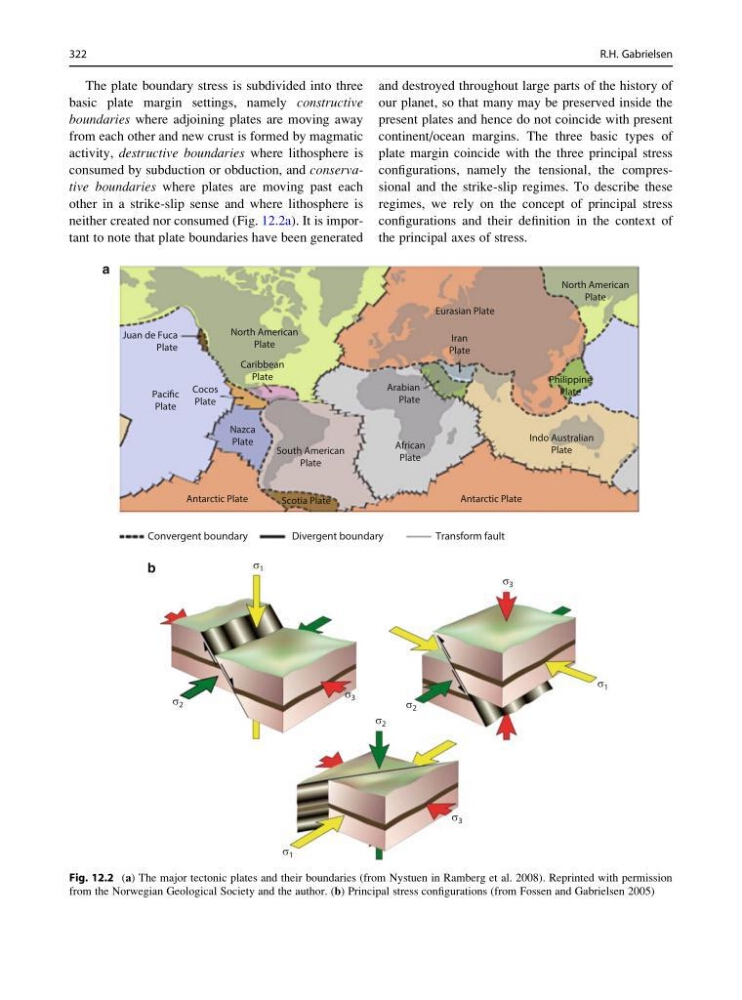
The plate boundary stress is subdivided into three
basic plate margin settings, namely constructive
boundaries where adjoining plates are moving away
from each other and new crust is formed by magmatic
activity, destructive boundaries where lithosphere is
consumed by subduction or obduction, and conservative boundaries where plates are moving past each
other in a strike-slip sense and where lithosphere is
neither created nor consumed (Fig. 12.2a). It is important to note that plate boundaries have been generated
and destroyed throughout large parts of the history of
our planet, so that many may be preserved inside the
present plates and hence do not coincide with present
continent/ocean margins. The three basic types of
plate margin coincide with the three principal stress
configurations, namely the tensional, the compressional and the strike-slip regimes. To describe these
regimes, we rely on the concept of principal stress
configurations and their definition in the context of
the principal axes of stress.
σ 1
σ 1
σ 3
σ 2
σ 2
σ 2
σ 3
σ 3
σ 1
Convergent boundary
Juan de Fuca
Plate
a
b
Pacific
Plate
Cocos
Plate
South American
Plate
Nazca
Plate
Antarctic Plate
Scotia Plate
Arabian
Plate
Philippine
Plate
African
Plate
Antarctic Plate
Indo Australian
Plate
Iran
Plate
Eurasian Plate
North American
Plate
Caribbean
Plate
North American
Plate
Divergent boundary
Transform fault
Fig. 12.2 (a) The major tectonic plates and their boundaries (from Nystuen in Ramberg et al. 2008). Reprinted with permission
from the Norwegian Geological Society and the author. (b) Principal stress configurations (from Fossen and Gabrielsen 2005)
322
R.H. Gabrielsen
basic plate margin settings, namely constructive
boundaries where adjoining plates are moving away
from each other and new crust is formed by magmatic
activity, destructive boundaries where lithosphere is
consumed by subduction or obduction, and conservative boundaries where plates are moving past each
other in a strike-slip sense and where lithosphere is
neither created nor consumed (Fig. 12.2a). It is important to note that plate boundaries have been generated
and destroyed throughout large parts of the history of
our planet, so that many may be preserved inside the
present plates and hence do not coincide with present
continent/ocean margins. The three basic types of
plate margin coincide with the three principal stress
configurations, namely the tensional, the compressional and the strike-slip regimes. To describe these
regimes, we rely on the concept of principal stress
configurations and their definition in the context of
the principal axes of stress.
σ 1
σ 1
σ 3
σ 2
σ 2
σ 2
σ 3
σ 3
σ 1
Convergent boundary
Juan de Fuca
Plate
a
b
Pacific
Plate
Cocos
Plate
South American
Plate
Nazca
Plate
Antarctic Plate
Scotia Plate
Arabian
Plate
Philippine
Plate
African
Plate
Antarctic Plate
Indo Australian
Plate
Iran
Plate
Eurasian Plate
North American
Plate
Caribbean
Plate
North American
Plate
Divergent boundary
Transform fault
Fig. 12.2 (a) The major tectonic plates and their boundaries (from Nystuen in Ramberg et al. 2008). Reprinted with permission
from the Norwegian Geological Society and the author. (b) Principal stress configurations (from Fossen and Gabrielsen 2005)
322
R.H. Gabrielsen