

be the rate-limiting step rather than the effective stress.
The mineral cement growing as overgrowth on detrital
quartz grains into the pore space between the grains is
not subjected to stress at the time of cement precipitation and is not influenced by the stress. However, after
further compaction it may become a part of the loadbearing structure. Therefore the grain-to-grain contact
stresses in a sandstone may be lower at depths of
3–4 km than at 1–2 km because the stress is distributed
over a larger grain contact area and is also supported
by quartz cement. Most mechanical grain crushing
therefore occurs at depths shallower than about
2–3 km where there is little quartz cement present. In
the case where quartz cementation (overgrowth) is
prevented by coatings (e.g. chlorite), grain fracturing
may occur at 3–4 km at about 35–40 MPa effective
stresses. Grain fracturing will then expose uncoated
fresh quartz surfaces for quartz cementation which
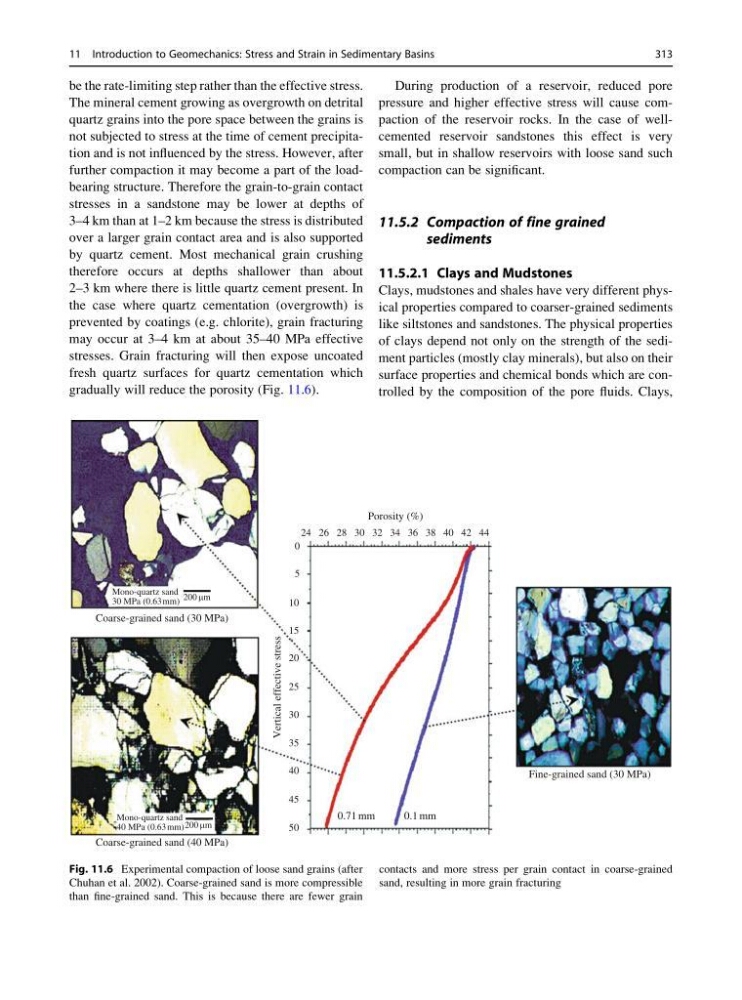
gradually will reduce the porosity (Fig. 11.6).
During production of a reservoir, reduced pore
pressure and higher effective stress will cause compaction of the reservoir rocks. In the case of wellcemented reservoir sandstones this effect is very
small, but in shallow reservoirs with loose sand such
compaction can be significant.
11.5.2 Compaction of fine grained
sediments
11.5.2.1 Clays and Mudstones
Clays, mudstones and shales have very different physical properties compared to coarser-grained sediments
like siltstones and sandstones. The physical properties
of clays depend not only on the strength of the sediment particles (mostly clay minerals), but also on their
surface properties and chemical bonds which are controlled by the composition of the pore fluids. Clays,
Coarse-grained sand (40 MPa)
Mono-quartz sand
40 MPa (0.63mm)
Mono-quartz sand
30 MPa (0.63mm) 200 μm
Fine-grained sand (30 MPa)
Porosity (%)
24
0
5
10
15
20
25
30
35
40
Vertical effective stress
45
50
0.71 mm
0.1 mm
26
30 32 34 36 38 40 42 44
28
Coarse-grained sand (30 MPa)
200 μm
Fig. 11.6 Experimental compaction of loose sand grains (after
Chuhan et al. 2002). Coarse-grained sand is more compressible
than fine-grained sand. This is because there are fewer grain
contacts and more stress per grain contact in coarse-grained
sand, resulting in more grain fracturing
11 Introduction to Geomechanics: Stress and Strain in Sedimentary Basins
313
The mineral cement growing as overgrowth on detrital
quartz grains into the pore space between the grains is
not subjected to stress at the time of cement precipitation and is not influenced by the stress. However, after
further compaction it may become a part of the loadbearing structure. Therefore the grain-to-grain contact
stresses in a sandstone may be lower at depths of
3–4 km than at 1–2 km because the stress is distributed
over a larger grain contact area and is also supported
by quartz cement. Most mechanical grain crushing
therefore occurs at depths shallower than about
2–3 km where there is little quartz cement present. In
the case where quartz cementation (overgrowth) is
prevented by coatings (e.g. chlorite), grain fracturing
may occur at 3–4 km at about 35–40 MPa effective
stresses. Grain fracturing will then expose uncoated
fresh quartz surfaces for quartz cementation which
gradually will reduce the porosity (Fig. 11.6).
During production of a reservoir, reduced pore
pressure and higher effective stress will cause compaction of the reservoir rocks. In the case of wellcemented reservoir sandstones this effect is very
small, but in shallow reservoirs with loose sand such
compaction can be significant.
11.5.2 Compaction of fine grained
sediments
11.5.2.1 Clays and Mudstones
Clays, mudstones and shales have very different physical properties compared to coarser-grained sediments
like siltstones and sandstones. The physical properties
of clays depend not only on the strength of the sediment particles (mostly clay minerals), but also on their
surface properties and chemical bonds which are controlled by the composition of the pore fluids. Clays,
Coarse-grained sand (40 MPa)
Mono-quartz sand
40 MPa (0.63mm)
Mono-quartz sand
30 MPa (0.63mm) 200 μm
Fine-grained sand (30 MPa)
Porosity (%)
24
0
5
10
15
20
25
30
35
40
Vertical effective stress
45
50
0.71 mm
0.1 mm
26
30 32 34 36 38 40 42 44
28
Coarse-grained sand (30 MPa)
200 μm
Fig. 11.6 Experimental compaction of loose sand grains (after
Chuhan et al. 2002). Coarse-grained sand is more compressible
than fine-grained sand. This is because there are fewer grain
contacts and more stress per grain contact in coarse-grained
sand, resulting in more grain fracturing
11 Introduction to Geomechanics: Stress and Strain in Sedimentary Basins
313