

porewater. These variables must, however, be compared with the range of permeability values that are
likely to exist in a sedimentary basin. Modelling of
fluid pressures and the build-up of pore pressure are
often based on permeability distributions derived from
porosity distributions, which are also poorly
constrained. Smectitic mudstones have very low
permeabilities even at shallow depth and are particularly effective seals and may be a significant factor
causing overpressure. In the North Sea smectite-rich
Eocene and Oligocene mudstones and associated
sandstones are frequently overpressured at just
1–2 km depth.
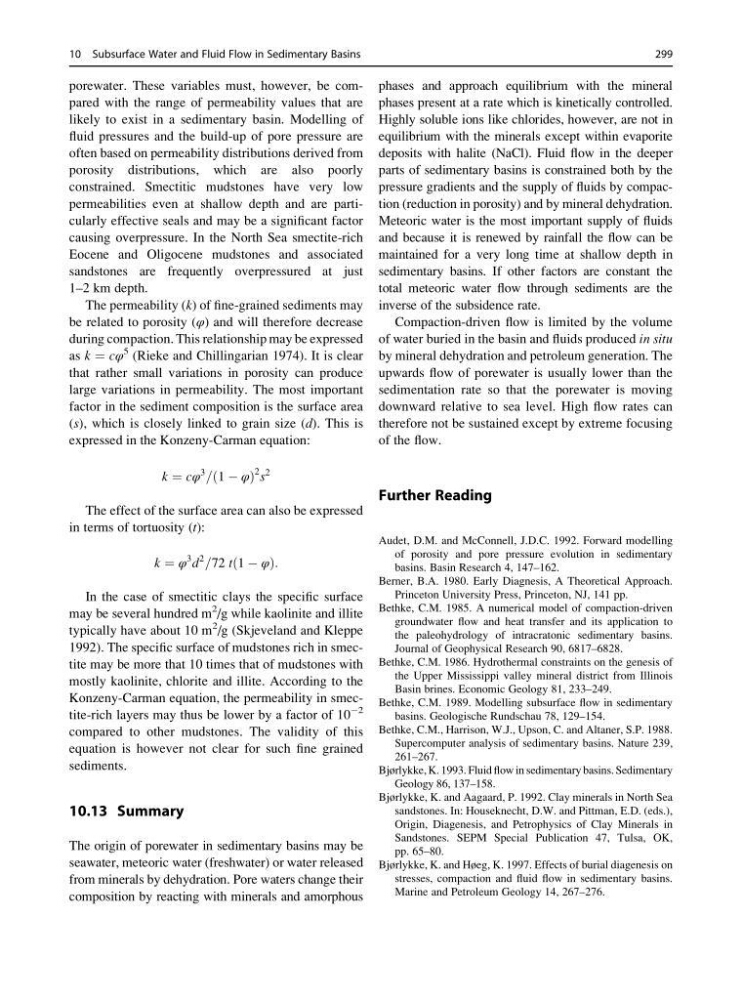
The permeability (k) of fine-grained sediments may
be related to porosity (φ) and will therefore decrease
during compaction. This relationship may be expressed
as k ¼ cφ
5 (Rieke and Chillingarian 1974). It is clear
that rather small variations in porosity can produce
large variations in permeability. The most important
factor in the sediment composition is the surface area
(s), which is closely linked to grain size (d). This is
expressed in the Konzeny-Carman equation:
k ¼ cφ
3
= 1 À φ
ð
Þ
2 s
2
The effect of the surface area can also be expressed
in terms of tortuosity (t):
k ¼ φ
3 d
2
=72 t 1 À φ
ð
Þ:
In the case of smectitic clays the specific surface
may be several hundred m
2
/g while kaolinite and illite
typically have about 10 m
2 /g (Skjeveland and Kleppe
1992). The specific surface of mudstones rich in smectite may be more that 10 times that of mudstones with
mostly kaolinite, chlorite and illite. According to the
Konzeny-Carman equation, the permeability in smectite-rich layers may thus be lower by a factor of 10
À2
compared to other mudstones. The validity of this
equation is however not clear for such fine grained
sediments.
10.13 Summary
The origin of porewater in sedimentary basins may be
seawater, meteoric water (freshwater) or water released
from minerals by dehydration. Pore waters change their
composition by reacting with minerals and amorphous
phases and approach equilibrium with the mineral
phases present at a rate which is kinetically controlled.
Highly soluble ions like chlorides, however, are not in
equilibrium with the minerals except within evaporite
deposits with halite (NaCl). Fluid flow in the deeper
parts of sedimentary basins is constrained both by the
pressure gradients and the supply of fluids by compaction (reduction in porosity) and by mineral dehydration.
Meteoric water is the most important supply of fluids
and because it is renewed by rainfall the flow can be
maintained for a very long time at shallow depth in
sedimentary basins. If other factors are constant the
total meteoric water flow through sediments are the
inverse of the subsidence rate.
Compaction-driven flow is limited by the volume
of water buried in the basin and fluids produced in situ
by mineral dehydration and petroleum generation. The
upwards flow of porewater is usually lower than the
sedimentation rate so that the porewater is moving
downward relative to sea level. High flow rates can
therefore not be sustained except by extreme focusing
of the flow.
Further Reading
Audet, D.M. and McConnell, J.D.C. 1992. Forward modelling
of porosity and pore pressure evolution in sedimentary
basins. Basin Research 4, 147–162.
Berner, B.A. 1980. Early Diagnesis, A Theoretical Approach.
Princeton University Press, Princeton, NJ, 141 pp.
Bethke, C.M. 1985. A numerical model of compaction-driven
groundwater flow and heat transfer and its application to
the paleohydrology of intracratonic sedimentary basins.
Journal of Geophysical Research 90, 6817–6828.
Bethke, C.M. 1986. Hydrothermal constraints on the genesis of
the Upper Mississippi valley mineral district from Illinois
Basin brines. Economic Geology 81, 233–249.
Bethke, C.M. 1989. Modelling subsurface flow in sedimentary
basins. Geologische Rundschau 78, 129–154.
Bethke, C.M., Harrison, W.J., Upson, C. and Altaner, S.P. 1988.
Supercomputer analysis of sedimentary basins. Nature 239,
261–267.
Bjørlykke, K. 1993. Fluid flow in sedimentary basins. Sedimentary
Geology 86, 137–158.
Bjørlykke, K. and Aagaard, P. 1992. Clay minerals in North Sea
sandstones. In: Houseknecht, D.W. and Pittman, E.D. (eds.),
Origin, Diagenesis, and Petrophysics of Clay Minerals in
Sandstones. SEPM Special Publication 47, Tulsa, OK,
pp. 65–80.
Bjørlykke, K. and Høeg, K. 1997. Effects of burial diagenesis on
stresses, compaction and fluid flow in sedimentary basins.
Marine and Petroleum Geology 14, 267–276.
10 Subsurface Water and Fluid Flow in Sedimentary Basins
299
likely to exist in a sedimentary basin. Modelling of
fluid pressures and the build-up of pore pressure are
often based on permeability distributions derived from
porosity distributions, which are also poorly
constrained. Smectitic mudstones have very low
permeabilities even at shallow depth and are particularly effective seals and may be a significant factor
causing overpressure. In the North Sea smectite-rich
Eocene and Oligocene mudstones and associated
sandstones are frequently overpressured at just
1–2 km depth.
The permeability (k) of fine-grained sediments may
be related to porosity (φ) and will therefore decrease
during compaction. This relationship may be expressed
as k ¼ cφ
5 (Rieke and Chillingarian 1974). It is clear
that rather small variations in porosity can produce
large variations in permeability. The most important
factor in the sediment composition is the surface area
(s), which is closely linked to grain size (d). This is
expressed in the Konzeny-Carman equation:
k ¼ cφ
3
= 1 À φ
ð
Þ
2 s
2
The effect of the surface area can also be expressed
in terms of tortuosity (t):
k ¼ φ
3 d
2
=72 t 1 À φ
ð
Þ:
In the case of smectitic clays the specific surface
may be several hundred m
2
/g while kaolinite and illite
typically have about 10 m
2 /g (Skjeveland and Kleppe
1992). The specific surface of mudstones rich in smectite may be more that 10 times that of mudstones with
mostly kaolinite, chlorite and illite. According to the
Konzeny-Carman equation, the permeability in smectite-rich layers may thus be lower by a factor of 10
À2
compared to other mudstones. The validity of this
equation is however not clear for such fine grained
sediments.
10.13 Summary
The origin of porewater in sedimentary basins may be
seawater, meteoric water (freshwater) or water released
from minerals by dehydration. Pore waters change their
composition by reacting with minerals and amorphous
phases and approach equilibrium with the mineral
phases present at a rate which is kinetically controlled.
Highly soluble ions like chlorides, however, are not in
equilibrium with the minerals except within evaporite
deposits with halite (NaCl). Fluid flow in the deeper
parts of sedimentary basins is constrained both by the
pressure gradients and the supply of fluids by compaction (reduction in porosity) and by mineral dehydration.
Meteoric water is the most important supply of fluids
and because it is renewed by rainfall the flow can be
maintained for a very long time at shallow depth in
sedimentary basins. If other factors are constant the
total meteoric water flow through sediments are the
inverse of the subsidence rate.
Compaction-driven flow is limited by the volume
of water buried in the basin and fluids produced in situ
by mineral dehydration and petroleum generation. The
upwards flow of porewater is usually lower than the
sedimentation rate so that the porewater is moving
downward relative to sea level. High flow rates can
therefore not be sustained except by extreme focusing
of the flow.
Further Reading
Audet, D.M. and McConnell, J.D.C. 1992. Forward modelling
of porosity and pore pressure evolution in sedimentary
basins. Basin Research 4, 147–162.
Berner, B.A. 1980. Early Diagnesis, A Theoretical Approach.
Princeton University Press, Princeton, NJ, 141 pp.
Bethke, C.M. 1985. A numerical model of compaction-driven
groundwater flow and heat transfer and its application to
the paleohydrology of intracratonic sedimentary basins.
Journal of Geophysical Research 90, 6817–6828.
Bethke, C.M. 1986. Hydrothermal constraints on the genesis of
the Upper Mississippi valley mineral district from Illinois
Basin brines. Economic Geology 81, 233–249.
Bethke, C.M. 1989. Modelling subsurface flow in sedimentary
basins. Geologische Rundschau 78, 129–154.
Bethke, C.M., Harrison, W.J., Upson, C. and Altaner, S.P. 1988.
Supercomputer analysis of sedimentary basins. Nature 239,
261–267.
Bjørlykke, K. 1993. Fluid flow in sedimentary basins. Sedimentary
Geology 86, 137–158.
Bjørlykke, K. and Aagaard, P. 1992. Clay minerals in North Sea
sandstones. In: Houseknecht, D.W. and Pittman, E.D. (eds.),
Origin, Diagenesis, and Petrophysics of Clay Minerals in
Sandstones. SEPM Special Publication 47, Tulsa, OK,
pp. 65–80.
Bjørlykke, K. and Høeg, K. 1997. Effects of burial diagenesis on
stresses, compaction and fluid flow in sedimentary basins.
Marine and Petroleum Geology 14, 267–276.
10 Subsurface Water and Fluid Flow in Sedimentary Basins
299