

Composition of porewater
NaCl
SO 4
2–
CO 2
PH
Seawater
Met. water flow
Clastic sediments
Diffusion of salt
Evaporites
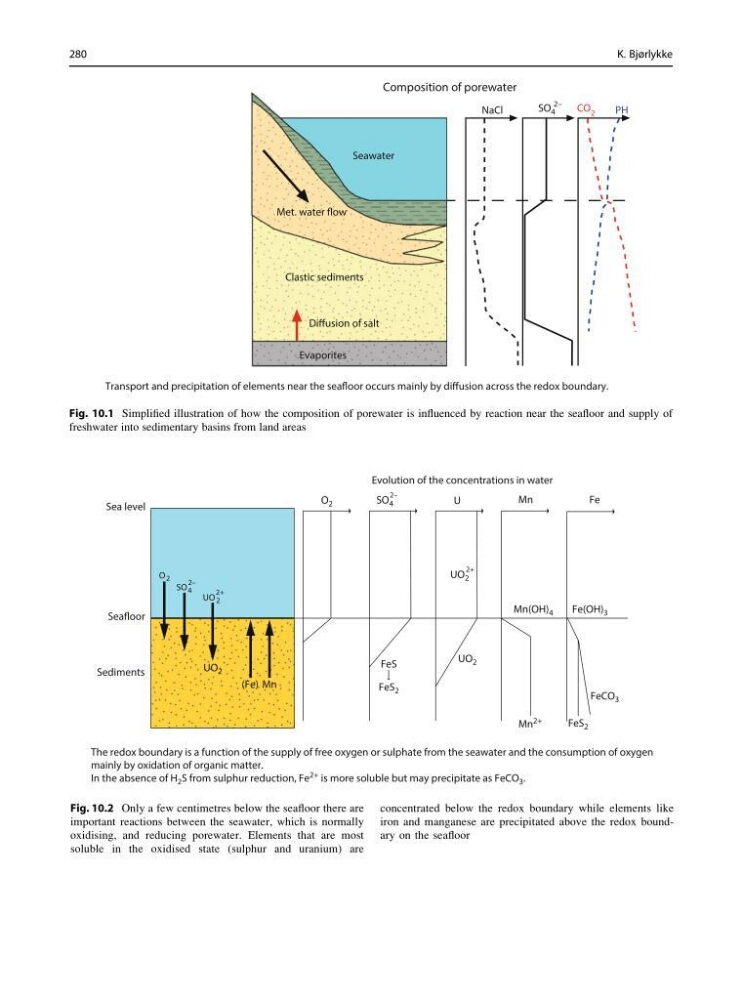
Transport and precipitation of elements near the seafloor occurs mainly by diffusion across the redox boundary.
Fig. 10.1 Simplified illustration of how the composition of porewater is influenced by reaction near the seafloor and supply of
freshwater into sedimentary basins from land areas
O 2
SO 4
2–
(Fe) Mn
UO 2
UO 2
2+
Sea level
Seafloor
Sediments
Mn(OH) 4
Fe(OH) 3
FeCO 3
Mn
2+
FeS 2
Evolution of the concentrations in water
O 2
Mn
Fe
SO 4
2–
UO 2
UO 2
2+
FeS 2
FeS
The redox boundary is a function of the supply of free oxygen or sulphate from the seawater and the consumption of oxygen
mainly by oxidation of organic matter.
In the absence of H 2 S from sulphur reduction, Fe
2+ is more soluble but may precipitate as FeCO 3 .
U
Fig. 10.2 Only a few centimetres below the seafloor there are
important reactions between the seawater, which is normally
oxidising, and reducing porewater. Elements that are most
soluble in the oxidised state (sulphur and uranium) are
concentrated below the redox boundary while elements like
iron and manganese are precipitated above the redox boundary on the seafloor
280
K. Bjørlykke
NaCl
SO 4
2–
CO 2
PH
Seawater
Met. water flow
Clastic sediments
Diffusion of salt
Evaporites
Transport and precipitation of elements near the seafloor occurs mainly by diffusion across the redox boundary.
Fig. 10.1 Simplified illustration of how the composition of porewater is influenced by reaction near the seafloor and supply of
freshwater into sedimentary basins from land areas
O 2
SO 4
2–
(Fe) Mn
UO 2
UO 2
2+
Sea level
Seafloor
Sediments
Mn(OH) 4
Fe(OH) 3
FeCO 3
Mn
2+
FeS 2
Evolution of the concentrations in water
O 2
Mn
Fe
SO 4
2–
UO 2
UO 2
2+
FeS 2
FeS
The redox boundary is a function of the supply of free oxygen or sulphate from the seawater and the consumption of oxygen
mainly by oxidation of organic matter.
In the absence of H 2 S from sulphur reduction, Fe
2+ is more soluble but may precipitate as FeCO 3 .
U
Fig. 10.2 Only a few centimetres below the seafloor there are
important reactions between the seawater, which is normally
oxidising, and reducing porewater. Elements that are most
soluble in the oxidised state (sulphur and uranium) are
concentrated below the redox boundary while elements like
iron and manganese are precipitated above the redox boundary on the seafloor
280
K. Bjørlykke