

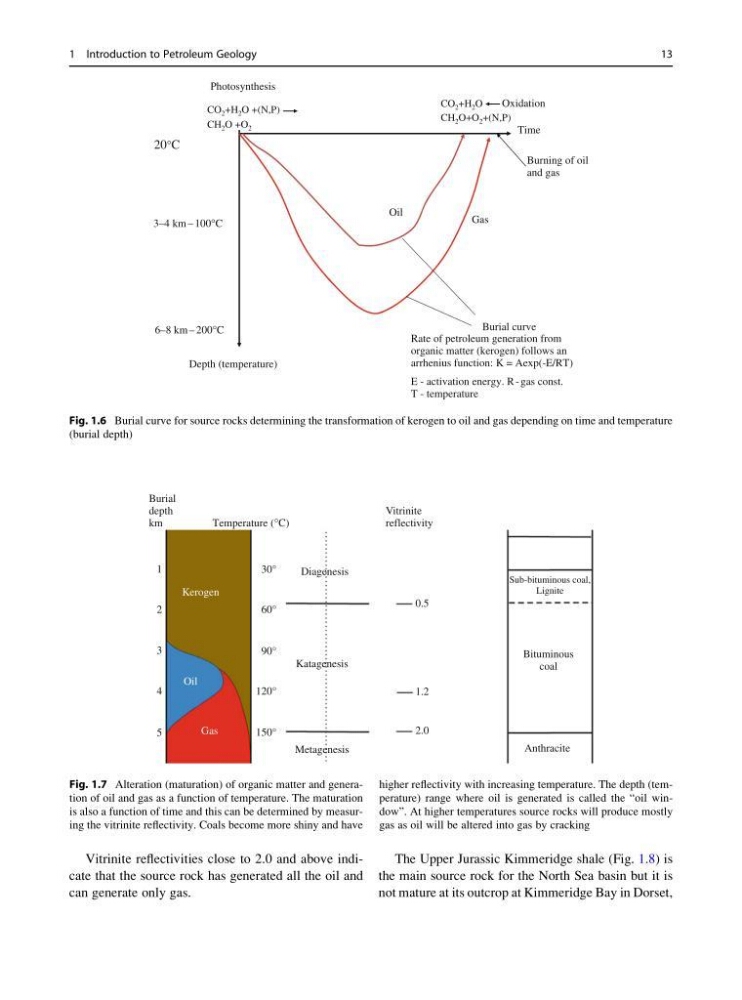
Vitrinite reflectivities close to 2.0 and above indicate that the source rock has generated all the oil and
can generate only gas.
The Upper Jurassic Kimmeridge shale (Fig. 1.8) is
the main source rock for the North Sea basin but it is
not mature at its outcrop at Kimmeridge Bay in Dorset,
Time
Depth (temperature)
20°C
3–4 km – 100°C
6–8 km – 200°C
CO 2 +H 2 O +(N,P)
CO 2 +H 2 O
CH 2 O+O 2 +(N,P)
CH 2 O +O 2
Photosynthesis
Oxidation
Burning of oil
and gas
Burial curve
Gas
Oil
Rate of petroleum generation from
organic matter (kerogen) follows an
arrhenius function: K = Aexp(-E/RT)
E - activation energy. R - gas const.
T - temperature
Fig. 1.6 Burial curve for source rocks determining the transformation of kerogen to oil and gas depending on time and temperature
(burial depth)
1
30°
Burial
depth
km
Temperature (°C)
Kerogen
Oil
Gas
Diagenesis
Anthracite
Vitrinite
reflectivity
Katagenesis
Metagenesis
60°
90°
120°
150°
2.0
1.2
0.5
Sub-bituminous coal,
Lignite
Bituminous
coal
2
3
4
5
Fig. 1.7 Alteration (maturation) of organic matter and generation of oil and gas as a function of temperature. The maturation
is also a function of time and this can be determined by measuring the vitrinite reflectivity. Coals become more shiny and have
higher reflectivity with increasing temperature. The depth (temperature) range where oil is generated is called the “oil window”. At higher temperatures source rocks will produce mostly
gas as oil will be altered into gas by cracking
1 Introduction to Petroleum Geology
13
can generate only gas.
The Upper Jurassic Kimmeridge shale (Fig. 1.8) is
the main source rock for the North Sea basin but it is
not mature at its outcrop at Kimmeridge Bay in Dorset,
Time
Depth (temperature)
20°C
3–4 km – 100°C
6–8 km – 200°C
CO 2 +H 2 O +(N,P)
CO 2 +H 2 O
CH 2 O+O 2 +(N,P)
CH 2 O +O 2
Photosynthesis
Oxidation
Burning of oil
and gas
Burial curve
Gas
Oil
Rate of petroleum generation from
organic matter (kerogen) follows an
arrhenius function: K = Aexp(-E/RT)
E - activation energy. R - gas const.
T - temperature
Fig. 1.6 Burial curve for source rocks determining the transformation of kerogen to oil and gas depending on time and temperature
(burial depth)
1
30°
Burial
depth
km
Temperature (°C)
Kerogen
Oil
Gas
Diagenesis
Anthracite
Vitrinite
reflectivity
Katagenesis
Metagenesis
60°
90°
120°
150°
2.0
1.2
0.5
Sub-bituminous coal,
Lignite
Bituminous
coal
2
3
4
5
Fig. 1.7 Alteration (maturation) of organic matter and generation of oil and gas as a function of temperature. The maturation
is also a function of time and this can be determined by measuring the vitrinite reflectivity. Coals become more shiny and have
higher reflectivity with increasing temperature. The depth (temperature) range where oil is generated is called the “oil window”. At higher temperatures source rocks will produce mostly
gas as oil will be altered into gas by cracking
1 Introduction to Petroleum Geology
13