

forces acting against migration are the capillary forces
and the resistance to flow though rocks with low
permeabilities. If the resistance to flow (permeability)
is very low the fluid pressure both in the water phase and
the petroleum phase will increase and cause tight shales
to fracture, thus opening up for petroleum migration.
Migration of oil and gas will therefore nearly
always have an upwards component. Petroleum may
however locally be expelled downwards from a source
rock into a sandstone.
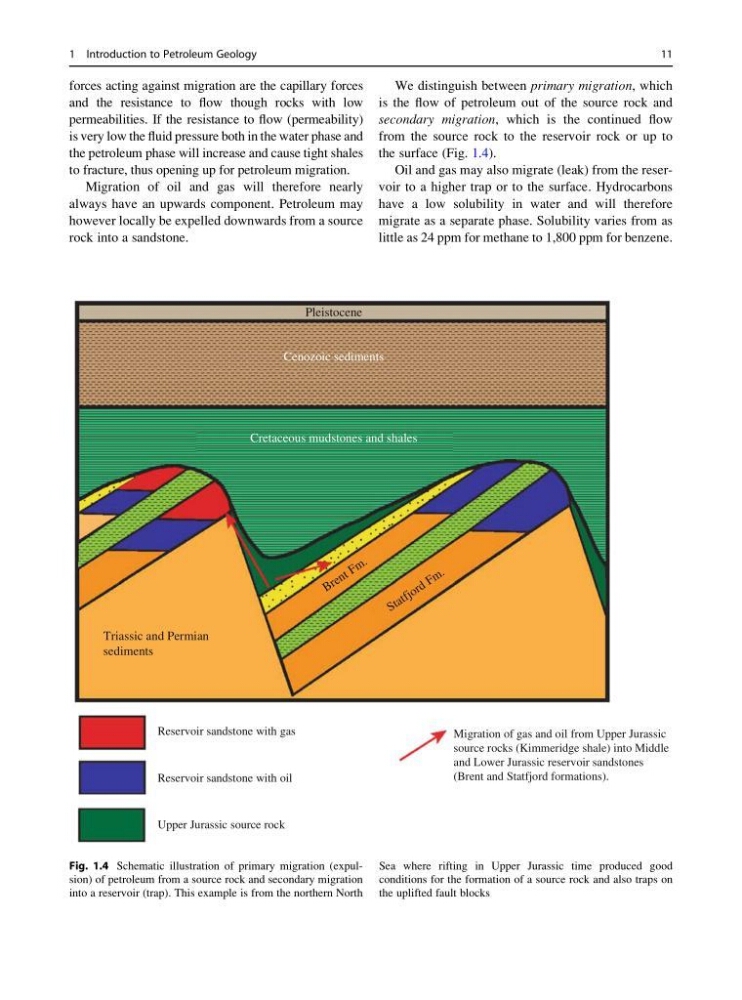
We distinguish between primary migration, which
is the flow of petroleum out of the source rock and
secondary migration, which is the continued flow
from the source rock to the reservoir rock or up to
the surface (Fig. 1.4).
Oil and gas may also migrate (leak) from the reservoir to a higher trap or to the surface. Hydrocarbons
have a low solubility in water and will therefore
migrate as a separate phase. Solubility varies from as
little as 24 ppm for methane to 1,800 ppm for benzene.
Reservoir sandstone with gas
Triassic and Permian
sediments
B r e n t F m .
S t a t f j o r d F m .
Pleistocene
Cenozoic sediments
Cretaceous mudstones and shales
Migration of gas and oil from Upper Jurassic
source rocks (Kimmeridge shale) into Middle
and Lower Jurassic reservoir sandstones
(Brent and Statfjord formations).
Reservoir sandstone with oil
Upper Jurassic source rock
Fig. 1.4 Schematic illustration of primary migration (expulsion) of petroleum from a source rock and secondary migration
into a reservoir (trap). This example is from the northern North
Sea where rifting in Upper Jurassic time produced good
conditions for the formation of a source rock and also traps on
the uplifted fault blocks
1 Introduction to Petroleum Geology
11
and the resistance to flow though rocks with low
permeabilities. If the resistance to flow (permeability)
is very low the fluid pressure both in the water phase and
the petroleum phase will increase and cause tight shales
to fracture, thus opening up for petroleum migration.
Migration of oil and gas will therefore nearly
always have an upwards component. Petroleum may
however locally be expelled downwards from a source
rock into a sandstone.
We distinguish between primary migration, which
is the flow of petroleum out of the source rock and
secondary migration, which is the continued flow
from the source rock to the reservoir rock or up to
the surface (Fig. 1.4).
Oil and gas may also migrate (leak) from the reservoir to a higher trap or to the surface. Hydrocarbons
have a low solubility in water and will therefore
migrate as a separate phase. Solubility varies from as
little as 24 ppm for methane to 1,800 ppm for benzene.
Reservoir sandstone with gas
Triassic and Permian
sediments
B r e n t F m .
S t a t f j o r d F m .
Pleistocene
Cenozoic sediments
Cretaceous mudstones and shales
Migration of gas and oil from Upper Jurassic
source rocks (Kimmeridge shale) into Middle
and Lower Jurassic reservoir sandstones
(Brent and Statfjord formations).
Reservoir sandstone with oil
Upper Jurassic source rock
Fig. 1.4 Schematic illustration of primary migration (expulsion) of petroleum from a source rock and secondary migration
into a reservoir (trap). This example is from the northern North
Sea where rifting in Upper Jurassic time produced good
conditions for the formation of a source rock and also traps on
the uplifted fault blocks
1 Introduction to Petroleum Geology
11