

minerals, since there is no quartz which in more acid
rocks forms most of the sand fraction. Minerals like
basic plagioclases, pyroxenes and hornblende will
quickly break down to clay minerals such as kaolinite,
and after long periods of weathering gibbsite (Al(OH) 3 .
6.2
Supply of Clay Minerals to
Sedimentary Basins
While kaolinite is derived from humid climate
weathering, smectite and illite are more typical of deserts
because there is less flow of fresh (meteoric) groundwater. Chlorite is mostly derived from erosion of metamorphic rocks in relatively cold climates where weathering
is slow. In warmer and wetter climates chlorite will
break down, but may occur near basalts and basic volcanic rocks, particularly in the marine environment where
chlorite is more stable. Volcanic ash consisting of glass
and unstable volcanic mineral assemblages may alter to
smectite, both on land and on the seafloor. In deep sea
sediments, zeolites like phillipsite are common.
Erosion of older mudrocks and shales can produce
nearly all types of clay minerals. Glacial clays are
essentially mechanically ground down sedimentary,
metamorphic or igneous rocks. Since there is very little
chemical weathering, their chemical composition is
nearly the same as the rocks eroded. Chlorite and illite
are formed by disintegration of mica and metamorphic
chlorite, and most of the quartz and feldspar is preserved. We find such clays accumulating in front of
modern glaciers that terminate in lakes or the ocean.
When the continental ice sheet withdrew from
Scandinavia 10,000–9,000 years ago, thick glaciomarine
clays were deposited in the fjords and sea. Subsequent
postglacial isostatic uplift elevated the inland portions
by up to 200 m above the present sea level.
Clay transported by rivers into lakes will remain
suspended for some time (due to slow flocculation)
and very finely laminated clayey sediments will be
deposited. In lakes there is usually less bioturbation
to destroy the lamination than in marine environments.
Freshwater sediments tend to be finely laminated compared to most marine sediments.
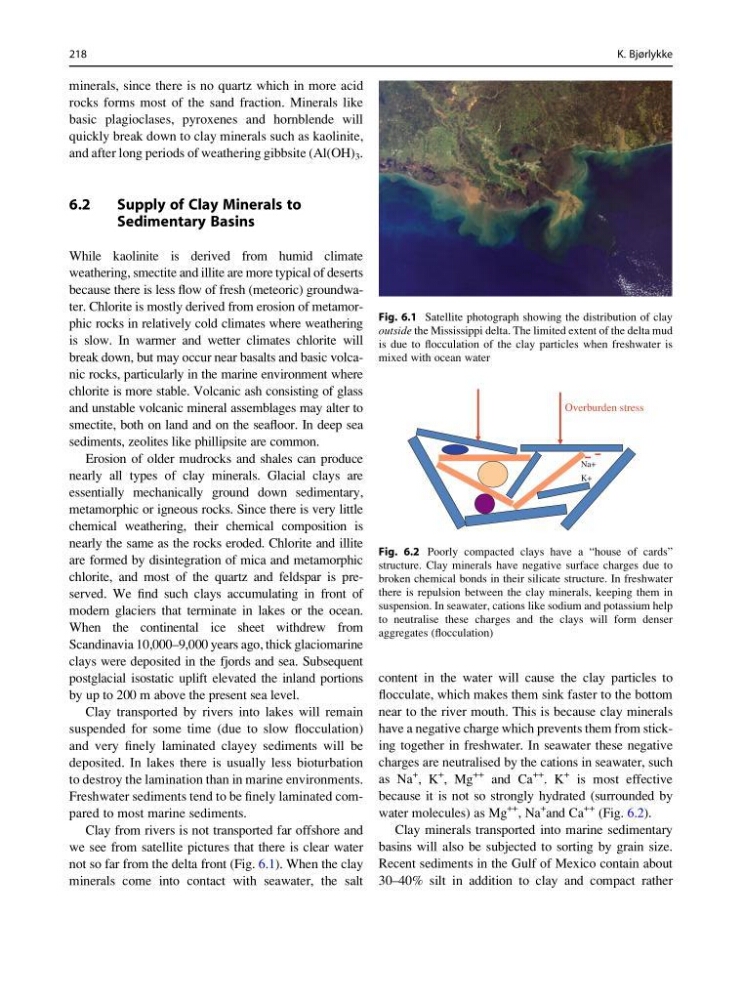
Clay from rivers is not transported far offshore and
we see from satellite pictures that there is clear water
not so far from the delta front (Fig. 6.1). When the clay
minerals come into contact with seawater, the salt
content in the water will cause the clay particles to
flocculate, which makes them sink faster to the bottom
near to the river mouth. This is because clay minerals
have a negative charge which prevents them from sticking together in freshwater. In seawater these negative
charges are neutralised by the cations in seawater, such
as Na
+
, K
+
, Mg
++ and Ca
++
. K
+ is most effective
because it is not so strongly hydrated (surrounded by
water molecules) as Mg
++
, Na
+
and Ca
++ (Fig. 6.2).
Clay minerals transported into marine sedimentary
basins will also be subjected to sorting by grain size.
Recent sediments in the Gulf of Mexico contain about
30–40% silt in addition to clay and compact rather
Fig. 6.1 Satellite photograph showing the distribution of clay
outside the Mississippi delta. The limited extent of the delta mud
is due to flocculation of the clay particles when freshwater is
mixed with ocean water
- -
Na+
K+
Overburden stress
Fig. 6.2 Poorly compacted clays have a “house of cards”
structure. Clay minerals have negative surface charges due to
broken chemical bonds in their silicate structure. In freshwater
there is repulsion between the clay minerals, keeping them in
suspension. In seawater, cations like sodium and potassium help
to neutralise these charges and the clays will form denser
aggregates (flocculation)
218
K. Bjørlykke
rocks forms most of the sand fraction. Minerals like
basic plagioclases, pyroxenes and hornblende will
quickly break down to clay minerals such as kaolinite,
and after long periods of weathering gibbsite (Al(OH) 3 .
6.2
Supply of Clay Minerals to
Sedimentary Basins
While kaolinite is derived from humid climate
weathering, smectite and illite are more typical of deserts
because there is less flow of fresh (meteoric) groundwater. Chlorite is mostly derived from erosion of metamorphic rocks in relatively cold climates where weathering
is slow. In warmer and wetter climates chlorite will
break down, but may occur near basalts and basic volcanic rocks, particularly in the marine environment where
chlorite is more stable. Volcanic ash consisting of glass
and unstable volcanic mineral assemblages may alter to
smectite, both on land and on the seafloor. In deep sea
sediments, zeolites like phillipsite are common.
Erosion of older mudrocks and shales can produce
nearly all types of clay minerals. Glacial clays are
essentially mechanically ground down sedimentary,
metamorphic or igneous rocks. Since there is very little
chemical weathering, their chemical composition is
nearly the same as the rocks eroded. Chlorite and illite
are formed by disintegration of mica and metamorphic
chlorite, and most of the quartz and feldspar is preserved. We find such clays accumulating in front of
modern glaciers that terminate in lakes or the ocean.
When the continental ice sheet withdrew from
Scandinavia 10,000–9,000 years ago, thick glaciomarine
clays were deposited in the fjords and sea. Subsequent
postglacial isostatic uplift elevated the inland portions
by up to 200 m above the present sea level.
Clay transported by rivers into lakes will remain
suspended for some time (due to slow flocculation)
and very finely laminated clayey sediments will be
deposited. In lakes there is usually less bioturbation
to destroy the lamination than in marine environments.
Freshwater sediments tend to be finely laminated compared to most marine sediments.
Clay from rivers is not transported far offshore and
we see from satellite pictures that there is clear water
not so far from the delta front (Fig. 6.1). When the clay
minerals come into contact with seawater, the salt
content in the water will cause the clay particles to
flocculate, which makes them sink faster to the bottom
near to the river mouth. This is because clay minerals
have a negative charge which prevents them from sticking together in freshwater. In seawater these negative
charges are neutralised by the cations in seawater, such
as Na
+
, K
+
, Mg
++ and Ca
++
. K
+ is most effective
because it is not so strongly hydrated (surrounded by
water molecules) as Mg
++
, Na
+
and Ca
++ (Fig. 6.2).
Clay minerals transported into marine sedimentary
basins will also be subjected to sorting by grain size.
Recent sediments in the Gulf of Mexico contain about
30–40% silt in addition to clay and compact rather
Fig. 6.1 Satellite photograph showing the distribution of clay
outside the Mississippi delta. The limited extent of the delta mud
is due to flocculation of the clay particles when freshwater is
mixed with ocean water
- -
Na+
K+
Overburden stress
Fig. 6.2 Poorly compacted clays have a “house of cards”
structure. Clay minerals have negative surface charges due to
broken chemical bonds in their silicate structure. In freshwater
there is repulsion between the clay minerals, keeping them in
suspension. In seawater, cations like sodium and potassium help
to neutralise these charges and the clays will form denser
aggregates (flocculation)
218
K. Bjørlykke