

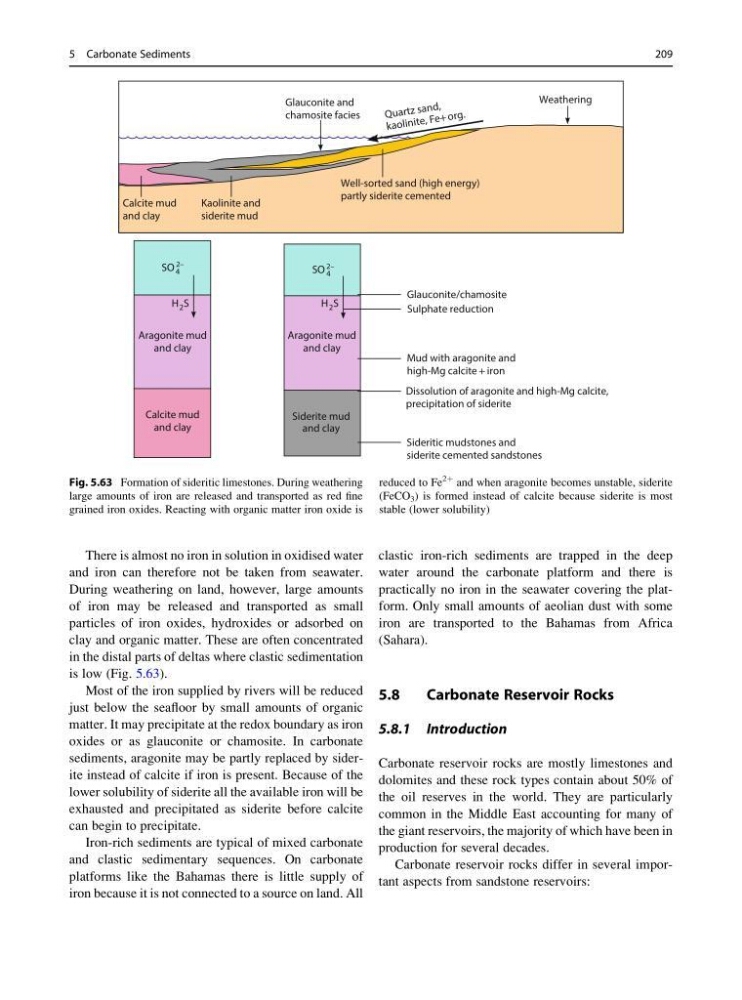
There is almost no iron in solution in oxidised water
and iron can therefore not be taken from seawater.
During weathering on land, however, large amounts
of iron may be released and transported as small
particles of iron oxides, hydroxides or adsorbed on
clay and organic matter. These are often concentrated
in the distal parts of deltas where clastic sedimentation
is low (Fig. 5.63).
Most of the iron supplied by rivers will be reduced
just below the seafloor by small amounts of organic
matter. It may precipitate at the redox boundary as iron
oxides or as glauconite or chamosite. In carbonate
sediments, aragonite may be partly replaced by siderite instead of calcite if iron is present. Because of the
lower solubility of siderite all the available iron will be
exhausted and precipitated as siderite before calcite
can begin to precipitate.
Iron-rich sediments are typical of mixed carbonate
and clastic sedimentary sequences. On carbonate
platforms like the Bahamas there is little supply of
iron because it is not connected to a source on land. All
clastic iron-rich sediments are trapped in the deep
water around the carbonate platform and there is
practically no iron in the seawater covering the platform. Only small amounts of aeolian dust with some
iron are transported to the Bahamas from Africa
(Sahara).
5.8
Carbonate Reservoir Rocks
5.8.1 Introduction
Carbonate reservoir rocks are mostly limestones and
dolomites and these rock types contain about 50% of
the oil reserves in the world. They are particularly
common in the Middle East accounting for many of
the giant reservoirs, the majority of which have been in
production for several decades.
Carbonate reservoir rocks differ in several important aspects from sandstone reservoirs:
Glauconite and
chamosite facies
Qu ar tz sa nd ,
ka oli nit e, Fe + or g.
Weathering
Calcite mud
and clay
Kaolinite and
siderite mud
Well-sorted sand (high energy)
partly siderite cemented
2–
SO 4
Aragonite mud
and clay
Calcite mud
and clay
H S
2
2–
SO 4
Aragonite mud
and clay
H S
2
Siderite mud
and clay
Glauconite/chamosite
Sulphate reduction
Mud with aragonite and
high-Mg calcite + iron
Dissolution of aragonite and high-Mg calcite,
precipitation of siderite
Sideritic mudstones and
siderite cemented sandstones
Fig. 5.63 Formation of sideritic limestones. During weathering
large amounts of iron are released and transported as red fine
grained iron oxides. Reacting with organic matter iron oxide is
reduced to Fe
2þ and when aragonite becomes unstable, siderite
(FeCO 3 ) is formed instead of calcite because siderite is most
stable (lower solubility)
5 Carbonate Sediments
209
and iron can therefore not be taken from seawater.
During weathering on land, however, large amounts
of iron may be released and transported as small
particles of iron oxides, hydroxides or adsorbed on
clay and organic matter. These are often concentrated
in the distal parts of deltas where clastic sedimentation
is low (Fig. 5.63).
Most of the iron supplied by rivers will be reduced
just below the seafloor by small amounts of organic
matter. It may precipitate at the redox boundary as iron
oxides or as glauconite or chamosite. In carbonate
sediments, aragonite may be partly replaced by siderite instead of calcite if iron is present. Because of the
lower solubility of siderite all the available iron will be
exhausted and precipitated as siderite before calcite
can begin to precipitate.
Iron-rich sediments are typical of mixed carbonate
and clastic sedimentary sequences. On carbonate
platforms like the Bahamas there is little supply of
iron because it is not connected to a source on land. All
clastic iron-rich sediments are trapped in the deep
water around the carbonate platform and there is
practically no iron in the seawater covering the platform. Only small amounts of aeolian dust with some
iron are transported to the Bahamas from Africa
(Sahara).
5.8
Carbonate Reservoir Rocks
5.8.1 Introduction
Carbonate reservoir rocks are mostly limestones and
dolomites and these rock types contain about 50% of
the oil reserves in the world. They are particularly
common in the Middle East accounting for many of
the giant reservoirs, the majority of which have been in
production for several decades.
Carbonate reservoir rocks differ in several important aspects from sandstone reservoirs:
Glauconite and
chamosite facies
Qu ar tz sa nd ,
ka oli nit e, Fe + or g.
Weathering
Calcite mud
and clay
Kaolinite and
siderite mud
Well-sorted sand (high energy)
partly siderite cemented
2–
SO 4
Aragonite mud
and clay
Calcite mud
and clay
H S
2
2–
SO 4
Aragonite mud
and clay
H S
2
Siderite mud
and clay
Glauconite/chamosite
Sulphate reduction
Mud with aragonite and
high-Mg calcite + iron
Dissolution of aragonite and high-Mg calcite,
precipitation of siderite
Sideritic mudstones and
siderite cemented sandstones
Fig. 5.63 Formation of sideritic limestones. During weathering
large amounts of iron are released and transported as red fine
grained iron oxides. Reacting with organic matter iron oxide is
reduced to Fe
2þ and when aragonite becomes unstable, siderite
(FeCO 3 ) is formed instead of calcite because siderite is most
stable (lower solubility)
5 Carbonate Sediments
209