

the most important are diatoms, which have amorphous silica (opal A) shells.
Diatoms are most abundant in the higher latitudes
and are also found in brackish and fresh water.
Blue–green algae (cyanobacteria) which live on the
bottom in shallow areas, also contribute to the organic
material in sediments.
In coastal swamps, and particularly on deltas, we
have extensive production of organic matter in the
form of plants and trees which may avoid being
oxidised by sinking into mud or bog. The residues of
these higher land plants may form peat, which with
deeper burial may be converted into lignite and bituminous coal. But such deposits are also a potential
source of gas and oil. Plant matter, including wood,
also floats down rivers and is deposited when it sinks
to the bottom, usually in a nearshore deltaic environment. When the trees rot they release CO 2 and consume as much oxygen as the plant produced during the
whole period when it was growing. There is thus no
net contribution of oxygen to the atmosphere. This
also applies to the bulk of the tropical rainforests.
Where trees and plants sink into black mud,
preventing them from being oxidised, there is a net
contribution of oxygen to the atmosphere and a
corresponding reduction of CO 2 in the atmosphere.
Trophic level
1
Trophic level
2
Trophic level
3
Trophic level
4
1,000 kg
100 kg
10 kg
1 kg
Phytoplankton Zooplankton
Crustaceans
Fish
All animal plankton (zooplankton) live on plant
plankton, and in turn are eaten by higher organisms
in the food chain. At each step in the food chain, which
we call a trophic level, the amount of organic matter
(the biomass) is reduced to 10%.
Ninety percent of the production of organic matter
is therefore from algae. This is why algae and to some
extent zooplankton account for the bulk of the organic
material which can be transformed into oil. Larger
animals such as dinosaurs are totally irrelevant as
sources of oil.
The most important of the zooplankton which provide organic matter for petroleum are:
1. Radiolaria – silica shells, wide distribution, particularly in tropical waters.
2. Foraminifera – shells of calcium carbonate.
3. Pteropods – pelagic gastropods (snails) with a foot
which has been converted into wing-shaped lobes;
carbonate shells.
This is the second lowest level within the marine
food chain. These zooplanktonic organisms are eaten
by crustaceans which themselves are eaten by fish.
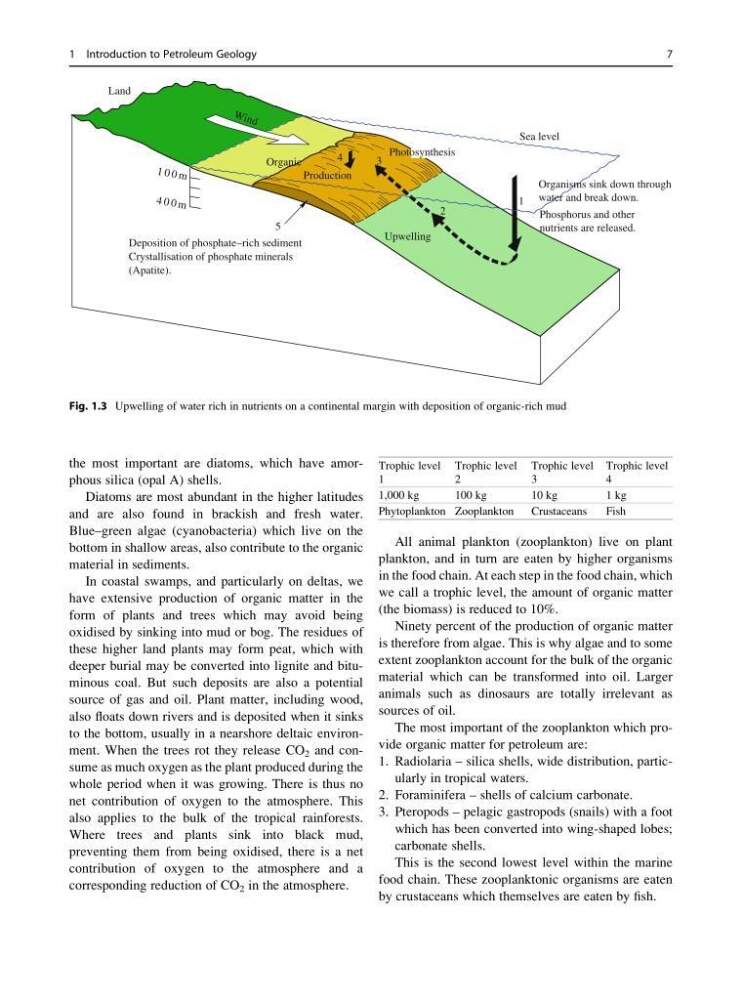
Sea level
Organisms sink down through
water and break down.
Phosphorus and other
nutrients are released.
Deposition of phosphate –rich sediment
Crystallisation of phosphate minerals
(Apatite).
Photosynthesis
Production
Upwelling
W in d
Organic
Land
1 0 0 m
4 0 0 m
4
3
2
1
5
Fig. 1.3 Upwelling of water rich in nutrients on a continental margin with deposition of organic-rich mud
1 Introduction to Petroleum Geology
7
Diatoms are most abundant in the higher latitudes
and are also found in brackish and fresh water.
Blue–green algae (cyanobacteria) which live on the
bottom in shallow areas, also contribute to the organic
material in sediments.
In coastal swamps, and particularly on deltas, we
have extensive production of organic matter in the
form of plants and trees which may avoid being
oxidised by sinking into mud or bog. The residues of
these higher land plants may form peat, which with
deeper burial may be converted into lignite and bituminous coal. But such deposits are also a potential
source of gas and oil. Plant matter, including wood,
also floats down rivers and is deposited when it sinks
to the bottom, usually in a nearshore deltaic environment. When the trees rot they release CO 2 and consume as much oxygen as the plant produced during the
whole period when it was growing. There is thus no
net contribution of oxygen to the atmosphere. This
also applies to the bulk of the tropical rainforests.
Where trees and plants sink into black mud,
preventing them from being oxidised, there is a net
contribution of oxygen to the atmosphere and a
corresponding reduction of CO 2 in the atmosphere.
Trophic level
1
Trophic level
2
Trophic level
3
Trophic level
4
1,000 kg
100 kg
10 kg
1 kg
Phytoplankton Zooplankton
Crustaceans
Fish
All animal plankton (zooplankton) live on plant
plankton, and in turn are eaten by higher organisms
in the food chain. At each step in the food chain, which
we call a trophic level, the amount of organic matter
(the biomass) is reduced to 10%.
Ninety percent of the production of organic matter
is therefore from algae. This is why algae and to some
extent zooplankton account for the bulk of the organic
material which can be transformed into oil. Larger
animals such as dinosaurs are totally irrelevant as
sources of oil.
The most important of the zooplankton which provide organic matter for petroleum are:
1. Radiolaria – silica shells, wide distribution, particularly in tropical waters.
2. Foraminifera – shells of calcium carbonate.
3. Pteropods – pelagic gastropods (snails) with a foot
which has been converted into wing-shaped lobes;
carbonate shells.
This is the second lowest level within the marine
food chain. These zooplanktonic organisms are eaten
by crustaceans which themselves are eaten by fish.
Sea level
Organisms sink down through
water and break down.
Phosphorus and other
nutrients are released.
Deposition of phosphate –rich sediment
Crystallisation of phosphate minerals
(Apatite).
Photosynthesis
Production
Upwelling
W in d
Organic
Land
1 0 0 m
4 0 0 m
4
3
2
1
5
Fig. 1.3 Upwelling of water rich in nutrients on a continental margin with deposition of organic-rich mud
1 Introduction to Petroleum Geology
7