

Calcite solubility depends on the solubility product
Ca
2þ
Â
à Á CO
2À
3
Â
Ã
. We see that when the water is relatively acid (high H
+ concentrations) the reaction is
driven towards the left and the carbonate ions concentration CO
2À
3
Â
Ã
will be low. With high pH (i.e. low H
+
activity), the bicarbonate HCO
À
3
À
Á
concentration will
be higher.
Mineral solubility is not strictly a function of the
ionic concentration, but of the activity (a) which is
influenced by the temperature and other ions present.
The dissociation constants for H 2 CO 3 and HCO
À
3
are:
K 1 ¼ aH
þ
Á aHCO
À
3 =aH 2 CO
2À
2
and
K 2 ¼ aH
þ
Á aCO
2À
3 =aHCO
À
3
This in turn requires that aCO
2À
3
also must be
higher in order to satisfy the dissociation equation.
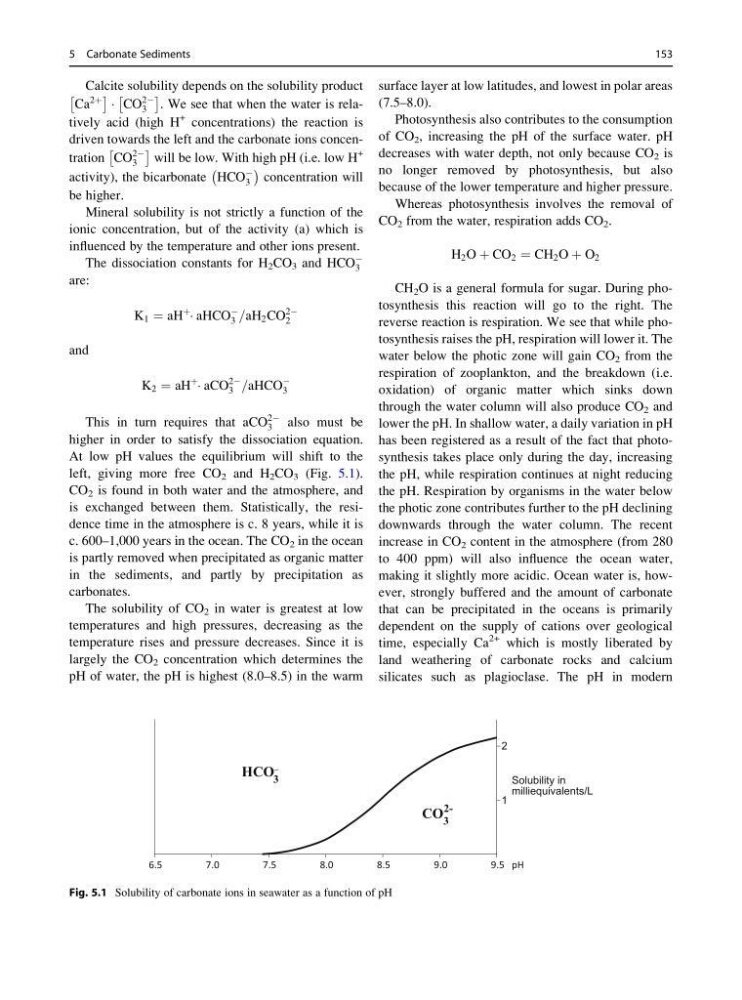
At low pH values the equilibrium will shift to the
left, giving more free CO 2 and H 2 CO 3 (Fig. 5.1).
CO 2 is found in both water and the atmosphere, and
is exchanged between them. Statistically, the residence time in the atmosphere is c. 8 years, while it is
c. 600–1,000 years in the ocean. The CO 2 in the ocean
is partly removed when precipitated as organic matter
in the sediments, and partly by precipitation as
carbonates.
The solubility of CO 2 in water is greatest at low
temperatures and high pressures, decreasing as the
temperature rises and pressure decreases. Since it is
largely the CO 2 concentration which determines the
pH of water, the pH is highest (8.0–8.5) in the warm
surface layer at low latitudes, and lowest in polar areas
(7.5–8.0).
Photosynthesis also contributes to the consumption
of CO 2 , increasing the pH of the surface water. pH
decreases with water depth, not only because CO 2 is
no longer removed by photosynthesis, but also
because of the lower temperature and higher pressure.
Whereas photosynthesis involves the removal of
CO 2 from the water, respiration adds CO 2 .
H 2 O þ CO 2 ¼ CH 2 O þ O 2
CH 2 O is a general formula for sugar. During photosynthesis this reaction will go to the right. The
reverse reaction is respiration. We see that while photosynthesis raises the pH, respiration will lower it. The
water below the photic zone will gain CO 2 from the
respiration of zooplankton, and the breakdown (i.e.
oxidation) of organic matter which sinks down
through the water column will also produce CO 2 and
lower the pH. In shallow water, a daily variation in pH
has been registered as a result of the fact that photosynthesis takes place only during the day, increasing
the pH, while respiration continues at night reducing
the pH. Respiration by organisms in the water below
the photic zone contributes further to the pH declining
downwards through the water column. The recent
increase in CO 2 content in the atmosphere (from 280
to 400 ppm) will also influence the ocean water,
making it slightly more acidic. Ocean water is, however, strongly buffered and the amount of carbonate
that can be precipitated in the oceans is primarily
dependent on the supply of cations over geological
time, especially Ca
2+ which is mostly liberated by
land weathering of carbonate rocks and calcium
silicates such as plagioclase. The pH in modern
6.5
7.0
7.5
8.0
8.5
9.0
9.5 pH
Solubility in
milliequivalents/L
2
HCO
–
CO 3
1
3
2Fig. 5.1 Solubility of carbonate ions in seawater as a function of pH
5 Carbonate Sediments
153
Ca
2þ
Â
à Á CO
2À
3
Â
Ã
. We see that when the water is relatively acid (high H
+ concentrations) the reaction is
driven towards the left and the carbonate ions concentration CO
2À
3
Â
Ã
will be low. With high pH (i.e. low H
+
activity), the bicarbonate HCO
À
3
À
Á
concentration will
be higher.
Mineral solubility is not strictly a function of the
ionic concentration, but of the activity (a) which is
influenced by the temperature and other ions present.
The dissociation constants for H 2 CO 3 and HCO
À
3
are:
K 1 ¼ aH
þ
Á aHCO
À
3 =aH 2 CO
2À
2
and
K 2 ¼ aH
þ
Á aCO
2À
3 =aHCO
À
3
This in turn requires that aCO
2À
3
also must be
higher in order to satisfy the dissociation equation.
At low pH values the equilibrium will shift to the
left, giving more free CO 2 and H 2 CO 3 (Fig. 5.1).
CO 2 is found in both water and the atmosphere, and
is exchanged between them. Statistically, the residence time in the atmosphere is c. 8 years, while it is
c. 600–1,000 years in the ocean. The CO 2 in the ocean
is partly removed when precipitated as organic matter
in the sediments, and partly by precipitation as
carbonates.
The solubility of CO 2 in water is greatest at low
temperatures and high pressures, decreasing as the
temperature rises and pressure decreases. Since it is
largely the CO 2 concentration which determines the
pH of water, the pH is highest (8.0–8.5) in the warm
surface layer at low latitudes, and lowest in polar areas
(7.5–8.0).
Photosynthesis also contributes to the consumption
of CO 2 , increasing the pH of the surface water. pH
decreases with water depth, not only because CO 2 is
no longer removed by photosynthesis, but also
because of the lower temperature and higher pressure.
Whereas photosynthesis involves the removal of
CO 2 from the water, respiration adds CO 2 .
H 2 O þ CO 2 ¼ CH 2 O þ O 2
CH 2 O is a general formula for sugar. During photosynthesis this reaction will go to the right. The
reverse reaction is respiration. We see that while photosynthesis raises the pH, respiration will lower it. The
water below the photic zone will gain CO 2 from the
respiration of zooplankton, and the breakdown (i.e.
oxidation) of organic matter which sinks down
through the water column will also produce CO 2 and
lower the pH. In shallow water, a daily variation in pH
has been registered as a result of the fact that photosynthesis takes place only during the day, increasing
the pH, while respiration continues at night reducing
the pH. Respiration by organisms in the water below
the photic zone contributes further to the pH declining
downwards through the water column. The recent
increase in CO 2 content in the atmosphere (from 280
to 400 ppm) will also influence the ocean water,
making it slightly more acidic. Ocean water is, however, strongly buffered and the amount of carbonate
that can be precipitated in the oceans is primarily
dependent on the supply of cations over geological
time, especially Ca
2+ which is mostly liberated by
land weathering of carbonate rocks and calcium
silicates such as plagioclase. The pH in modern
6.5
7.0
7.5
8.0
8.5
9.0
9.5 pH
Solubility in
milliequivalents/L
2
HCO
–
CO 3
1
3
2Fig. 5.1 Solubility of carbonate ions in seawater as a function of pH
5 Carbonate Sediments
153