

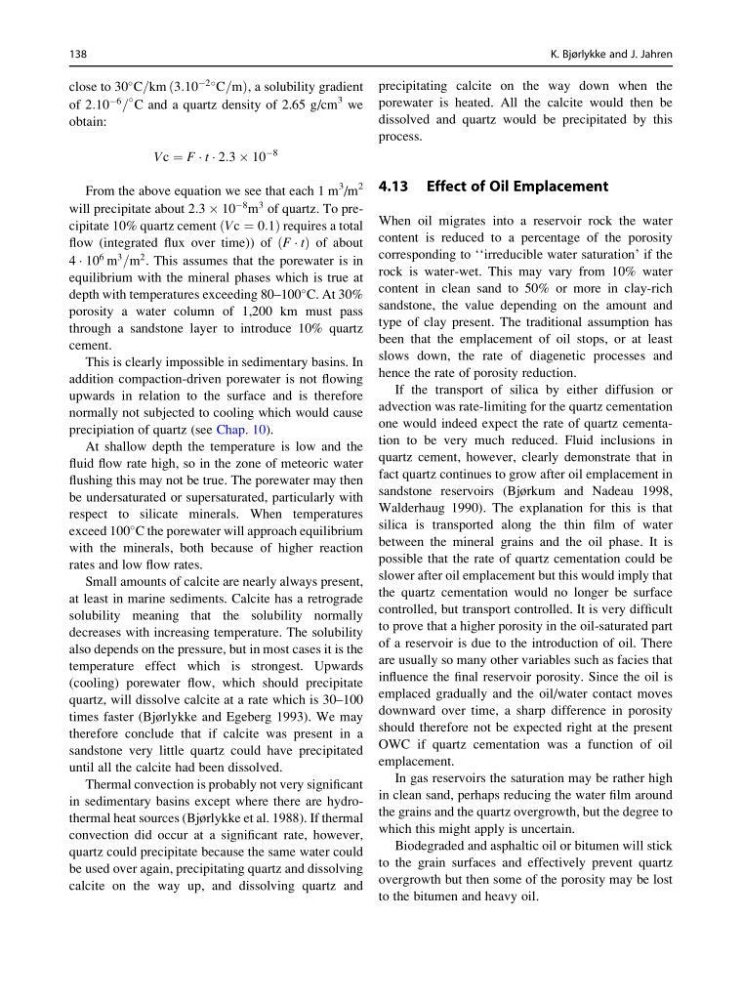
close to 30
C=km ð3:10
À2 C=mÞ, a solubility gradient
of 2:10
À6
=
C and a quartz density of 2.65 g/cm
3 we
obtain:
Vc ¼ F Á t Á 2:3 Â 10
À8
From the above equation we see that each 1 m
3 /m
2
will precipitate about 2:3 Â 10
À8 m
3 of quartz. To precipitate 10% quartz cement ðVc ¼ 0:1Þ requires a total
flow (integrated flux over time)) of ðF Á tÞ of about
4 Á 10
6 m
3
=m
2 . This assumes that the porewater is in
equilibrium with the mineral phases which is true at
depth with temperatures exceeding 80–100
C. At 30%
porosity a water column of 1,200 km must pass
through a sandstone layer to introduce 10% quartz
cement.
This is clearly impossible in sedimentary basins. In
addition compaction-driven porewater is not flowing
upwards in relation to the surface and is therefore
normally not subjected to cooling which would cause
precipiation of quartz (see Chap. 10).
At shallow depth the temperature is low and the
fluid flow rate high, so in the zone of meteoric water
flushing this may not be true. The porewater may then
be undersaturated or supersaturated, particularly with
respect to silicate minerals. When temperatures
exceed 100
C the porewater will approach equilibrium
with the minerals, both because of higher reaction
rates and low flow rates.
Small amounts of calcite are nearly always present,
at least in marine sediments. Calcite has a retrograde
solubility meaning that the solubility normally
decreases with increasing temperature. The solubility
also depends on the pressure, but in most cases it is the
temperature effect which is strongest. Upwards
(cooling) porewater flow, which should precipitate
quartz, will dissolve calcite at a rate which is 30–100
times faster (Bjørlykke and Egeberg 1993). We may
therefore conclude that if calcite was present in a
sandstone very little quartz could have precipitated
until all the calcite had been dissolved.
Thermal convection is probably not very significant
in sedimentary basins except where there are hydrothermal heat sources (Bjørlykke et al. 1988). If thermal
convection did occur at a significant rate, however,
quartz could precipitate because the same water could
be used over again, precipitating quartz and dissolving
calcite on the way up, and dissolving quartz and
precipitating calcite on the way down when the
porewater is heated. All the calcite would then be
dissolved and quartz would be precipitated by this
process.
4.13 Effect of Oil Emplacement
When oil migrates into a reservoir rock the water
content is reduced to a percentage of the porosity
corresponding to ‘‘irreducible water saturation’ if the
rock is water-wet. This may vary from 10% water
content in clean sand to 50% or more in clay-rich
sandstone, the value depending on the amount and
type of clay present. The traditional assumption has
been that the emplacement of oil stops, or at least
slows down, the rate of diagenetic processes and
hence the rate of porosity reduction.
If the transport of silica by either diffusion or
advection was rate-limiting for the quartz cementation
one would indeed expect the rate of quartz cementation to be very much reduced. Fluid inclusions in
quartz cement, however, clearly demonstrate that in
fact quartz continues to grow after oil emplacement in
sandstone reservoirs (Bjørkum and Nadeau 1998,
Walderhaug 1990). The explanation for this is that
silica is transported along the thin film of water
between the mineral grains and the oil phase. It is
possible that the rate of quartz cementation could be
slower after oil emplacement but this would imply that
the quartz cementation would no longer be surface
controlled, but transport controlled. It is very difficult
to prove that a higher porosity in the oil-saturated part
of a reservoir is due to the introduction of oil. There
are usually so many other variables such as facies that
influence the final reservoir porosity. Since the oil is
emplaced gradually and the oil/water contact moves
downward over time, a sharp difference in porosity
should therefore not be expected right at the present
OWC if quartz cementation was a function of oil
emplacement.
In gas reservoirs the saturation may be rather high
in clean sand, perhaps reducing the water film around
the grains and the quartz overgrowth, but the degree to
which this might apply is uncertain.
Biodegraded and asphaltic oil or bitumen will stick
to the grain surfaces and effectively prevent quartz
overgrowth but then some of the porosity may be lost
to the bitumen and heavy oil.
138
K. Bjørlykke and J. Jahren
C=km ð3:10
À2 C=mÞ, a solubility gradient
of 2:10
À6
=
C and a quartz density of 2.65 g/cm
3 we
obtain:
Vc ¼ F Á t Á 2:3 Â 10
À8
From the above equation we see that each 1 m
3 /m
2
will precipitate about 2:3 Â 10
À8 m
3 of quartz. To precipitate 10% quartz cement ðVc ¼ 0:1Þ requires a total
flow (integrated flux over time)) of ðF Á tÞ of about
4 Á 10
6 m
3
=m
2 . This assumes that the porewater is in
equilibrium with the mineral phases which is true at
depth with temperatures exceeding 80–100
C. At 30%
porosity a water column of 1,200 km must pass
through a sandstone layer to introduce 10% quartz
cement.
This is clearly impossible in sedimentary basins. In
addition compaction-driven porewater is not flowing
upwards in relation to the surface and is therefore
normally not subjected to cooling which would cause
precipiation of quartz (see Chap. 10).
At shallow depth the temperature is low and the
fluid flow rate high, so in the zone of meteoric water
flushing this may not be true. The porewater may then
be undersaturated or supersaturated, particularly with
respect to silicate minerals. When temperatures
exceed 100
C the porewater will approach equilibrium
with the minerals, both because of higher reaction
rates and low flow rates.
Small amounts of calcite are nearly always present,
at least in marine sediments. Calcite has a retrograde
solubility meaning that the solubility normally
decreases with increasing temperature. The solubility
also depends on the pressure, but in most cases it is the
temperature effect which is strongest. Upwards
(cooling) porewater flow, which should precipitate
quartz, will dissolve calcite at a rate which is 30–100
times faster (Bjørlykke and Egeberg 1993). We may
therefore conclude that if calcite was present in a
sandstone very little quartz could have precipitated
until all the calcite had been dissolved.
Thermal convection is probably not very significant
in sedimentary basins except where there are hydrothermal heat sources (Bjørlykke et al. 1988). If thermal
convection did occur at a significant rate, however,
quartz could precipitate because the same water could
be used over again, precipitating quartz and dissolving
calcite on the way up, and dissolving quartz and
precipitating calcite on the way down when the
porewater is heated. All the calcite would then be
dissolved and quartz would be precipitated by this
process.
4.13 Effect of Oil Emplacement
When oil migrates into a reservoir rock the water
content is reduced to a percentage of the porosity
corresponding to ‘‘irreducible water saturation’ if the
rock is water-wet. This may vary from 10% water
content in clean sand to 50% or more in clay-rich
sandstone, the value depending on the amount and
type of clay present. The traditional assumption has
been that the emplacement of oil stops, or at least
slows down, the rate of diagenetic processes and
hence the rate of porosity reduction.
If the transport of silica by either diffusion or
advection was rate-limiting for the quartz cementation
one would indeed expect the rate of quartz cementation to be very much reduced. Fluid inclusions in
quartz cement, however, clearly demonstrate that in
fact quartz continues to grow after oil emplacement in
sandstone reservoirs (Bjørkum and Nadeau 1998,
Walderhaug 1990). The explanation for this is that
silica is transported along the thin film of water
between the mineral grains and the oil phase. It is
possible that the rate of quartz cementation could be
slower after oil emplacement but this would imply that
the quartz cementation would no longer be surface
controlled, but transport controlled. It is very difficult
to prove that a higher porosity in the oil-saturated part
of a reservoir is due to the introduction of oil. There
are usually so many other variables such as facies that
influence the final reservoir porosity. Since the oil is
emplaced gradually and the oil/water contact moves
downward over time, a sharp difference in porosity
should therefore not be expected right at the present
OWC if quartz cementation was a function of oil
emplacement.
In gas reservoirs the saturation may be rather high
in clean sand, perhaps reducing the water film around
the grains and the quartz overgrowth, but the degree to
which this might apply is uncertain.
Biodegraded and asphaltic oil or bitumen will stick
to the grain surfaces and effectively prevent quartz
overgrowth but then some of the porosity may be lost
to the bitumen and heavy oil.
138
K. Bjørlykke and J. Jahren