

sedimentation rates characterise the Gulf of Mexico,
where rapid deposition of thick sequences from the
Mississippi delta has prevailed since Mesozoic times.
The South American and African continents drain
mainly into the Atlantic. The water divide between the
Atlantic and the Pacific Oceans lies far to the west in
South America, and that with the Indian Ocean in
Africa is far to the east.
The Pacific Ocean is surrounded by a belt of volcanic regions and island arcs. There are relatively few
rivers that carry large amounts of clastic sediment
directly into the Pacific Ocean, in contrast to the
Atlantic. Sediment which is eroded, for example on
the Asian continent, is deposited in shallow marine
areas (marginal seas) such as the Yellow Sea and
China Sea. The sediments are cut off from further
transport by the island arc running from Japan and
southwards. The Pacific Ocean is therefore dominated
by volcanic sediments.
Volcanic sedimentation takes the form of volcanic
dust and glass, which may be transported aerially over
long distances. After sedimentation, volcanic glass
will turn into palagonite, an amorphous compound
formed by hydration of basaltic tuff. Palagonite may
then be further converted into montmorillonite or zeolite minerals. The zeolite phillipsite is very widely
found in the Pacific, but is scarce in the other oceans.
Pumice is also a volcanic product, and may drift floating over great distances. The eruption of volcanoes in
the Pacific Ocean area in historic times has shown that
large eruptions produce 10
9 –10
10 tonnes of ash, and
much the same amount of pumice and agglomerates.
Submarine volcanism, by contrast, produces very
little ash to form sediment. The lava which flows out
onto the seabed will solidify as an insulating crust on
contact with the water (often forming pillow lava), so
that little volcanic matter goes into suspension.
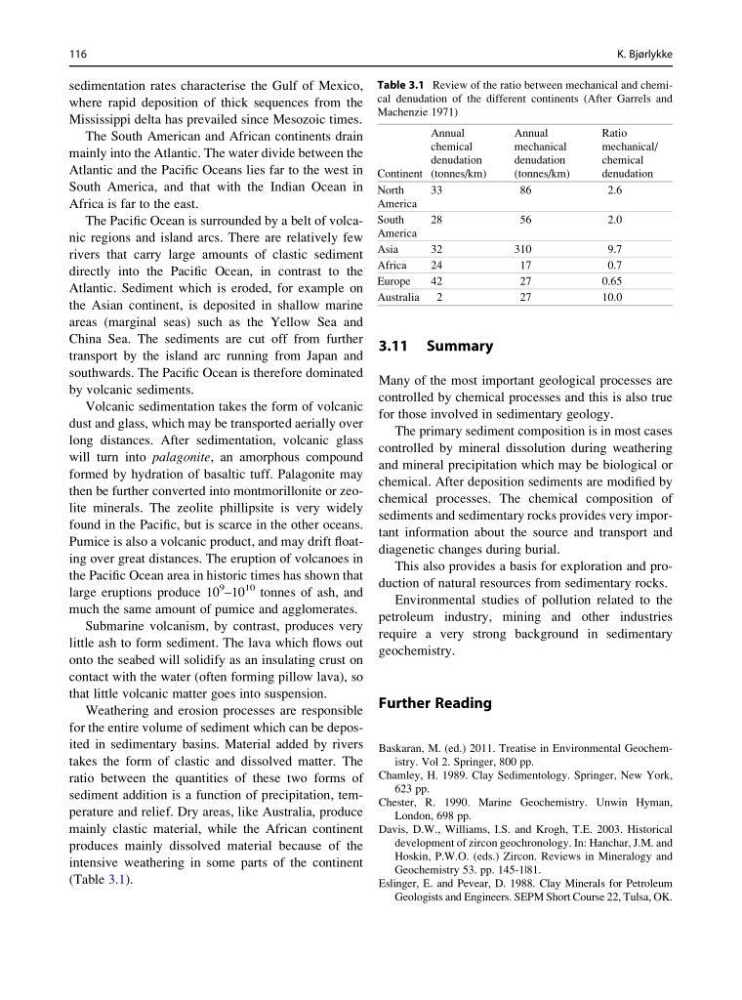
Weathering and erosion processes are responsible
for the entire volume of sediment which can be deposited in sedimentary basins. Material added by rivers
takes the form of clastic and dissolved matter. The
ratio between the quantities of these two forms of
sediment addition is a function of precipitation, temperature and relief. Dry areas, like Australia, produce
mainly clastic material, while the African continent
produces mainly dissolved material because of the
intensive weathering in some parts of the continent
(Table 3.1).
3.11 Summary
Many of the most important geological processes are
controlled by chemical processes and this is also true
for those involved in sedimentary geology.
The primary sediment composition is in most cases
controlled by mineral dissolution during weathering
and mineral precipitation which may be biological or
chemical. After deposition sediments are modified by
chemical processes. The chemical composition of
sediments and sedimentary rocks provides very important information about the source and transport and
diagenetic changes during burial.
This also provides a basis for exploration and production of natural resources from sedimentary rocks.
Environmental studies of pollution related to the
petroleum industry, mining and other industries
require a very strong background in sedimentary
geochemistry.
Further Reading
Baskaran, M. (ed.) 2011. Treatise in Environmental Geochemistry. Vol 2. Springer, 800 pp.
Chamley, H. 1989. Clay Sedimentology. Springer, New York,
623 pp.
Chester, R. 1990. Marine Geochemistry. Unwin Hyman,
London, 698 pp.
Davis, D.W., Williams, I.S. and Krogh, T.E. 2003. Historical
development of zircon geochronology. In: Hanchar, J.M. and
Hoskin, P.W.O. (eds.) Zircon. Reviews in Mineralogy and
Geochemistry 53. pp. 145-1|81.
Eslinger, E. and Pevear, D. 1988. Clay Minerals for Petroleum
Geologists and Engineers. SEPM Short Course 22, Tulsa, OK.
Table 3.1 Review of the ratio between mechanical and chemical denudation of the different continents (After Garrels and
Machenzie 1971)
Continent
Annual
chemical
denudation
(tonnes/km)
Annual
mechanical
denudation
(tonnes/km)
Ratio
mechanical/
chemical
denudation
North
America
33
86
2.6
South
America
28
56
2.0
Asia
32
310
9.7
Africa
24
17
0.7
Europe
42
27
0.65
Australia 2
27
10.0
116
K. Bjørlykke
where rapid deposition of thick sequences from the
Mississippi delta has prevailed since Mesozoic times.
The South American and African continents drain
mainly into the Atlantic. The water divide between the
Atlantic and the Pacific Oceans lies far to the west in
South America, and that with the Indian Ocean in
Africa is far to the east.
The Pacific Ocean is surrounded by a belt of volcanic regions and island arcs. There are relatively few
rivers that carry large amounts of clastic sediment
directly into the Pacific Ocean, in contrast to the
Atlantic. Sediment which is eroded, for example on
the Asian continent, is deposited in shallow marine
areas (marginal seas) such as the Yellow Sea and
China Sea. The sediments are cut off from further
transport by the island arc running from Japan and
southwards. The Pacific Ocean is therefore dominated
by volcanic sediments.
Volcanic sedimentation takes the form of volcanic
dust and glass, which may be transported aerially over
long distances. After sedimentation, volcanic glass
will turn into palagonite, an amorphous compound
formed by hydration of basaltic tuff. Palagonite may
then be further converted into montmorillonite or zeolite minerals. The zeolite phillipsite is very widely
found in the Pacific, but is scarce in the other oceans.
Pumice is also a volcanic product, and may drift floating over great distances. The eruption of volcanoes in
the Pacific Ocean area in historic times has shown that
large eruptions produce 10
9 –10
10 tonnes of ash, and
much the same amount of pumice and agglomerates.
Submarine volcanism, by contrast, produces very
little ash to form sediment. The lava which flows out
onto the seabed will solidify as an insulating crust on
contact with the water (often forming pillow lava), so
that little volcanic matter goes into suspension.
Weathering and erosion processes are responsible
for the entire volume of sediment which can be deposited in sedimentary basins. Material added by rivers
takes the form of clastic and dissolved matter. The
ratio between the quantities of these two forms of
sediment addition is a function of precipitation, temperature and relief. Dry areas, like Australia, produce
mainly clastic material, while the African continent
produces mainly dissolved material because of the
intensive weathering in some parts of the continent
(Table 3.1).
3.11 Summary
Many of the most important geological processes are
controlled by chemical processes and this is also true
for those involved in sedimentary geology.
The primary sediment composition is in most cases
controlled by mineral dissolution during weathering
and mineral precipitation which may be biological or
chemical. After deposition sediments are modified by
chemical processes. The chemical composition of
sediments and sedimentary rocks provides very important information about the source and transport and
diagenetic changes during burial.
This also provides a basis for exploration and production of natural resources from sedimentary rocks.
Environmental studies of pollution related to the
petroleum industry, mining and other industries
require a very strong background in sedimentary
geochemistry.
Further Reading
Baskaran, M. (ed.) 2011. Treatise in Environmental Geochemistry. Vol 2. Springer, 800 pp.
Chamley, H. 1989. Clay Sedimentology. Springer, New York,
623 pp.
Chester, R. 1990. Marine Geochemistry. Unwin Hyman,
London, 698 pp.
Davis, D.W., Williams, I.S. and Krogh, T.E. 2003. Historical
development of zircon geochronology. In: Hanchar, J.M. and
Hoskin, P.W.O. (eds.) Zircon. Reviews in Mineralogy and
Geochemistry 53. pp. 145-1|81.
Eslinger, E. and Pevear, D. 1988. Clay Minerals for Petroleum
Geologists and Engineers. SEPM Short Course 22, Tulsa, OK.
Table 3.1 Review of the ratio between mechanical and chemical denudation of the different continents (After Garrels and
Machenzie 1971)
Continent
Annual
chemical
denudation
(tonnes/km)
Annual
mechanical
denudation
(tonnes/km)
Ratio
mechanical/
chemical
denudation
North
America
33
86
2.6
South
America
28
56
2.0
Asia
32
310
9.7
Africa
24
17
0.7
Europe
42
27
0.65
Australia 2
27
10.0
116
K. Bjørlykke