

present day, although there have certainly been some
variations.
The supply of elements to ocean water from rivers
and by water circulation at the spreading ridges must
be balanced by a removal of the same elements from
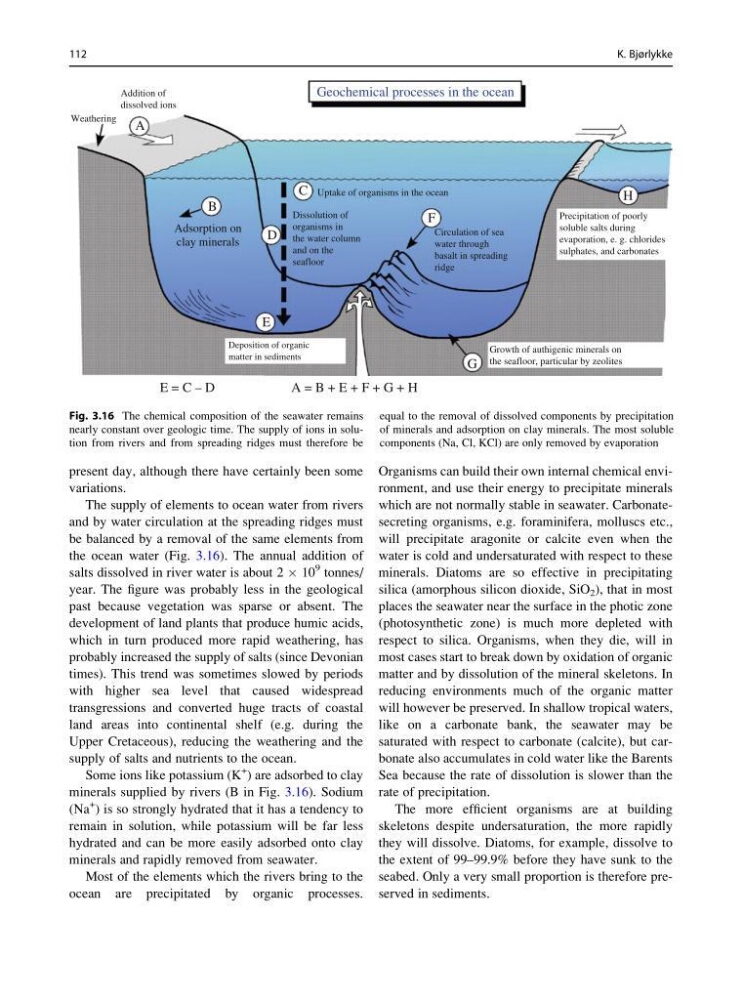
the ocean water (Fig. 3.16). The annual addition of
salts dissolved in river water is about 2 Â 10
9 tonnes/
year. The figure was probably less in the geological
past because vegetation was sparse or absent. The
development of land plants that produce humic acids,
which in turn produced more rapid weathering, has
probably increased the supply of salts (since Devonian
times). This trend was sometimes slowed by periods
with higher sea level that caused widespread
transgressions and converted huge tracts of coastal
land areas into continental shelf (e.g. during the
Upper Cretaceous), reducing the weathering and the
supply of salts and nutrients to the ocean.
Some ions like potassium (K
+ ) are adsorbed to clay
minerals supplied by rivers (B in Fig. 3.16). Sodium
(Na
+
) is so strongly hydrated that it has a tendency to
remain in solution, while potassium will be far less
hydrated and can be more easily adsorbed onto clay
minerals and rapidly removed from seawater.
Most of the elements which the rivers bring to the
ocean are precipitated by organic processes.
Organisms can build their own internal chemical environment, and use their energy to precipitate minerals
which are not normally stable in seawater. Carbonatesecreting organisms, e.g. foraminifera, molluscs etc.,
will precipitate aragonite or calcite even when the
water is cold and undersaturated with respect to these
minerals. Diatoms are so effective in precipitating
silica (amorphous silicon dioxide, SiO 2 ), that in most
places the seawater near the surface in the photic zone
(photosynthetic zone) is much more depleted with
respect to silica. Organisms, when they die, will in
most cases start to break down by oxidation of organic
matter and by dissolution of the mineral skeletons. In
reducing environments much of the organic matter
will however be preserved. In shallow tropical waters,
like on a carbonate bank, the seawater may be
saturated with respect to carbonate (calcite), but carbonate also accumulates in cold water like the Barents
Sea because the rate of dissolution is slower than the
rate of precipitation.
The more efficient organisms are at building
skeletons despite undersaturation, the more rapidly
they will dissolve. Diatoms, for example, dissolve to
the extent of 99–99.9% before they have sunk to the
seabed. Only a very small proportion is therefore preserved in sediments.
Addition of
dissolved ions
Weathering
A
B
Adsorption on
clay minerals
Uptake of organisms in the ocean
Dissolution of
organisms in
the water column
and on the
seafloor
Circulation of sea
water through
basalt in spreading
ridge
C
Geochemical processes in the ocean
F
E = C – D
A = B + E + F + G + H
H
Precipitation of poorly
soluble salts during
evaporation, e. g. chlorides
sulphates, and carbonates
G
Growth of authigenic minerals on
the seafloor, particular by zeolites
D
E
Deposition of organic
matter in sediments
Fig. 3.16 The chemical composition of the seawater remains
nearly constant over geologic time. The supply of ions in solution from rivers and from spreading ridges must therefore be
equal to the removal of dissolved components by precipitation
of minerals and adsorption on clay minerals. The most soluble
components (Na, Cl, KCl) are only removed by evaporation
112
K. Bjørlykke
variations.
The supply of elements to ocean water from rivers
and by water circulation at the spreading ridges must
be balanced by a removal of the same elements from
the ocean water (Fig. 3.16). The annual addition of
salts dissolved in river water is about 2 Â 10
9 tonnes/
year. The figure was probably less in the geological
past because vegetation was sparse or absent. The
development of land plants that produce humic acids,
which in turn produced more rapid weathering, has
probably increased the supply of salts (since Devonian
times). This trend was sometimes slowed by periods
with higher sea level that caused widespread
transgressions and converted huge tracts of coastal
land areas into continental shelf (e.g. during the
Upper Cretaceous), reducing the weathering and the
supply of salts and nutrients to the ocean.
Some ions like potassium (K
+ ) are adsorbed to clay
minerals supplied by rivers (B in Fig. 3.16). Sodium
(Na
+
) is so strongly hydrated that it has a tendency to
remain in solution, while potassium will be far less
hydrated and can be more easily adsorbed onto clay
minerals and rapidly removed from seawater.
Most of the elements which the rivers bring to the
ocean are precipitated by organic processes.
Organisms can build their own internal chemical environment, and use their energy to precipitate minerals
which are not normally stable in seawater. Carbonatesecreting organisms, e.g. foraminifera, molluscs etc.,
will precipitate aragonite or calcite even when the
water is cold and undersaturated with respect to these
minerals. Diatoms are so effective in precipitating
silica (amorphous silicon dioxide, SiO 2 ), that in most
places the seawater near the surface in the photic zone
(photosynthetic zone) is much more depleted with
respect to silica. Organisms, when they die, will in
most cases start to break down by oxidation of organic
matter and by dissolution of the mineral skeletons. In
reducing environments much of the organic matter
will however be preserved. In shallow tropical waters,
like on a carbonate bank, the seawater may be
saturated with respect to carbonate (calcite), but carbonate also accumulates in cold water like the Barents
Sea because the rate of dissolution is slower than the
rate of precipitation.
The more efficient organisms are at building
skeletons despite undersaturation, the more rapidly
they will dissolve. Diatoms, for example, dissolve to
the extent of 99–99.9% before they have sunk to the
seabed. Only a very small proportion is therefore preserved in sediments.
Addition of
dissolved ions
Weathering
A
B
Adsorption on
clay minerals
Uptake of organisms in the ocean
Dissolution of
organisms in
the water column
and on the
seafloor
Circulation of sea
water through
basalt in spreading
ridge
C
Geochemical processes in the ocean
F
E = C – D
A = B + E + F + G + H
H
Precipitation of poorly
soluble salts during
evaporation, e. g. chlorides
sulphates, and carbonates
G
Growth of authigenic minerals on
the seafloor, particular by zeolites
D
E
Deposition of organic
matter in sediments
Fig. 3.16 The chemical composition of the seawater remains
nearly constant over geologic time. The supply of ions in solution from rivers and from spreading ridges must therefore be
equal to the removal of dissolved components by precipitation
of minerals and adsorption on clay minerals. The most soluble
components (Na, Cl, KCl) are only removed by evaporation
112
K. Bjørlykke