

3.7
Distribution of Clay Minerals and
other Authigenic Minerals as a
Function of Erosion and
Weathering
3.7.1 What Determines the Type of Clay
Minerals We Find in Sediments and
Sedimentary Rocks?
When rocks are subjected to erosion and weathering,
clastic minerals are broken down and perhaps somewhat altered, with respect to the minerals in the parent
rocks. We can also get new minerals formed in the
source rock itself, and precipitation of new minerals
through weathering.
The more rapidly erosion and transport take place
compared to the rate of weathering, the closer the
composition of sediments is to the source rock. Glacial
sediments represent one end of the scale in terms of
sediment composition. Because glaciations are
characterised by very high rates of erosion and low
temperatures, chemical weathering will be very weak,
and Quaternary sediments – including clays – will
have a composition which essentially represents the
average of the rocks which have been eroded. Quartzrich rock will produce very different clays than basic
rocks and older sedimentary rocks. Sediments deposited in fault-controlled basins (e.g. rift basins) have a
short transport distance between the site of erosion and
deposition and the sediments have little time to weather
on the way. Clastic chlorite and biotite, which break
down relatively rapidly during weathering, are therefore likely to be preserved in addition to feldspar in rift
basins. These unstable minerals are good indicators of
rapid erosion and/or cold climates, since otherwise
they are unlikely to survive.
An analysis of the distribution of clay minerals in
modern sediments shows that we find clastic chlorite
almost exclusively in high latitudes, except around
islands of basic volcanic rocks (e.g. basalts). Clastic
chlorites from metamorphic rocks or altered basic
rocks are more magnesium-rich than authigenic
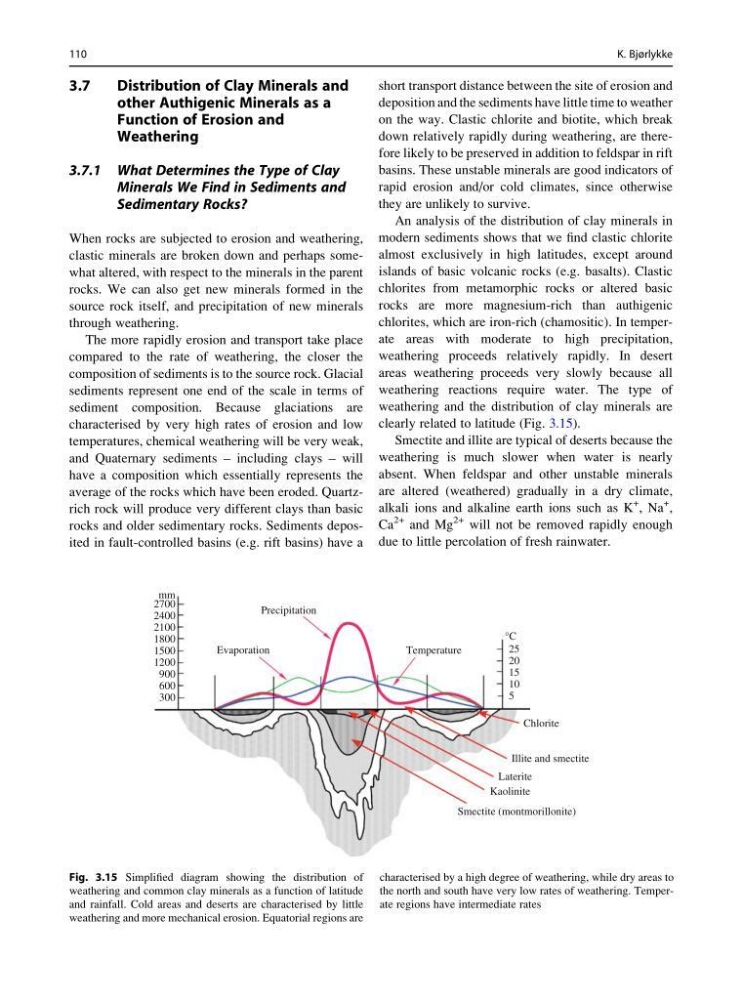
chlorites, which are iron-rich (chamositic). In temperate areas with moderate to high precipitation,
weathering proceeds relatively rapidly. In desert
areas weathering proceeds very slowly because all
weathering reactions require water. The type of
weathering and the distribution of clay minerals are
clearly related to latitude (Fig. 3.15).
Smectite and illite are typical of deserts because the
weathering is much slower when water is nearly
absent. When feldspar and other unstable minerals
are altered (weathered) gradually in a dry climate,
alkali ions and alkaline earth ions such as K
+ , Na
+
,
Ca
2+ and Mg
2+ will not be removed rapidly enough
due to little percolation of fresh rainwater.
2700
mm
Evaporation
Precipitation
Temperature
°C
25
20
15
10
5
Chlorite
Illite and smectite
Laterite
Kaolinite
Smectite (montmorillonite)
2400
2100
1800
1500
1200
900
600
300
Fig. 3.15 Simplified diagram showing the distribution of
weathering and common clay minerals as a function of latitude
and rainfall. Cold areas and deserts are characterised by little
weathering and more mechanical erosion. Equatorial regions are
characterised by a high degree of weathering, while dry areas to
the north and south have very low rates of weathering. Temperate regions have intermediate rates
110
K. Bjørlykke
Distribution of Clay Minerals and
other Authigenic Minerals as a
Function of Erosion and
Weathering
3.7.1 What Determines the Type of Clay
Minerals We Find in Sediments and
Sedimentary Rocks?
When rocks are subjected to erosion and weathering,
clastic minerals are broken down and perhaps somewhat altered, with respect to the minerals in the parent
rocks. We can also get new minerals formed in the
source rock itself, and precipitation of new minerals
through weathering.
The more rapidly erosion and transport take place
compared to the rate of weathering, the closer the
composition of sediments is to the source rock. Glacial
sediments represent one end of the scale in terms of
sediment composition. Because glaciations are
characterised by very high rates of erosion and low
temperatures, chemical weathering will be very weak,
and Quaternary sediments – including clays – will
have a composition which essentially represents the
average of the rocks which have been eroded. Quartzrich rock will produce very different clays than basic
rocks and older sedimentary rocks. Sediments deposited in fault-controlled basins (e.g. rift basins) have a
short transport distance between the site of erosion and
deposition and the sediments have little time to weather
on the way. Clastic chlorite and biotite, which break
down relatively rapidly during weathering, are therefore likely to be preserved in addition to feldspar in rift
basins. These unstable minerals are good indicators of
rapid erosion and/or cold climates, since otherwise
they are unlikely to survive.
An analysis of the distribution of clay minerals in
modern sediments shows that we find clastic chlorite
almost exclusively in high latitudes, except around
islands of basic volcanic rocks (e.g. basalts). Clastic
chlorites from metamorphic rocks or altered basic
rocks are more magnesium-rich than authigenic
chlorites, which are iron-rich (chamositic). In temperate areas with moderate to high precipitation,
weathering proceeds relatively rapidly. In desert
areas weathering proceeds very slowly because all
weathering reactions require water. The type of
weathering and the distribution of clay minerals are
clearly related to latitude (Fig. 3.15).
Smectite and illite are typical of deserts because the
weathering is much slower when water is nearly
absent. When feldspar and other unstable minerals
are altered (weathered) gradually in a dry climate,
alkali ions and alkaline earth ions such as K
+ , Na
+
,
Ca
2+ and Mg
2+ will not be removed rapidly enough
due to little percolation of fresh rainwater.
2700
mm
Evaporation
Precipitation
Temperature
°C
25
20
15
10
5
Chlorite
Illite and smectite
Laterite
Kaolinite
Smectite (montmorillonite)
2400
2100
1800
1500
1200
900
600
300
Fig. 3.15 Simplified diagram showing the distribution of
weathering and common clay minerals as a function of latitude
and rainfall. Cold areas and deserts are characterised by little
weathering and more mechanical erosion. Equatorial regions are
characterised by a high degree of weathering, while dry areas to
the north and south have very low rates of weathering. Temperate regions have intermediate rates
110
K. Bjørlykke