

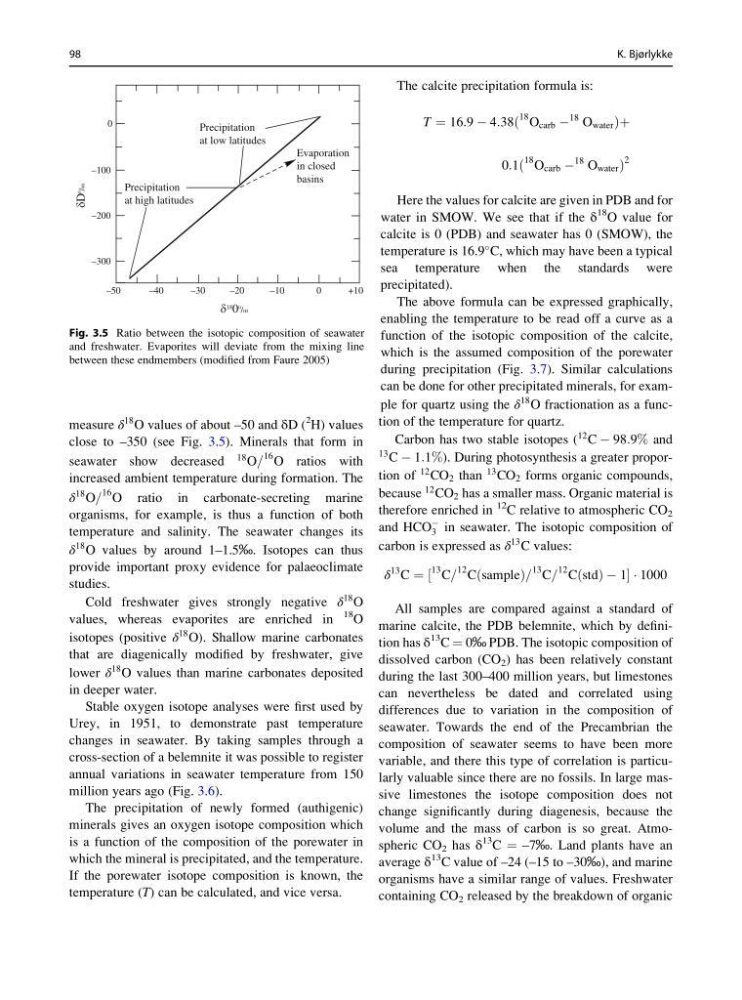
measure δ
18 O values of about –50 and δD (
2 H) values
close to –350 (see Fig. 3.5). Minerals that form in
seawater show decreased
18 O=
16 O ratios with
increased ambient temperature during formation. The
δ
18 O=
16 O ratio in carbonate-secreting marine
organisms, for example, is thus a function of both
temperature and salinity. The seawater changes its
δ
18 O values by around 1–1.5‰. Isotopes can thus
provide important proxy evidence for palaeoclimate
studies.
Cold freshwater gives strongly negative δ
18 O
values, whereas evaporites are enriched in
18 O
isotopes (positive δ
18 O). Shallow marine carbonates
that are diagenically modified by freshwater, give
lower δ
18 O values than marine carbonates deposited
in deeper water.
Stable oxygen isotope analyses were first used by
Urey, in 1951, to demonstrate past temperature
changes in seawater. By taking samples through a
cross-section of a belemnite it was possible to register
annual variations in seawater temperature from 150
million years ago (Fig. 3.6).
The precipitation of newly formed (authigenic)
minerals gives an oxygen isotope composition which
is a function of the composition of the porewater in
which the mineral is precipitated, and the temperature.
If the porewater isotope composition is known, the
temperature (T) can be calculated, and vice versa.
The calcite precipitation formula is:
T ¼ 16:9 À 4:38ð
18 O carb À
18 O water Þþ
0:1ð
18 O carb À
18 O water Þ
2
Here the values for calcite are given in PDB and for
water in SMOW. We see that if the δ
18 O value for
calcite is 0 (PDB) and seawater has 0 (SMOW), the
temperature is 16.9
C, which may have been a typical
sea temperature when the standards were
precipitated).
The above formula can be expressed graphically,
enabling the temperature to be read off a curve as a
function of the isotopic composition of the calcite,
which is the assumed composition of the porewater
during precipitation (Fig. 3.7). Similar calculations
can be done for other precipitated minerals, for example for quartz using the δ
18 O fractionation as a function of the temperature for quartz.
Carbon has two stable isotopes (
12 C À 98:9% and
13 C À 1:1%). During photosynthesis a greater proportion of
12 CO 2 than
13 CO 2 forms organic compounds,
because
12 CO 2 has a smaller mass. Organic material is
therefore enriched in
12 C relative to atmospheric CO 2
and HCO
À
3 in seawater. The isotopic composition of
carbon is expressed as δ
13 C values:
δ
13 C ¼ ½
13 C=
12 CðsampleÞ=
13 C=
12 CðstdÞ À 1 Á 1000
All samples are compared against a standard of
marine calcite, the PDB belemnite, which by definition has δ
13 C ¼ 0‰ PDB. The isotopic composition of
dissolved carbon (CO 2 ) has been relatively constant
during the last 300–400 million years, but limestones
can nevertheless be dated and correlated using
differences due to variation in the composition of
seawater. Towards the end of the Precambrian the
composition of seawater seems to have been more
variable, and there this type of correlation is particularly valuable since there are no fossils. In large massive limestones the isotope composition does not
change significantly during diagenesis, because the
volume and the mass of carbon is so great. Atmospheric CO 2 has δ
13 C ¼ –7‰. Land plants have an
average δ
13 C value of –24 (–15 to –30‰), and marine
organisms have a similar range of values. Freshwater
containing CO 2 released by the breakdown of organic
–50
δ
18 0
0
/00
δD
0
/00
–40
–30
–20
–10
0
+10
–300
–200
–100
0
Precipitation
at low latitudes
Precipitation
at high latitudes
Evaporation
in closed
basins
Fig. 3.5 Ratio between the isotopic composition of seawater
and freshwater. Evaporites will deviate from the mixing line
between these endmembers (modified from Faure 2005)
98
K. Bjørlykke
18 O values of about –50 and δD (
2 H) values
close to –350 (see Fig. 3.5). Minerals that form in
seawater show decreased
18 O=
16 O ratios with
increased ambient temperature during formation. The
δ
18 O=
16 O ratio in carbonate-secreting marine
organisms, for example, is thus a function of both
temperature and salinity. The seawater changes its
δ
18 O values by around 1–1.5‰. Isotopes can thus
provide important proxy evidence for palaeoclimate
studies.
Cold freshwater gives strongly negative δ
18 O
values, whereas evaporites are enriched in
18 O
isotopes (positive δ
18 O). Shallow marine carbonates
that are diagenically modified by freshwater, give
lower δ
18 O values than marine carbonates deposited
in deeper water.
Stable oxygen isotope analyses were first used by
Urey, in 1951, to demonstrate past temperature
changes in seawater. By taking samples through a
cross-section of a belemnite it was possible to register
annual variations in seawater temperature from 150
million years ago (Fig. 3.6).
The precipitation of newly formed (authigenic)
minerals gives an oxygen isotope composition which
is a function of the composition of the porewater in
which the mineral is precipitated, and the temperature.
If the porewater isotope composition is known, the
temperature (T) can be calculated, and vice versa.
The calcite precipitation formula is:
T ¼ 16:9 À 4:38ð
18 O carb À
18 O water Þþ
0:1ð
18 O carb À
18 O water Þ
2
Here the values for calcite are given in PDB and for
water in SMOW. We see that if the δ
18 O value for
calcite is 0 (PDB) and seawater has 0 (SMOW), the
temperature is 16.9
C, which may have been a typical
sea temperature when the standards were
precipitated).
The above formula can be expressed graphically,
enabling the temperature to be read off a curve as a
function of the isotopic composition of the calcite,
which is the assumed composition of the porewater
during precipitation (Fig. 3.7). Similar calculations
can be done for other precipitated minerals, for example for quartz using the δ
18 O fractionation as a function of the temperature for quartz.
Carbon has two stable isotopes (
12 C À 98:9% and
13 C À 1:1%). During photosynthesis a greater proportion of
12 CO 2 than
13 CO 2 forms organic compounds,
because
12 CO 2 has a smaller mass. Organic material is
therefore enriched in
12 C relative to atmospheric CO 2
and HCO
À
3 in seawater. The isotopic composition of
carbon is expressed as δ
13 C values:
δ
13 C ¼ ½
13 C=
12 CðsampleÞ=
13 C=
12 CðstdÞ À 1 Á 1000
All samples are compared against a standard of
marine calcite, the PDB belemnite, which by definition has δ
13 C ¼ 0‰ PDB. The isotopic composition of
dissolved carbon (CO 2 ) has been relatively constant
during the last 300–400 million years, but limestones
can nevertheless be dated and correlated using
differences due to variation in the composition of
seawater. Towards the end of the Precambrian the
composition of seawater seems to have been more
variable, and there this type of correlation is particularly valuable since there are no fossils. In large massive limestones the isotope composition does not
change significantly during diagenesis, because the
volume and the mass of carbon is so great. Atmospheric CO 2 has δ
13 C ¼ –7‰. Land plants have an
average δ
13 C value of –24 (–15 to –30‰), and marine
organisms have a similar range of values. Freshwater
containing CO 2 released by the breakdown of organic
–50
δ
18 0
0
/00
δD
0
/00
–40
–30
–20
–10
0
+10
–300
–200
–100
0
Precipitation
at low latitudes
Precipitation
at high latitudes
Evaporation
in closed
basins
Fig. 3.5 Ratio between the isotopic composition of seawater
and freshwater. Evaporites will deviate from the mixing line
between these endmembers (modified from Faure 2005)
98
K. Bjørlykke