

k is here the ratio between the distribution
coefficients of Ca
++ and Mn
++
) which is about 17,
that is to say the manganese concentration in the
calcite is 17 times greater than in the solution.
At low temperatures (25
C) Mg
++ , Sr
++ , Ba
++ and
Na
+ have distribution coefficients <1. This means that
the mineral phase will contain proportionately less of
these elements than the aqueous phase. For Sr
++
, k is
about 0.1 (0.05–0.14) in calcite, such that the Sr content in calcite is relatively low. The Sr content in
aragonite is considerably higher because the Sr
++ ion,
which is larger than the Ca
++ ion, is more easily
accommodated within the lattice. By analysing trace
elements in minerals like calcite we can infer something about the environment when the minerals
precipitated. Limestones with a high content of strontium may have had much primary aragonite which was
replaced by calcite. Strontium Carbonate (strontianite)
may also form from the excess Sr. Calcite containing
significant amounts of iron must have precipitated
under reducing conditions because only Fe
++ would
be admitted into the calcite structure.
3.4
Isotopes
A number of elements occur in nature as different
isotopes: the atomic number (protons) is constant but
there are different numbers of neutrons. They therefore have the same chemical properties although their
masses are slightly different. Isotopes which are radioactive (unstable) break down at a specific rate characteristic for the isotope species (the decay constant). By
analysing the reaction products formed in the minerals
they can be dated. The
87 Rb À
87
Sr and the
40 K À
40
Ar
methods have been used in determining the age of
rocks. This has been replaced by argon-argon datings
40Ar/39Ar. The ratios between lead isotopes can also
be employed because of the
235 U À
207 Pb,
238 U À
206
Pb
and
238 Th À
208 Pb reactions. Now age dating of zircons
is extensively used. Such age dating can be used to trace
the source (provenance) of sandstones and other sedimentary rocks.
Dating sedimentary rocks is a complicated procedure and the results are often difficult to interpret.
Separating the newly formed (authigenic) mineral to
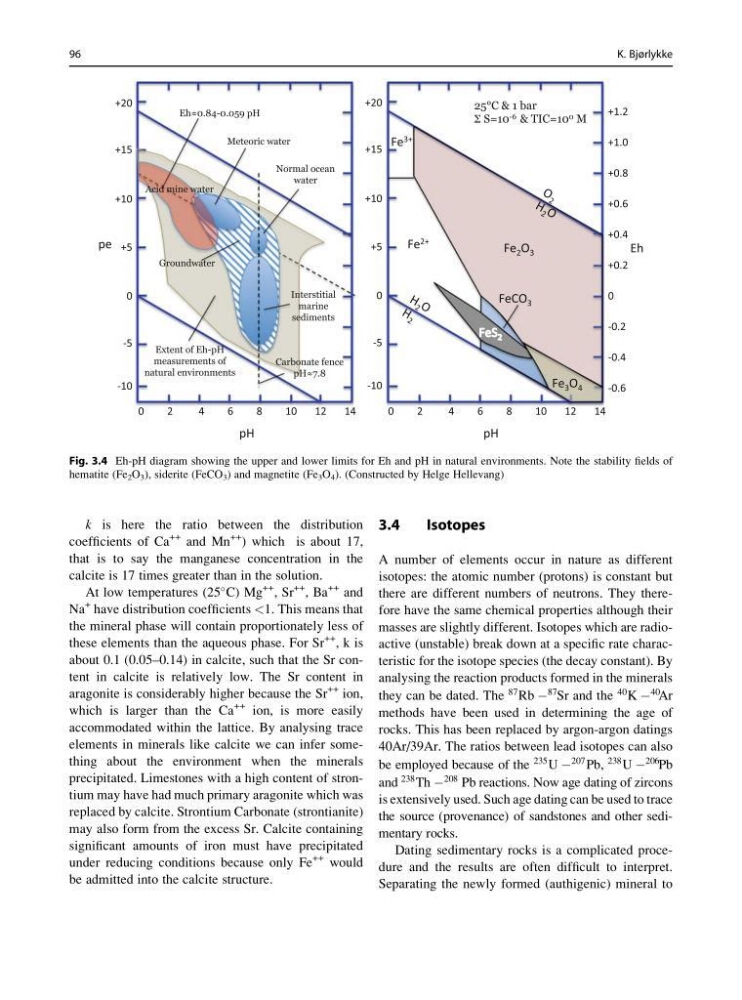
Fig. 3.4 Eh-pH diagram showing the upper and lower limits for Eh and pH in natural environments. Note the stability fields of
hematite (Fe 2 O 3 ), siderite (FeCO 3 ) and magnetite (Fe 3 O 4 ). (Constructed by Helge Hellevang)
96
K. Bjørlykke
coefficients of Ca
++ and Mn
++
) which is about 17,
that is to say the manganese concentration in the
calcite is 17 times greater than in the solution.
At low temperatures (25
C) Mg
++ , Sr
++ , Ba
++ and
Na
+ have distribution coefficients <1. This means that
the mineral phase will contain proportionately less of
these elements than the aqueous phase. For Sr
++
, k is
about 0.1 (0.05–0.14) in calcite, such that the Sr content in calcite is relatively low. The Sr content in
aragonite is considerably higher because the Sr
++ ion,
which is larger than the Ca
++ ion, is more easily
accommodated within the lattice. By analysing trace
elements in minerals like calcite we can infer something about the environment when the minerals
precipitated. Limestones with a high content of strontium may have had much primary aragonite which was
replaced by calcite. Strontium Carbonate (strontianite)
may also form from the excess Sr. Calcite containing
significant amounts of iron must have precipitated
under reducing conditions because only Fe
++ would
be admitted into the calcite structure.
3.4
Isotopes
A number of elements occur in nature as different
isotopes: the atomic number (protons) is constant but
there are different numbers of neutrons. They therefore have the same chemical properties although their
masses are slightly different. Isotopes which are radioactive (unstable) break down at a specific rate characteristic for the isotope species (the decay constant). By
analysing the reaction products formed in the minerals
they can be dated. The
87 Rb À
87
Sr and the
40 K À
40
Ar
methods have been used in determining the age of
rocks. This has been replaced by argon-argon datings
40Ar/39Ar. The ratios between lead isotopes can also
be employed because of the
235 U À
207 Pb,
238 U À
206
Pb
and
238 Th À
208 Pb reactions. Now age dating of zircons
is extensively used. Such age dating can be used to trace
the source (provenance) of sandstones and other sedimentary rocks.
Dating sedimentary rocks is a complicated procedure and the results are often difficult to interpret.
Separating the newly formed (authigenic) mineral to
Fig. 3.4 Eh-pH diagram showing the upper and lower limits for Eh and pH in natural environments. Note the stability fields of
hematite (Fe 2 O 3 ), siderite (FeCO 3 ) and magnetite (Fe 3 O 4 ). (Constructed by Helge Hellevang)
96
K. Bjørlykke