

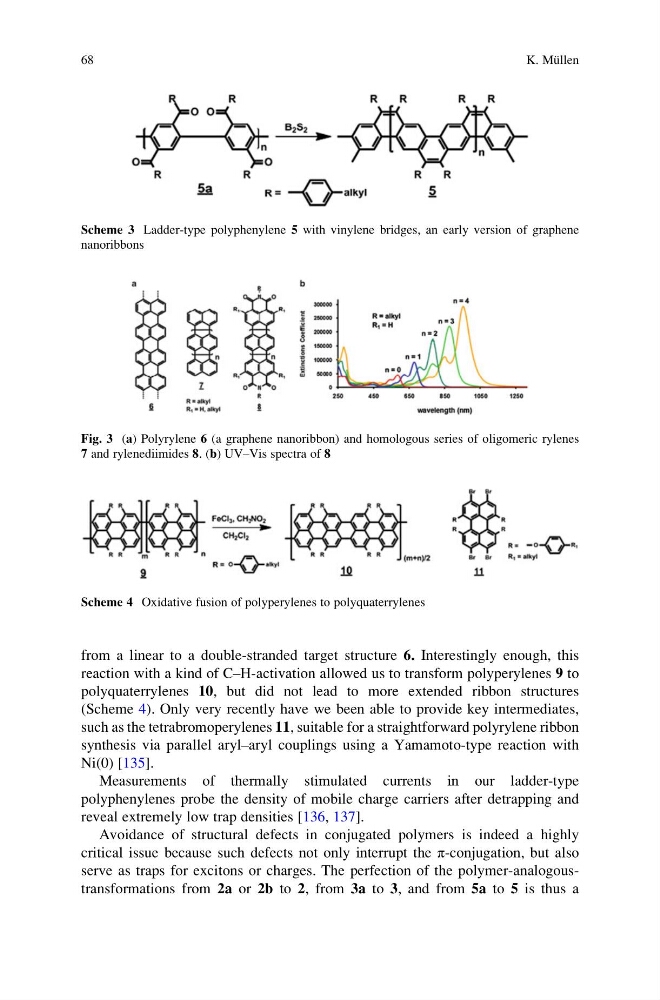
from a linear to a double-stranded target structure 6. Interestingly enough, this
reaction with a kind of C–H-activation allowed us to transform polyperylenes 9 to
polyquaterrylenes 10, but did not lead to more extended ribbon structures
(Scheme 4). Only very recently have we been able to provide key intermediates,
such as the tetrabromoperylenes 11, suitable for a straightforward polyrylene ribbon
synthesis via parallel aryl–aryl couplings using a Yamamoto-type reaction with
Ni(0) [135].
Measurements of thermally stimulated currents in our ladder-type
polyphenylenes probe the density of mobile charge carriers after detrapping and
reveal extremely low trap densities [136, 137].
Avoidance of structural defects in conjugated polymers is indeed a highly
critical issue because such defects not only interrupt the π-conjugation, but also
serve as traps for excitons or charges. The perfection of the polymer-analogoustransformations from 2a or 2b to 2, from 3a to 3, and from 5a to 5 is thus a
Scheme 3 Ladder-type polyphenylene 5 with vinylene bridges, an early version of graphene
nanoribbons
Fig. 3 (a) Polyrylene 6 (a graphene nanoribbon) and homologous series of oligomeric rylenes
7 and rylenediimides 8. (b) UV–Vis spectra of 8
Scheme 4 Oxidative fusion of polyperylenes to polyquaterrylenes
68
K. Mu ¨llen
reaction with a kind of C–H-activation allowed us to transform polyperylenes 9 to
polyquaterrylenes 10, but did not lead to more extended ribbon structures
(Scheme 4). Only very recently have we been able to provide key intermediates,
such as the tetrabromoperylenes 11, suitable for a straightforward polyrylene ribbon
synthesis via parallel aryl–aryl couplings using a Yamamoto-type reaction with
Ni(0) [135].
Measurements of thermally stimulated currents in our ladder-type
polyphenylenes probe the density of mobile charge carriers after detrapping and
reveal extremely low trap densities [136, 137].
Avoidance of structural defects in conjugated polymers is indeed a highly
critical issue because such defects not only interrupt the π-conjugation, but also
serve as traps for excitons or charges. The perfection of the polymer-analogoustransformations from 2a or 2b to 2, from 3a to 3, and from 5a to 5 is thus a
Scheme 3 Ladder-type polyphenylene 5 with vinylene bridges, an early version of graphene
nanoribbons
Fig. 3 (a) Polyrylene 6 (a graphene nanoribbon) and homologous series of oligomeric rylenes
7 and rylenediimides 8. (b) UV–Vis spectra of 8
Scheme 4 Oxidative fusion of polyperylenes to polyquaterrylenes
68
K. Mu ¨llen