

The synthesis of these ladder-type polyphenylenes 2 and 3, as first accomplished in
our group by Ullrich Scherf [120, 121], was realized via suitably functionalized
polyphenylene precursors 2a and 3a, which were then transformed into the target
ribbon via a polymer-analogous Friedel–Crafts cyclization [122, 123] (Scheme 2).
The poly(9,9-dialkylfluorene)s 4 use the same principle of alkyl substitution at a
methylene bridge [124]. They constitute step-ladder rather than ladder polymers
because only every second biphenyl inter-ring bond is free of torsion. Not surprisingly, the blue electroluminescence of the ladder polyphenylene [125, 126] appears
bathochromically shifted with respect to that of the polyfluorenes. To better adjust
the blue emission to the sensitivity of the human eye, we have made step-ladder
polymers in which not two, but rather three, four, or five benzene rings were
incorporated in the planarized ladder as in polymers 4a, 4b and 4c (Fig. 2). Andrew
Grimsdale and Josemon Jacob in our group developed the fine tuning of physical
properties to a high level of sophistication – from light emission [125–127] to single
molecule conductance [128].
A polymer-analogous ring closure similar to that of 2 and 3 afforded the ribbon
structure 5, which was composed only of benzenoid rings and, thus, constituted
a true graphene nanoribbon [129, 130] (Scheme 3). As in 2 and 3, a successful
two-step protocol was employed. It included the substituted polyphenylene 5a,
which was subjected to multiple formation of six-membered rings by reductively
coupling the carbonyl-containing substituents.
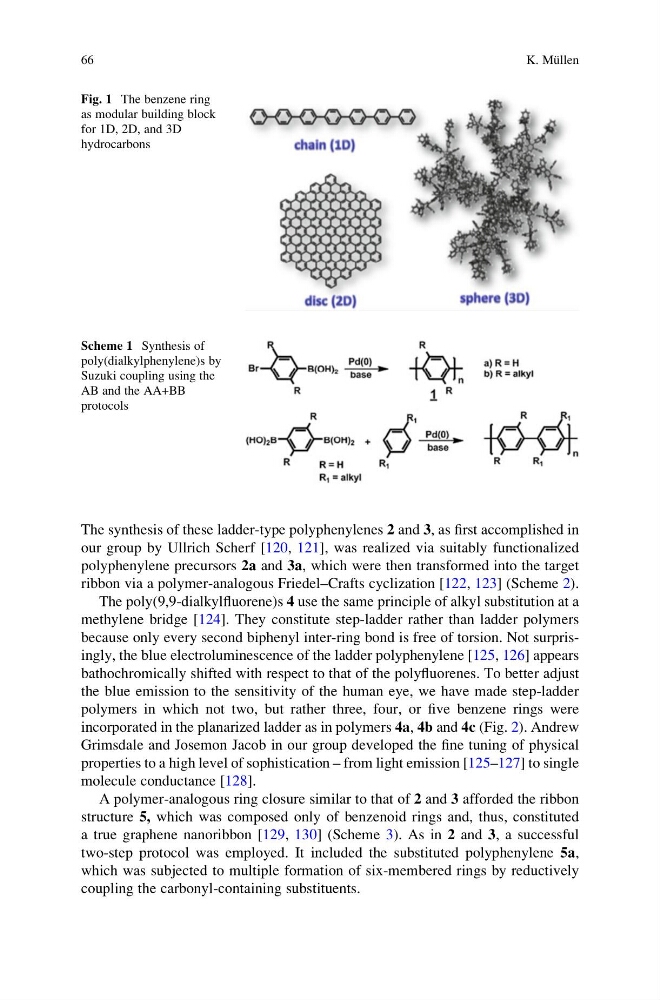
Fig. 1 The benzene ring
as modular building block
for 1D, 2D, and 3D
hydrocarbons
Scheme 1 Synthesis of
poly(dialkylphenylene)s by
Suzuki coupling using the
AB and the AA+BB
protocols
66
K. Mu ¨llen
our group by Ullrich Scherf [120, 121], was realized via suitably functionalized
polyphenylene precursors 2a and 3a, which were then transformed into the target
ribbon via a polymer-analogous Friedel–Crafts cyclization [122, 123] (Scheme 2).
The poly(9,9-dialkylfluorene)s 4 use the same principle of alkyl substitution at a
methylene bridge [124]. They constitute step-ladder rather than ladder polymers
because only every second biphenyl inter-ring bond is free of torsion. Not surprisingly, the blue electroluminescence of the ladder polyphenylene [125, 126] appears
bathochromically shifted with respect to that of the polyfluorenes. To better adjust
the blue emission to the sensitivity of the human eye, we have made step-ladder
polymers in which not two, but rather three, four, or five benzene rings were
incorporated in the planarized ladder as in polymers 4a, 4b and 4c (Fig. 2). Andrew
Grimsdale and Josemon Jacob in our group developed the fine tuning of physical
properties to a high level of sophistication – from light emission [125–127] to single
molecule conductance [128].
A polymer-analogous ring closure similar to that of 2 and 3 afforded the ribbon
structure 5, which was composed only of benzenoid rings and, thus, constituted
a true graphene nanoribbon [129, 130] (Scheme 3). As in 2 and 3, a successful
two-step protocol was employed. It included the substituted polyphenylene 5a,
which was subjected to multiple formation of six-membered rings by reductively
coupling the carbonyl-containing substituents.
Fig. 1 The benzene ring
as modular building block
for 1D, 2D, and 3D
hydrocarbons
Scheme 1 Synthesis of
poly(dialkylphenylene)s by
Suzuki coupling using the
AB and the AA+BB
protocols
66
K. Mu ¨llen