

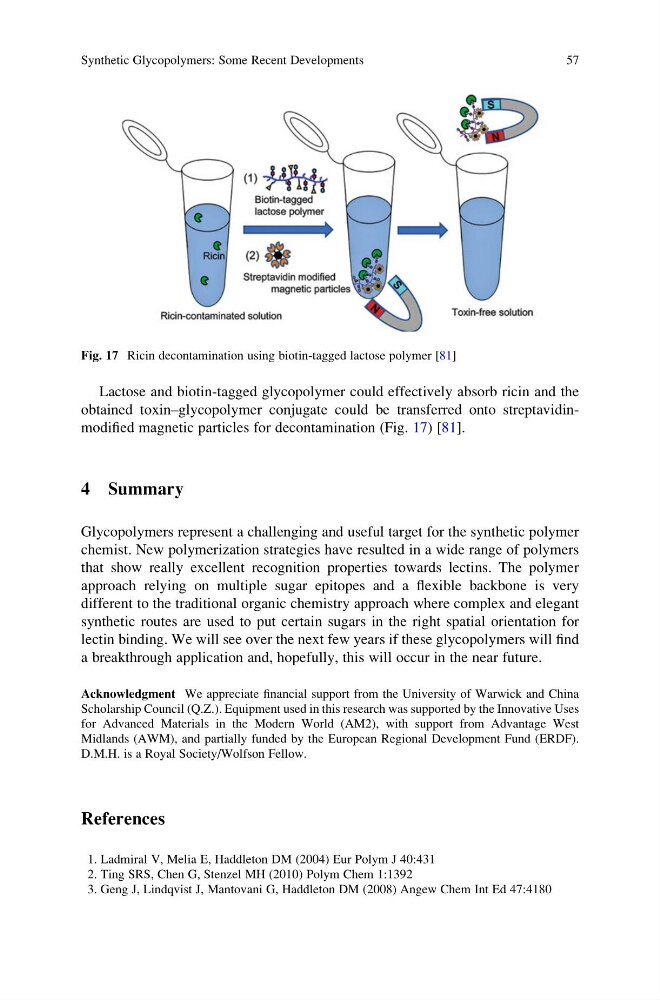
Lactose and biotin-tagged glycopolymer could effectively absorb ricin and the
obtained toxin–glycopolymer conjugate could be transferred onto streptavidinmodified magnetic particles for decontamination (Fig. 17) [81].
4 Summary
Glycopolymers represent a challenging and useful target for the synthetic polymer
chemist. New polymerization strategies have resulted in a wide range of polymers
that show really excellent recognition properties towards lectins. The polymer
approach relying on multiple sugar epitopes and a flexible backbone is very
different to the traditional organic chemistry approach where complex and elegant
synthetic routes are used to put certain sugars in the right spatial orientation for
lectin binding. We will see over the next few years if these glycopolymers will find
a breakthrough application and, hopefully, this will occur in the near future.
Acknowledgment We appreciate financial support from the University of Warwick and China
Scholarship Council (Q.Z.). Equipment used in this research was supported by the Innovative Uses
for Advanced Materials in the Modern World (AM2), with support from Advantage West
Midlands (AWM), and partially funded by the European Regional Development Fund (ERDF).
D.M.H. is a Royal Society/Wolfson Fellow.
References
1. Ladmiral V, Melia E, Haddleton DM (2004) Eur Polym J 40:431
2. Ting SRS, Chen G, Stenzel MH (2010) Polym Chem 1:1392
3. Geng J, Lindqvist J, Mantovani G, Haddleton DM (2008) Angew Chem Int Ed 47:4180
Fig. 17 Ricin decontamination using biotin-tagged lactose polymer [81]
Synthetic Glycopolymers: Some Recent Developments
57
obtained toxin–glycopolymer conjugate could be transferred onto streptavidinmodified magnetic particles for decontamination (Fig. 17) [81].
4 Summary
Glycopolymers represent a challenging and useful target for the synthetic polymer
chemist. New polymerization strategies have resulted in a wide range of polymers
that show really excellent recognition properties towards lectins. The polymer
approach relying on multiple sugar epitopes and a flexible backbone is very
different to the traditional organic chemistry approach where complex and elegant
synthetic routes are used to put certain sugars in the right spatial orientation for
lectin binding. We will see over the next few years if these glycopolymers will find
a breakthrough application and, hopefully, this will occur in the near future.
Acknowledgment We appreciate financial support from the University of Warwick and China
Scholarship Council (Q.Z.). Equipment used in this research was supported by the Innovative Uses
for Advanced Materials in the Modern World (AM2), with support from Advantage West
Midlands (AWM), and partially funded by the European Regional Development Fund (ERDF).
D.M.H. is a Royal Society/Wolfson Fellow.
References
1. Ladmiral V, Melia E, Haddleton DM (2004) Eur Polym J 40:431
2. Ting SRS, Chen G, Stenzel MH (2010) Polym Chem 1:1392
3. Geng J, Lindqvist J, Mantovani G, Haddleton DM (2008) Angew Chem Int Ed 47:4180
Fig. 17 Ricin decontamination using biotin-tagged lactose polymer [81]
Synthetic Glycopolymers: Some Recent Developments
57