

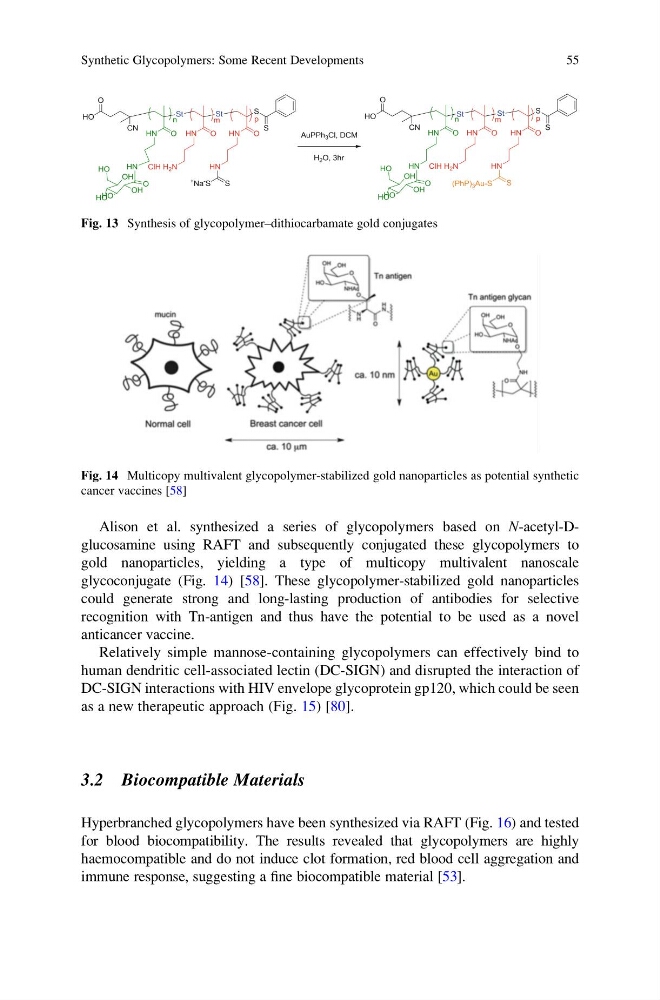
Alison et al. synthesized a series of glycopolymers based on N-acetyl-Dglucosamine using RAFT and subsequently conjugated these glycopolymers to
gold nanoparticles, yielding a type of multicopy multivalent nanoscale
glycoconjugate (Fig. 14) [58]. These glycopolymer-stabilized gold nanoparticles
could generate strong and long-lasting production of antibodies for selective
recognition with Tn-antigen and thus have the potential to be used as a novel
anticancer vaccine.
Relatively simple mannose-containing glycopolymers can effectively bind to
human dendritic cell-associated lectin (DC-SIGN) and disrupted the interaction of
DC-SIGN interactions with HIV envelope glycoprotein gp120, which could be seen
as a new therapeutic approach (Fig. 15) [80].
3.2 Biocompatible Materials
Hyperbranched glycopolymers have been synthesized via RAFT (Fig. 16) and tested
for blood biocompatibility. The results revealed that glycopolymers are highly
haemocompatible and do not induce clot formation, red blood cell aggregation and
immune response, suggesting a fine biocompatible material [53].
Fig. 13 Synthesis of glycopolymer–dithiocarbamate gold conjugates
Fig. 14 Multicopy multivalent glycopolymer-stabilized gold nanoparticles as potential synthetic
cancer vaccines [58]
Synthetic Glycopolymers: Some Recent Developments
55
gold nanoparticles, yielding a type of multicopy multivalent nanoscale
glycoconjugate (Fig. 14) [58]. These glycopolymer-stabilized gold nanoparticles
could generate strong and long-lasting production of antibodies for selective
recognition with Tn-antigen and thus have the potential to be used as a novel
anticancer vaccine.
Relatively simple mannose-containing glycopolymers can effectively bind to
human dendritic cell-associated lectin (DC-SIGN) and disrupted the interaction of
DC-SIGN interactions with HIV envelope glycoprotein gp120, which could be seen
as a new therapeutic approach (Fig. 15) [80].
3.2 Biocompatible Materials
Hyperbranched glycopolymers have been synthesized via RAFT (Fig. 16) and tested
for blood biocompatibility. The results revealed that glycopolymers are highly
haemocompatible and do not induce clot formation, red blood cell aggregation and
immune response, suggesting a fine biocompatible material [53].
Fig. 13 Synthesis of glycopolymer–dithiocarbamate gold conjugates
Fig. 14 Multicopy multivalent glycopolymer-stabilized gold nanoparticles as potential synthetic
cancer vaccines [58]
Synthetic Glycopolymers: Some Recent Developments
55