

in PP increased from 121 nm at 0.25 wt% to 163 nm at 2.0 wt%. Neither the shape nor
the uniform distribution was affected. In contrast to blends with SAN, the more polar
n-butyl-substituted nanoPIL afforded very poor dispersion of much larger droplets in
nonpolar PP. Obviously, the facile polarity matching obtained by varying the n-alkyl
length of the outer shell enables adjustments of the compatibility. As nanometer-sized
compartments in polymers, PIL nanodroplets host a large variety of organic and
inorganic (nano)materials. For example, compatibilized PEHO-C18ImTos enables
the uniform dispersion of hydrophilic dye E133 in PP, whereas the corresponding low
molecular weight IL is ineffective [68].
4 Graphene/PIL Hybrids
As a single carbon layer of the graphite lattice, graphene is a two-dimensional
carbon macromolecule. It exhibits high electrical and thermal conductivity,
ultrahigh stiffness and strength, and barrier resistance [70–72]. Specific interactions
between imidazolium groups and the polycyclic aromatic carbon layers were
proposed to account for improved adhesion of IL to graphene or CNTs, respectively
[57, 73]. Hence, this is expected to improve dispersion of graphene in ILs and also
in the presence of PILs [74, 75]. As reported above, the PIL addition enables the
phase transfer and efficient dispersion of graphene [55, 68] and of CNTs [54]. Most
likely, PIL assembles at the graphene interface. Blending graphene with PILs such
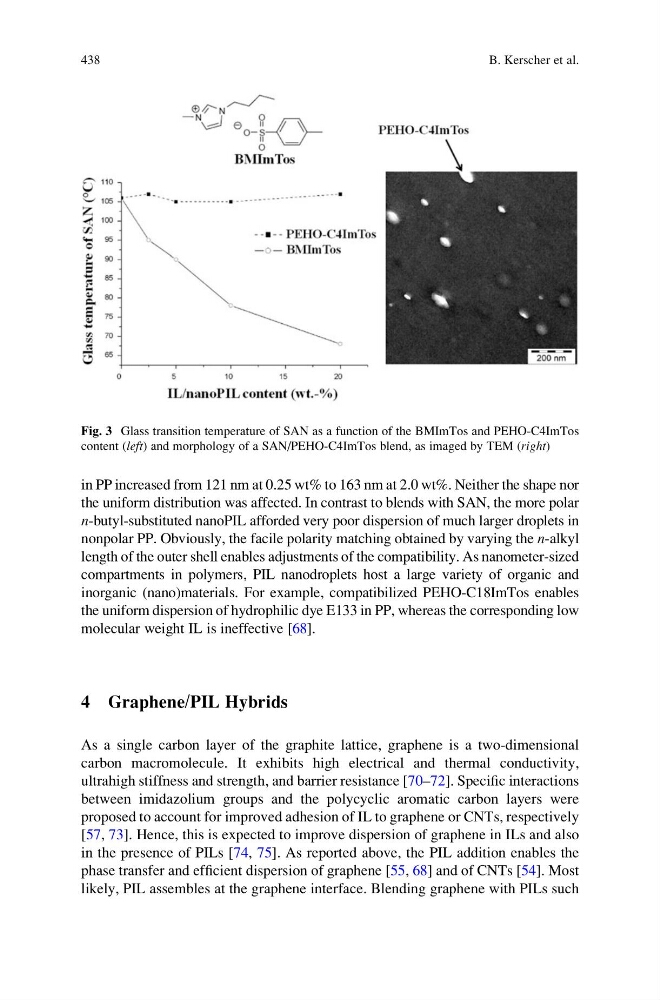
Fig. 3 Glass transition temperature of SAN as a function of the BMImTos and PEHO-C4ImTos
content (left) and morphology of a SAN/PEHO-C4ImTos blend, as imaged by TEM (right)
438
B. Kerscher et al.
the uniform distribution was affected. In contrast to blends with SAN, the more polar
n-butyl-substituted nanoPIL afforded very poor dispersion of much larger droplets in
nonpolar PP. Obviously, the facile polarity matching obtained by varying the n-alkyl
length of the outer shell enables adjustments of the compatibility. As nanometer-sized
compartments in polymers, PIL nanodroplets host a large variety of organic and
inorganic (nano)materials. For example, compatibilized PEHO-C18ImTos enables
the uniform dispersion of hydrophilic dye E133 in PP, whereas the corresponding low
molecular weight IL is ineffective [68].
4 Graphene/PIL Hybrids
As a single carbon layer of the graphite lattice, graphene is a two-dimensional
carbon macromolecule. It exhibits high electrical and thermal conductivity,
ultrahigh stiffness and strength, and barrier resistance [70–72]. Specific interactions
between imidazolium groups and the polycyclic aromatic carbon layers were
proposed to account for improved adhesion of IL to graphene or CNTs, respectively
[57, 73]. Hence, this is expected to improve dispersion of graphene in ILs and also
in the presence of PILs [74, 75]. As reported above, the PIL addition enables the
phase transfer and efficient dispersion of graphene [55, 68] and of CNTs [54]. Most
likely, PIL assembles at the graphene interface. Blending graphene with PILs such
Fig. 3 Glass transition temperature of SAN as a function of the BMImTos and PEHO-C4ImTos
content (left) and morphology of a SAN/PEHO-C4ImTos blend, as imaged by TEM (right)
438
B. Kerscher et al.