

N-alkylated with long-chain alkyl halides, and rendered amphiphilic by subsequent
quaternization with methyl iodide. They employed their hyperbranched nanoPIL
amphiphiles as antimicrobial agents, embedded in restorative dental composites
[61, 62]. Dispersed in NBR rubber, PILs derived from hyperbranched PEI enabled
self-healing [63]. Following a similar ionene synthetic route, Fradet and coworkers
obtained hyperbranched nanoPILs by poly(N-alkylation) of lutidine derivatives [64].
Mimicking micelles and vesicles, new generations of nanoPILs incorporate IL
moieties in the periphery of nonionic hyperbranched polyether cores with low glass
transition temperature. One of the first examples was reported by Mecking and
coworkers, who used such hyperbranched PILs as catalyst supports. They employed
anionic ring-opening polymerization of glycidol to prepare liquid polyglycidol
polyols. In the subsequent step, the hyperbranched polyols were reacted with
ω-acylbromides in 1,2-dimethylimidazole or pyridine, thus forming a shell of
covalently attached imidazolium or pyridinium groups, respectively [65, 66].
Similar core–shell-type nanoPILs containing imidazolium endgroups, obtained
by tosylation of polyglycidol and substitution of the tosylate groups by
1-methylimidazole, were tailored as solvents with lower critical solution
temperature, thus enabling liquid–liquid and liquid–solid phase transition in
organic separation media [67].
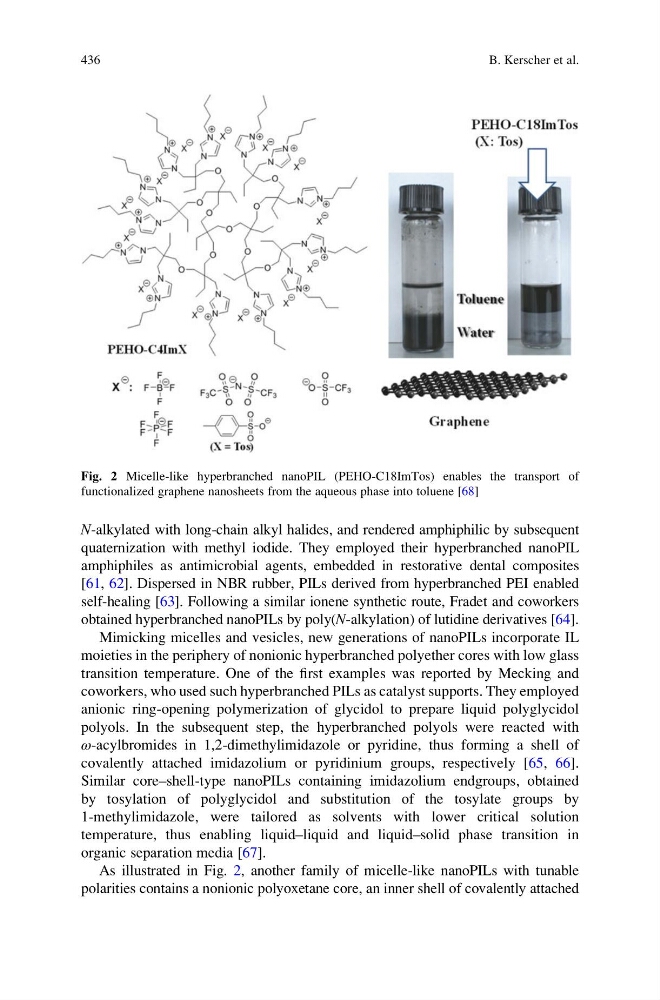
As illustrated in Fig. 2, another family of micelle-like nanoPILs with tunable
polarities contains a nonionic polyoxetane core, an inner shell of covalently attached
Fig. 2 Micelle-like hyperbranched nanoPIL (PEHO-C18ImTos) enables the transport of
functionalized graphene nanosheets from the aqueous phase into toluene [68]
436
B. Kerscher et al.
quaternization with methyl iodide. They employed their hyperbranched nanoPIL
amphiphiles as antimicrobial agents, embedded in restorative dental composites
[61, 62]. Dispersed in NBR rubber, PILs derived from hyperbranched PEI enabled
self-healing [63]. Following a similar ionene synthetic route, Fradet and coworkers
obtained hyperbranched nanoPILs by poly(N-alkylation) of lutidine derivatives [64].
Mimicking micelles and vesicles, new generations of nanoPILs incorporate IL
moieties in the periphery of nonionic hyperbranched polyether cores with low glass
transition temperature. One of the first examples was reported by Mecking and
coworkers, who used such hyperbranched PILs as catalyst supports. They employed
anionic ring-opening polymerization of glycidol to prepare liquid polyglycidol
polyols. In the subsequent step, the hyperbranched polyols were reacted with
ω-acylbromides in 1,2-dimethylimidazole or pyridine, thus forming a shell of
covalently attached imidazolium or pyridinium groups, respectively [65, 66].
Similar core–shell-type nanoPILs containing imidazolium endgroups, obtained
by tosylation of polyglycidol and substitution of the tosylate groups by
1-methylimidazole, were tailored as solvents with lower critical solution
temperature, thus enabling liquid–liquid and liquid–solid phase transition in
organic separation media [67].
As illustrated in Fig. 2, another family of micelle-like nanoPILs with tunable
polarities contains a nonionic polyoxetane core, an inner shell of covalently attached
Fig. 2 Micelle-like hyperbranched nanoPIL (PEHO-C18ImTos) enables the transport of
functionalized graphene nanosheets from the aqueous phase into toluene [68]
436
B. Kerscher et al.