

cells, and electroactive actuators [39]. Although (nano)phase separation is highly
likely to occur, many of the resulting polyelectrolyte gels are rather ill-defined.
Much better control of nanostructure formation is achieved when well-defined
nanostructured block copolymers are blended together with ILs. For example,
as reported by Park and coworkers, upon adding IL to polystyrene-blockpolyethyleneoxide (PS-b-PEO) with lamellar nanostructure, the IL accumulates
exclusively in the PEO nanophase. As a consequence, the lithium ion conductivity
is markedly improved [40]. In an elegant approach, Lodge and coworkers exploited
nanostructure formation of IL/block copolymer blends to render micellar polymerbased ILs smart and thermoresponsive. In their micellar shuttle system, 1-butyl-3methylimidazolium hexafluorophosphate, [BMIm][PF6], is blended together with
amphiphilic diblock copolymers such as poly(1,2-butadiene)-block-poly(ethylene
oxide), abbreviated as PB-b-PEO. As verified by cryo-TEM and light scattering, the
PB-b-PEO self-assembly in IL produced spherical, worm-like, and bilayered
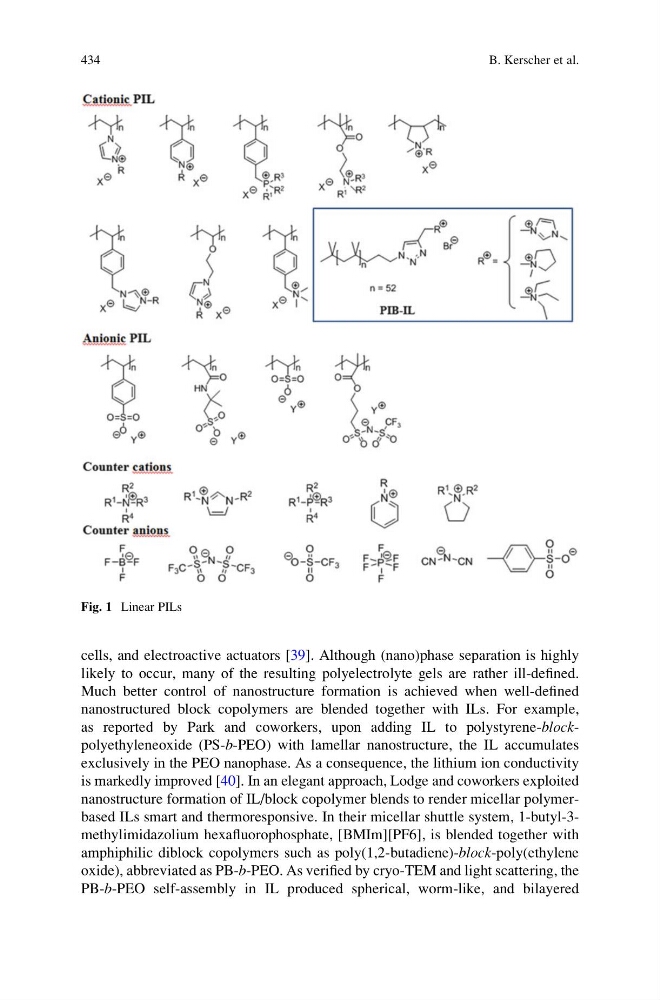
Fig. 1 Linear PILs
434
B. Kerscher et al.
likely to occur, many of the resulting polyelectrolyte gels are rather ill-defined.
Much better control of nanostructure formation is achieved when well-defined
nanostructured block copolymers are blended together with ILs. For example,
as reported by Park and coworkers, upon adding IL to polystyrene-blockpolyethyleneoxide (PS-b-PEO) with lamellar nanostructure, the IL accumulates
exclusively in the PEO nanophase. As a consequence, the lithium ion conductivity
is markedly improved [40]. In an elegant approach, Lodge and coworkers exploited
nanostructure formation of IL/block copolymer blends to render micellar polymerbased ILs smart and thermoresponsive. In their micellar shuttle system, 1-butyl-3methylimidazolium hexafluorophosphate, [BMIm][PF6], is blended together with
amphiphilic diblock copolymers such as poly(1,2-butadiene)-block-poly(ethylene
oxide), abbreviated as PB-b-PEO. As verified by cryo-TEM and light scattering, the
PB-b-PEO self-assembly in IL produced spherical, worm-like, and bilayered
Fig. 1 Linear PILs
434
B. Kerscher et al.