

[88]. They also could not be reduced in size by liposome-type extrusion techniques,
and could only be made smaller by more aggressive sonication methods. The
inability of the uncharged vesicles to pass through small pore diameter filters was
probably due to membrane rigidity and virtual absence of chain flexibility. One
advantage of these materials for many applications is the media-insensitivity of the
ethylene glycol coating on the membrane surface. These vesicles were inert towards
different ionic media, variations in pH, and the presence of large macromolecules
such as proteins in serum. However, the rigidity of these chains created drawbacks
in sample processing, namely the need to use denaturants for vesicle formation,
which may be problematic for encapsulation of sensitive materials, and difficulty in
preparing nanoscale vesicles due to high membrane rigidity.
In 2005, Lecommandoux’s group reported on the self-assembly behavior of a
short, zwitterionic diblock copolypeptide, poly(L-glutamatic acid)-b-poly(L-lysine),
E 15 K 15 [89]. This polymer has the interesting characteristic that in aqueous solutions near neutral pH (5 < pH < 9), both segments are charged and the polypeptide is dispersed as soluble chains. However, if pH is lowered to values below pH 4
or raised above pH 10, one of the segments is neutralized and the chains selfassemble into small vesicles. By adjustment of pH, vesicles with either anionic
(high pH) or cationic (low pH) surfaces could be prepared; hence their description
as “schizophrenic” vesicles. It is notable that these chains are soluble in water when
both segments are highly charged, considering that the formation of water-insoluble
polyion complexes between poly(L-lysine) and poly(L-glutamatic acid) is well
documented [90]. A key feature of this work is the utilization of short polyelectrolyte segments, which limits such polyion complex formation in dilute solutions.
Deming’s group also reported in 2005 on the assembly of charged diblock
copolypeptide amphiphiles, utilizing the structure-directing properties of rod-like
N
H
O
N
H
O
H
N
H
R'
R"
R'
y
x
K P
x L y =
R" = -CH 2 CH(CH 3 ) 2
R' = -(CH 2 ) 4 NHC(O)CH 2 (OCH 2 CH 2 ) 2 OCH 3
=
=
H 2 O
H 2 O
a
b
c
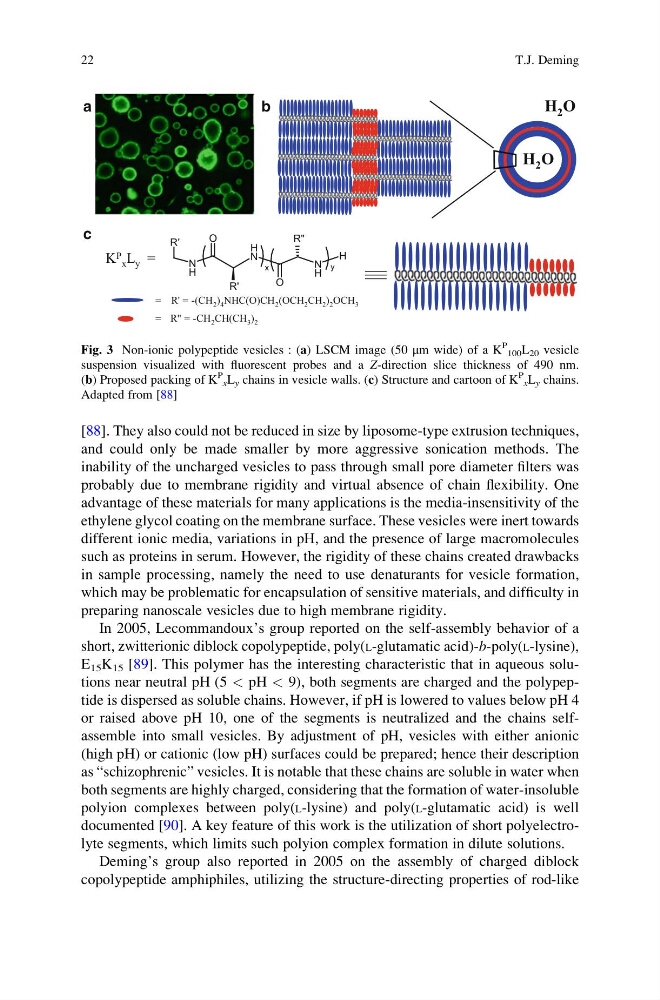
Fig. 3 Non-ionic polypeptide vesicles : (a) LSCM image (50 μm wide) of a K
P
100 L 20 vesicle
suspension visualized with fluorescent probes and a Z-direction slice thickness of 490 nm.
(b) Proposed packing of K
P
x L y chains in vesicle walls. (c) Structure and cartoon of K
P
x L y chains.
Adapted from [88]
22
T.J. Deming
and could only be made smaller by more aggressive sonication methods. The
inability of the uncharged vesicles to pass through small pore diameter filters was
probably due to membrane rigidity and virtual absence of chain flexibility. One
advantage of these materials for many applications is the media-insensitivity of the
ethylene glycol coating on the membrane surface. These vesicles were inert towards
different ionic media, variations in pH, and the presence of large macromolecules
such as proteins in serum. However, the rigidity of these chains created drawbacks
in sample processing, namely the need to use denaturants for vesicle formation,
which may be problematic for encapsulation of sensitive materials, and difficulty in
preparing nanoscale vesicles due to high membrane rigidity.
In 2005, Lecommandoux’s group reported on the self-assembly behavior of a
short, zwitterionic diblock copolypeptide, poly(L-glutamatic acid)-b-poly(L-lysine),
E 15 K 15 [89]. This polymer has the interesting characteristic that in aqueous solutions near neutral pH (5 < pH < 9), both segments are charged and the polypeptide is dispersed as soluble chains. However, if pH is lowered to values below pH 4
or raised above pH 10, one of the segments is neutralized and the chains selfassemble into small vesicles. By adjustment of pH, vesicles with either anionic
(high pH) or cationic (low pH) surfaces could be prepared; hence their description
as “schizophrenic” vesicles. It is notable that these chains are soluble in water when
both segments are highly charged, considering that the formation of water-insoluble
polyion complexes between poly(L-lysine) and poly(L-glutamatic acid) is well
documented [90]. A key feature of this work is the utilization of short polyelectrolyte segments, which limits such polyion complex formation in dilute solutions.
Deming’s group also reported in 2005 on the assembly of charged diblock
copolypeptide amphiphiles, utilizing the structure-directing properties of rod-like
N
H
O
N
H
O
H
N
H
R'
R"
R'
y
x
K P
x L y =
R" = -CH 2 CH(CH 3 ) 2
R' = -(CH 2 ) 4 NHC(O)CH 2 (OCH 2 CH 2 ) 2 OCH 3
=
=
H 2 O
H 2 O
a
b
c
Fig. 3 Non-ionic polypeptide vesicles : (a) LSCM image (50 μm wide) of a K
P
100 L 20 vesicle
suspension visualized with fluorescent probes and a Z-direction slice thickness of 490 nm.
(b) Proposed packing of K
P
x L y chains in vesicle walls. (c) Structure and cartoon of K
P
x L y chains.
Adapted from [88]
22
T.J. Deming