

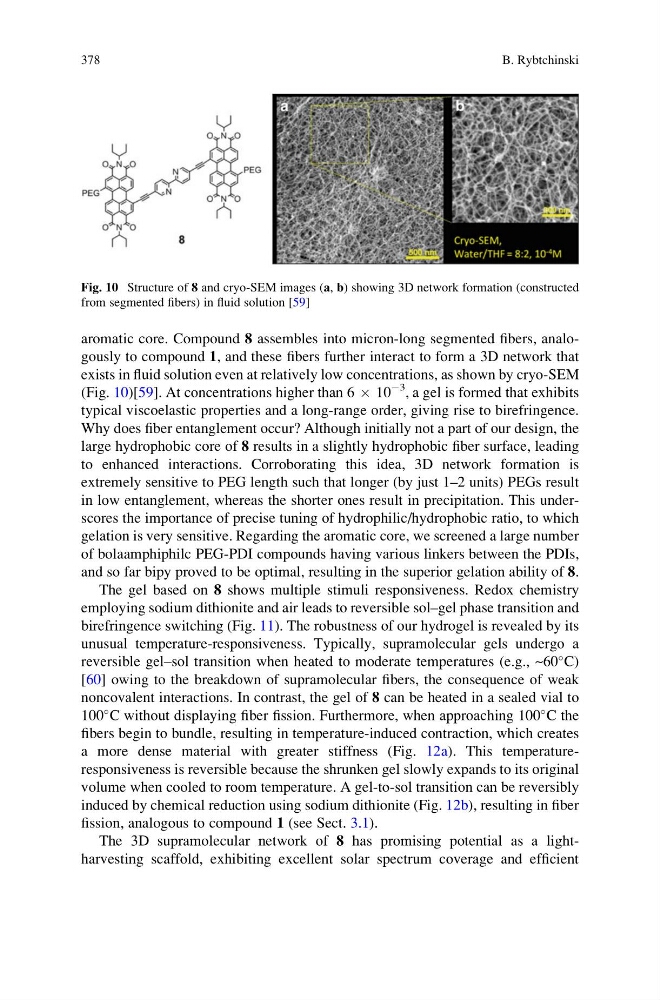
aromatic core. Compound 8 assembles into micron-long segmented fibers, analogously to compound 1, and these fibers further interact to form a 3D network that
exists in fluid solution even at relatively low concentrations, as shown by cryo-SEM
(Fig. 10)[59]. At concentrations higher than 6 Â 10
À3 , a gel is formed that exhibits
typical viscoelastic properties and a long-range order, giving rise to birefringence.
Why does fiber entanglement occur? Although initially not a part of our design, the
large hydrophobic core of 8 results in a slightly hydrophobic fiber surface, leading
to enhanced interactions. Corroborating this idea, 3D network formation is
extremely sensitive to PEG length such that longer (by just 1–2 units) PEGs result
in low entanglement, whereas the shorter ones result in precipitation. This underscores the importance of precise tuning of hydrophilic/hydrophobic ratio, to which
gelation is very sensitive. Regarding the aromatic core, we screened a large number
of bolaamphiphilc PEG-PDI compounds having various linkers between the PDIs,
and so far bipy proved to be optimal, resulting in the superior gelation ability of 8.
The gel based on 8 shows multiple stimuli responsiveness. Redox chemistry
employing sodium dithionite and air leads to reversible sol–gel phase transition and
birefringence switching (Fig. 11). The robustness of our hydrogel is revealed by its
unusual temperature-responsiveness. Typically, supramolecular gels undergo a
reversible gel–sol transition when heated to moderate temperatures (e.g., ~60
C)
[60] owing to the breakdown of supramolecular fibers, the consequence of weak
noncovalent interactions. In contrast, the gel of 8 can be heated in a sealed vial to
100
C without displaying fiber fission. Furthermore, when approaching 100
C the
fibers begin to bundle, resulting in temperature-induced contraction, which creates
a more dense material with greater stiffness (Fig. 12a). This temperatureresponsiveness is reversible because the shrunken gel slowly expands to its original
volume when cooled to room temperature. A gel-to-sol transition can be reversibly
induced by chemical reduction using sodium dithionite (Fig. 12b), resulting in fiber
fission, analogous to compound 1 (see Sect. 3.1).
The 3D supramolecular network of 8 has promising potential as a lightharvesting scaffold, exhibiting excellent solar spectrum coverage and efficient
Fig. 10 Structure of 8 and cryo-SEM images (a, b) showing 3D network formation (constructed
from segmented fibers) in fluid solution [59]
378
B. Rybtchinski
exists in fluid solution even at relatively low concentrations, as shown by cryo-SEM
(Fig. 10)[59]. At concentrations higher than 6 Â 10
À3 , a gel is formed that exhibits
typical viscoelastic properties and a long-range order, giving rise to birefringence.
Why does fiber entanglement occur? Although initially not a part of our design, the
large hydrophobic core of 8 results in a slightly hydrophobic fiber surface, leading
to enhanced interactions. Corroborating this idea, 3D network formation is
extremely sensitive to PEG length such that longer (by just 1–2 units) PEGs result
in low entanglement, whereas the shorter ones result in precipitation. This underscores the importance of precise tuning of hydrophilic/hydrophobic ratio, to which
gelation is very sensitive. Regarding the aromatic core, we screened a large number
of bolaamphiphilc PEG-PDI compounds having various linkers between the PDIs,
and so far bipy proved to be optimal, resulting in the superior gelation ability of 8.
The gel based on 8 shows multiple stimuli responsiveness. Redox chemistry
employing sodium dithionite and air leads to reversible sol–gel phase transition and
birefringence switching (Fig. 11). The robustness of our hydrogel is revealed by its
unusual temperature-responsiveness. Typically, supramolecular gels undergo a
reversible gel–sol transition when heated to moderate temperatures (e.g., ~60
C)
[60] owing to the breakdown of supramolecular fibers, the consequence of weak
noncovalent interactions. In contrast, the gel of 8 can be heated in a sealed vial to
100
C without displaying fiber fission. Furthermore, when approaching 100
C the
fibers begin to bundle, resulting in temperature-induced contraction, which creates
a more dense material with greater stiffness (Fig. 12a). This temperatureresponsiveness is reversible because the shrunken gel slowly expands to its original
volume when cooled to room temperature. A gel-to-sol transition can be reversibly
induced by chemical reduction using sodium dithionite (Fig. 12b), resulting in fiber
fission, analogous to compound 1 (see Sect. 3.1).
The 3D supramolecular network of 8 has promising potential as a lightharvesting scaffold, exhibiting excellent solar spectrum coverage and efficient
Fig. 10 Structure of 8 and cryo-SEM images (a, b) showing 3D network formation (constructed
from segmented fibers) in fluid solution [59]
378
B. Rybtchinski