

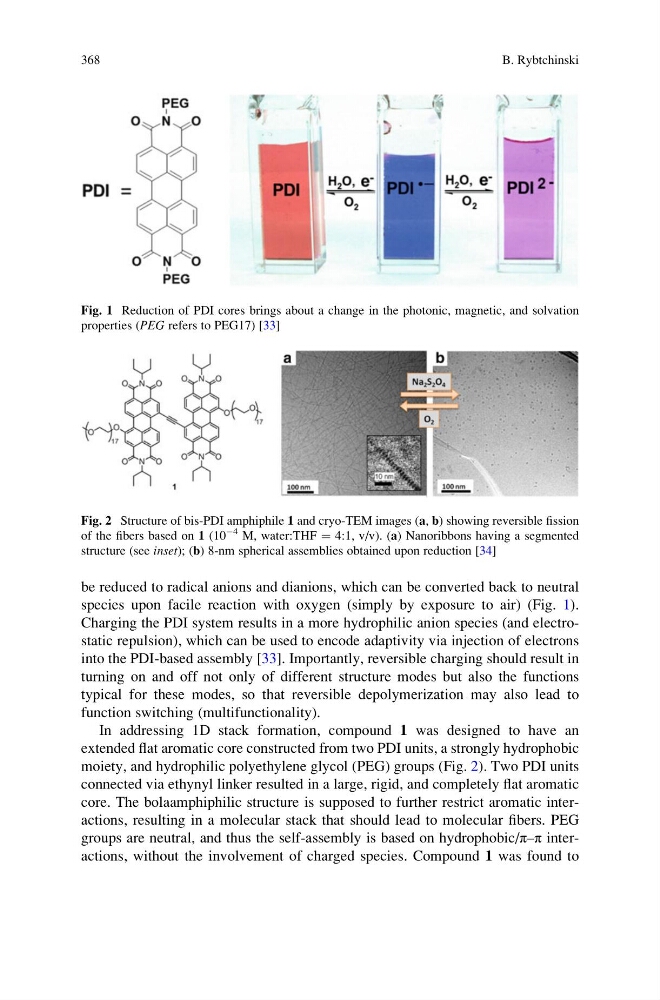
be reduced to radical anions and dianions, which can be converted back to neutral
species upon facile reaction with oxygen (simply by exposure to air) (Fig. 1).
Charging the PDI system results in a more hydrophilic anion species (and electrostatic repulsion), which can be used to encode adaptivity via injection of electrons
into the PDI-based assembly [33]. Importantly, reversible charging should result in
turning on and off not only of different structure modes but also the functions
typical for these modes, so that reversible depolymerization may also lead to
function switching (multifunctionality).
In addressing 1D stack formation, compound 1 was designed to have an
extended flat aromatic core constructed from two PDI units, a strongly hydrophobic
moiety, and hydrophilic polyethylene glycol (PEG) groups (Fig. 2). Two PDI units
connected via ethynyl linker resulted in a large, rigid, and completely flat aromatic
core. The bolaamphiphilic structure is supposed to further restrict aromatic interactions, resulting in a molecular stack that should lead to molecular fibers. PEG
groups are neutral, and thus the self-assembly is based on hydrophobic/π–π interactions, without the involvement of charged species. Compound 1 was found to
Fig. 1 Reduction of PDI cores brings about a change in the photonic, magnetic, and solvation
properties (PEG refers to PEG17) [33]
Fig. 2 Structure of bis-PDI amphiphile 1 and cryo-TEM images (a, b) showing reversible fission
of the fibers based on 1 (10
À4 M, water:THF ¼ 4:1, v/v). (a) Nanoribbons having a segmented
structure (see inset); (b) 8-nm spherical assemblies obtained upon reduction [34]
368
B. Rybtchinski
species upon facile reaction with oxygen (simply by exposure to air) (Fig. 1).
Charging the PDI system results in a more hydrophilic anion species (and electrostatic repulsion), which can be used to encode adaptivity via injection of electrons
into the PDI-based assembly [33]. Importantly, reversible charging should result in
turning on and off not only of different structure modes but also the functions
typical for these modes, so that reversible depolymerization may also lead to
function switching (multifunctionality).
In addressing 1D stack formation, compound 1 was designed to have an
extended flat aromatic core constructed from two PDI units, a strongly hydrophobic
moiety, and hydrophilic polyethylene glycol (PEG) groups (Fig. 2). Two PDI units
connected via ethynyl linker resulted in a large, rigid, and completely flat aromatic
core. The bolaamphiphilic structure is supposed to further restrict aromatic interactions, resulting in a molecular stack that should lead to molecular fibers. PEG
groups are neutral, and thus the self-assembly is based on hydrophobic/π–π interactions, without the involvement of charged species. Compound 1 was found to
Fig. 1 Reduction of PDI cores brings about a change in the photonic, magnetic, and solvation
properties (PEG refers to PEG17) [33]
Fig. 2 Structure of bis-PDI amphiphile 1 and cryo-TEM images (a, b) showing reversible fission
of the fibers based on 1 (10
À4 M, water:THF ¼ 4:1, v/v). (a) Nanoribbons having a segmented
structure (see inset); (b) 8-nm spherical assemblies obtained upon reduction [34]
368
B. Rybtchinski