

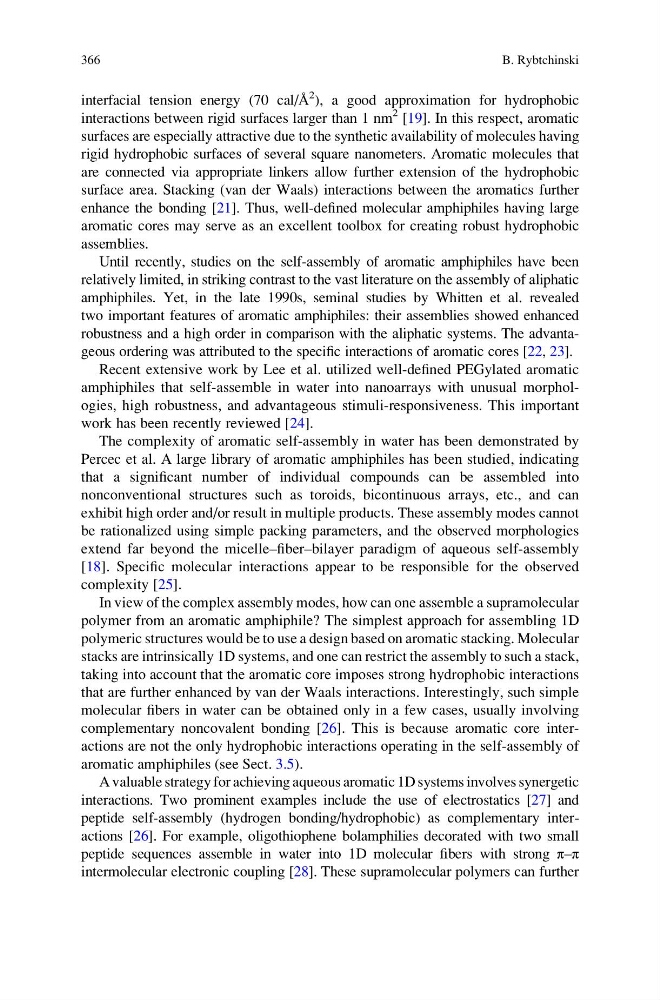
interfacial tension energy (70 cal/Å
2
), a good approximation for hydrophobic
interactions between rigid surfaces larger than 1 nm
2 [19]. In this respect, aromatic
surfaces are especially attractive due to the synthetic availability of molecules having
rigid hydrophobic surfaces of several square nanometers. Aromatic molecules that
are connected via appropriate linkers allow further extension of the hydrophobic
surface area. Stacking (van der Waals) interactions between the aromatics further
enhance the bonding [21]. Thus, well-defined molecular amphiphiles having large
aromatic cores may serve as an excellent toolbox for creating robust hydrophobic
assemblies.
Until recently, studies on the self-assembly of aromatic amphiphiles have been
relatively limited, in striking contrast to the vast literature on the assembly of aliphatic
amphiphiles. Yet, in the late 1990s, seminal studies by Whitten et al. revealed
two important features of aromatic amphiphiles: their assemblies showed enhanced
robustness and a high order in comparison with the aliphatic systems. The advantageous ordering was attributed to the specific interactions of aromatic cores [22, 23].
Recent extensive work by Lee et al. utilized well-defined PEGylated aromatic
amphiphiles that self-assemble in water into nanoarrays with unusual morphologies, high robustness, and advantageous stimuli-responsiveness. This important
work has been recently reviewed [24].
The complexity of aromatic self-assembly in water has been demonstrated by
Percec et al. A large library of aromatic amphiphiles has been studied, indicating
that a significant number of individual compounds can be assembled into
nonconventional structures such as toroids, bicontinuous arrays, etc., and can
exhibit high order and/or result in multiple products. These assembly modes cannot
be rationalized using simple packing parameters, and the observed morphologies
extend far beyond the micelle–fiber–bilayer paradigm of aqueous self-assembly
[18]. Specific molecular interactions appear to be responsible for the observed
complexity [25].
In view of the complex assembly modes, how can one assemble a supramolecular
polymer from an aromatic amphiphile? The simplest approach for assembling 1D
polymeric structures would be to use a design based on aromatic stacking. Molecular
stacks are intrinsically 1D systems, and one can restrict the assembly to such a stack,
taking into account that the aromatic core imposes strong hydrophobic interactions
that are further enhanced by van der Waals interactions. Interestingly, such simple
molecular fibers in water can be obtained only in a few cases, usually involving
complementary noncovalent bonding [26]. This is because aromatic core interactions are not the only hydrophobic interactions operating in the self-assembly of
aromatic amphiphiles (see Sect. 3.5).
A valuable strategy for achieving aqueous aromatic 1D systems involves synergetic
interactions. Two prominent examples include the use of electrostatics [27] and
peptide self-assembly (hydrogen bonding/hydrophobic) as complementary interactions [26]. For example, oligothiophene bolamphilies decorated with two small
peptide sequences assemble in water into 1D molecular fibers with strong π–π
intermolecular electronic coupling [28]. These supramolecular polymers can further
366
B. Rybtchinski
2
), a good approximation for hydrophobic
interactions between rigid surfaces larger than 1 nm
2 [19]. In this respect, aromatic
surfaces are especially attractive due to the synthetic availability of molecules having
rigid hydrophobic surfaces of several square nanometers. Aromatic molecules that
are connected via appropriate linkers allow further extension of the hydrophobic
surface area. Stacking (van der Waals) interactions between the aromatics further
enhance the bonding [21]. Thus, well-defined molecular amphiphiles having large
aromatic cores may serve as an excellent toolbox for creating robust hydrophobic
assemblies.
Until recently, studies on the self-assembly of aromatic amphiphiles have been
relatively limited, in striking contrast to the vast literature on the assembly of aliphatic
amphiphiles. Yet, in the late 1990s, seminal studies by Whitten et al. revealed
two important features of aromatic amphiphiles: their assemblies showed enhanced
robustness and a high order in comparison with the aliphatic systems. The advantageous ordering was attributed to the specific interactions of aromatic cores [22, 23].
Recent extensive work by Lee et al. utilized well-defined PEGylated aromatic
amphiphiles that self-assemble in water into nanoarrays with unusual morphologies, high robustness, and advantageous stimuli-responsiveness. This important
work has been recently reviewed [24].
The complexity of aromatic self-assembly in water has been demonstrated by
Percec et al. A large library of aromatic amphiphiles has been studied, indicating
that a significant number of individual compounds can be assembled into
nonconventional structures such as toroids, bicontinuous arrays, etc., and can
exhibit high order and/or result in multiple products. These assembly modes cannot
be rationalized using simple packing parameters, and the observed morphologies
extend far beyond the micelle–fiber–bilayer paradigm of aqueous self-assembly
[18]. Specific molecular interactions appear to be responsible for the observed
complexity [25].
In view of the complex assembly modes, how can one assemble a supramolecular
polymer from an aromatic amphiphile? The simplest approach for assembling 1D
polymeric structures would be to use a design based on aromatic stacking. Molecular
stacks are intrinsically 1D systems, and one can restrict the assembly to such a stack,
taking into account that the aromatic core imposes strong hydrophobic interactions
that are further enhanced by van der Waals interactions. Interestingly, such simple
molecular fibers in water can be obtained only in a few cases, usually involving
complementary noncovalent bonding [26]. This is because aromatic core interactions are not the only hydrophobic interactions operating in the self-assembly of
aromatic amphiphiles (see Sect. 3.5).
A valuable strategy for achieving aqueous aromatic 1D systems involves synergetic
interactions. Two prominent examples include the use of electrostatics [27] and
peptide self-assembly (hydrogen bonding/hydrophobic) as complementary interactions [26]. For example, oligothiophene bolamphilies decorated with two small
peptide sequences assemble in water into 1D molecular fibers with strong π–π
intermolecular electronic coupling [28]. These supramolecular polymers can further
366
B. Rybtchinski