

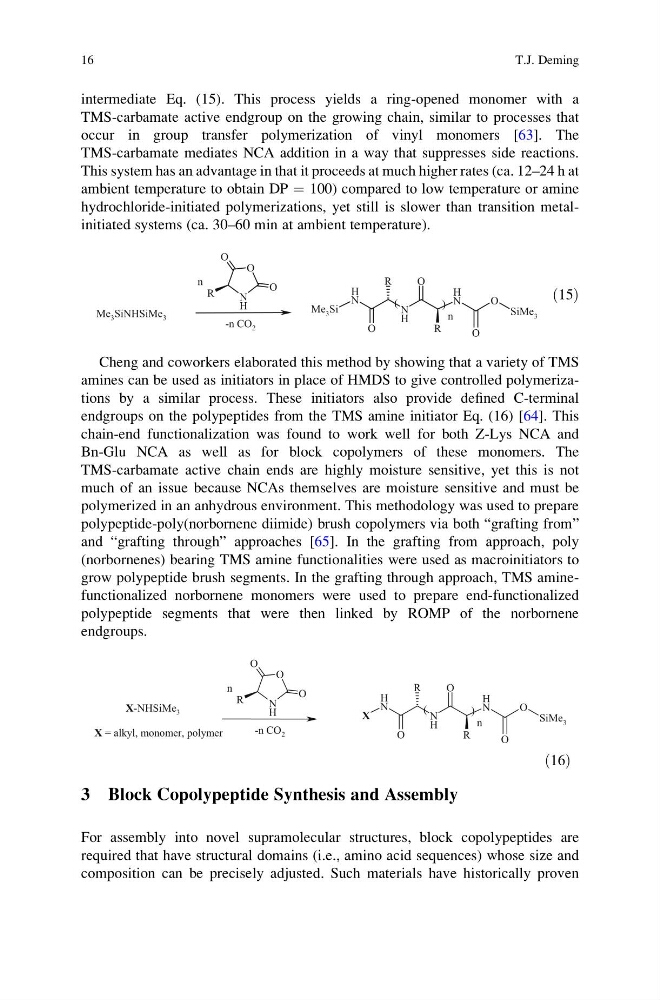
intermediate Eq. (15). This process yields a ring-opened monomer with a
TMS-carbamate active endgroup on the growing chain, similar to processes that
occur in group transfer polymerization of vinyl monomers [63]. The
TMS-carbamate mediates NCA addition in a way that suppresses side reactions.
This system has an advantage in that it proceeds at much higher rates (ca. 12–24 h at
ambient temperature to obtain DP ¼ 100) compared to low temperature or amine
hydrochloride-initiated polymerizations, yet still is slower than transition metalinitiated systems (ca. 30–60 min at ambient temperature).
N
H
O
O
O
R
N
H
R
N
H
O
R
O
N
H
Me 3 Si
O
O
SiMe 3
n
-n CO 2
)
(
n
Me 3 SiNHSiMe 3
ð15Þ
Cheng and coworkers elaborated this method by showing that a variety of TMS
amines can be used as initiators in place of HMDS to give controlled polymerizations by a similar process. These initiators also provide defined C-terminal
endgroups on the polypeptides from the TMS amine initiator Eq. (16) [64]. This
chain-end functionalization was found to work well for both Z-Lys NCA and
Bn-Glu NCA as well as for block copolymers of these monomers. The
TMS-carbamate active chain ends are highly moisture sensitive, yet this is not
much of an issue because NCAs themselves are moisture sensitive and must be
polymerized in an anhydrous environment. This methodology was used to prepare
polypeptide-poly(norbornene diimide) brush copolymers via both “grafting from”
and “grafting through” approaches [65]. In the grafting from approach, poly
(norbornenes) bearing TMS amine functionalities were used as macroinitiators to
grow polypeptide brush segments. In the grafting through approach, TMS aminefunctionalized norbornene monomers were used to prepare end-functionalized
polypeptide segments that were then linked by ROMP of the norbornene
endgroups.
N
H
O
O
O
R
N
H
R
N
H
O
R
O
N
H
X
O
O
SiMe 3
n
-n CO 2
)
(
n
X-NHSiMe 3
X = alkyl, monomer, polymer
ð16Þ
3 Block Copolypeptide Synthesis and Assembly
For assembly into novel supramolecular structures, block copolypeptides are
required that have structural domains (i.e., amino acid sequences) whose size and
composition can be precisely adjusted. Such materials have historically proven
16
T.J. Deming
TMS-carbamate active endgroup on the growing chain, similar to processes that
occur in group transfer polymerization of vinyl monomers [63]. The
TMS-carbamate mediates NCA addition in a way that suppresses side reactions.
This system has an advantage in that it proceeds at much higher rates (ca. 12–24 h at
ambient temperature to obtain DP ¼ 100) compared to low temperature or amine
hydrochloride-initiated polymerizations, yet still is slower than transition metalinitiated systems (ca. 30–60 min at ambient temperature).
N
H
O
O
O
R
N
H
R
N
H
O
R
O
N
H
Me 3 Si
O
O
SiMe 3
n
-n CO 2
)
(
n
Me 3 SiNHSiMe 3
ð15Þ
Cheng and coworkers elaborated this method by showing that a variety of TMS
amines can be used as initiators in place of HMDS to give controlled polymerizations by a similar process. These initiators also provide defined C-terminal
endgroups on the polypeptides from the TMS amine initiator Eq. (16) [64]. This
chain-end functionalization was found to work well for both Z-Lys NCA and
Bn-Glu NCA as well as for block copolymers of these monomers. The
TMS-carbamate active chain ends are highly moisture sensitive, yet this is not
much of an issue because NCAs themselves are moisture sensitive and must be
polymerized in an anhydrous environment. This methodology was used to prepare
polypeptide-poly(norbornene diimide) brush copolymers via both “grafting from”
and “grafting through” approaches [65]. In the grafting from approach, poly
(norbornenes) bearing TMS amine functionalities were used as macroinitiators to
grow polypeptide brush segments. In the grafting through approach, TMS aminefunctionalized norbornene monomers were used to prepare end-functionalized
polypeptide segments that were then linked by ROMP of the norbornene
endgroups.
N
H
O
O
O
R
N
H
R
N
H
O
R
O
N
H
X
O
O
SiMe 3
n
-n CO 2
)
(
n
X-NHSiMe 3
X = alkyl, monomer, polymer
ð16Þ
3 Block Copolypeptide Synthesis and Assembly
For assembly into novel supramolecular structures, block copolypeptides are
required that have structural domains (i.e., amino acid sequences) whose size and
composition can be precisely adjusted. Such materials have historically proven
16
T.J. Deming