

2.1.2 Ring Closure Through Bimolecular Coupling Between
Homodifunctional Linear Polymers with Small Molecules (A 2 +B)
In contrast to the difunctional bimolecular coupling reaction A 2 + B 2 , a linear
difunctional polymer precursor (A 2 ) can also be coupled with a small molecule
that does not show obvious difunctional groups (B). However, once one of the
telechelic chain ends of the linear polymers reacts with the small molecules, the
resulting group can further react with another chain end to form a cyclic polymer.
Here we denoted the reaction as A 2 + B.
Early work on the synthesis of cyclic polymers through this method was reported
by Booth and Price et al. [62]. They synthesized the cyclic polyether from
α,ω-dihydroxyl PEO. The dihydroxyl PEO was dissolved in dichloromethane
(DCM) into which the powdery KOH was added. One of the hydroxyl groups
first reacted with DCM to form the chloromethyl ether. The latter has high reactivity with another hydroxyl group under base conditions. The cyclic PEO was
obtained with an acetal linkage, as shown in Scheme 13.
Yu et al. [63] described the same method for preparation of cyclic poly(propylene oxide) (PPO) with an acetal linkage, and achieved 60–75% conversion for a
linear PPO of 2,000 molecular weight. Jia et al. [64] used the same method to
synthesize cyclic poly(ethylene oxide-co-4-glycidyloxy-2,2,6,6-tetramethylpiperydine-1-oxyl) with up to 85% conversion (Scheme 14). The purification of this
product was conducted by ultrafiltration using a polymer membrane.
Recently, Tillman and coworkers [65] reported an intramolecular radical trapassisted atom transfer radical coupling (IRT-ATRC) as shown in Scheme 15. The
α,ω-dibromo functional PSTY was first synthesized by ATRP. The bromo chain end
was first activated by CuBr/Me 6 TREN complex to yield a radical that simultaneously
reacted with 2-methyl-2-nitrosopropane to form a nitroxide radical. The another
bromo chain end was also activated to a radical and rapidly trapped by nitroxide
radical through the well-known ATRC process to form cyclic PSTY. However, in this
case, the hydrodynamic volume changes ( ¼ M pc /M pl ) from linear to cyclic
were mostly greater than 0.85, which is much higher than that of cyclic PSTY made
from anionic polymerization (i.e., 0.78). Although the authors ascribed the reason to
n
n
or
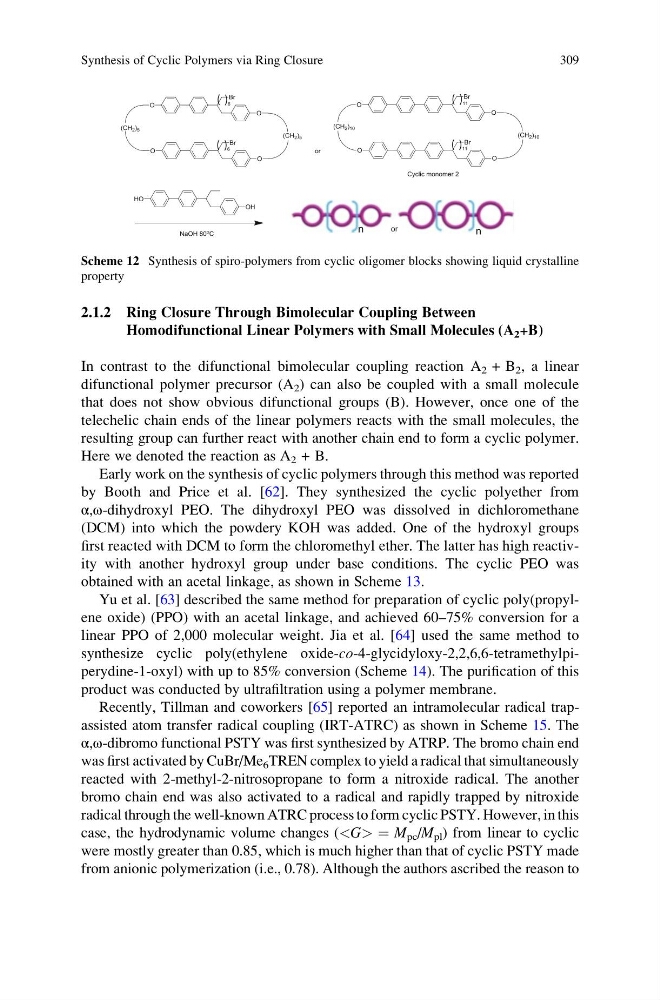
Scheme 12 Synthesis of spiro-polymers from cyclic oligomer blocks showing liquid crystalline
property
Synthesis of Cyclic Polymers via Ring Closure
309
Homodifunctional Linear Polymers with Small Molecules (A 2 +B)
In contrast to the difunctional bimolecular coupling reaction A 2 + B 2 , a linear
difunctional polymer precursor (A 2 ) can also be coupled with a small molecule
that does not show obvious difunctional groups (B). However, once one of the
telechelic chain ends of the linear polymers reacts with the small molecules, the
resulting group can further react with another chain end to form a cyclic polymer.
Here we denoted the reaction as A 2 + B.
Early work on the synthesis of cyclic polymers through this method was reported
by Booth and Price et al. [62]. They synthesized the cyclic polyether from
α,ω-dihydroxyl PEO. The dihydroxyl PEO was dissolved in dichloromethane
(DCM) into which the powdery KOH was added. One of the hydroxyl groups
first reacted with DCM to form the chloromethyl ether. The latter has high reactivity with another hydroxyl group under base conditions. The cyclic PEO was
obtained with an acetal linkage, as shown in Scheme 13.
Yu et al. [63] described the same method for preparation of cyclic poly(propylene oxide) (PPO) with an acetal linkage, and achieved 60–75% conversion for a
linear PPO of 2,000 molecular weight. Jia et al. [64] used the same method to
synthesize cyclic poly(ethylene oxide-co-4-glycidyloxy-2,2,6,6-tetramethylpiperydine-1-oxyl) with up to 85% conversion (Scheme 14). The purification of this
product was conducted by ultrafiltration using a polymer membrane.
Recently, Tillman and coworkers [65] reported an intramolecular radical trapassisted atom transfer radical coupling (IRT-ATRC) as shown in Scheme 15. The
α,ω-dibromo functional PSTY was first synthesized by ATRP. The bromo chain end
was first activated by CuBr/Me 6 TREN complex to yield a radical that simultaneously
reacted with 2-methyl-2-nitrosopropane to form a nitroxide radical. The another
bromo chain end was also activated to a radical and rapidly trapped by nitroxide
radical through the well-known ATRC process to form cyclic PSTY. However, in this
case, the hydrodynamic volume changes (
were mostly greater than 0.85, which is much higher than that of cyclic PSTY made
from anionic polymerization (i.e., 0.78). Although the authors ascribed the reason to
n
n
or
Scheme 12 Synthesis of spiro-polymers from cyclic oligomer blocks showing liquid crystalline
property
Synthesis of Cyclic Polymers via Ring Closure
309