

battery or lithium metal battery. Since lithium ions can be oxidized and reduced on
the lithium anode surface and lithium metal is the densest lithium ion source without
wasted mass on a host material, lithium batteries can have much higher capacity than
lithium ion batteries.
Despite such good characteristics, lithium batteries have severe drawbacks. First,
there are not many cathode materials that have an appropriate electrochemical
potential difference from the lithium anode combined with a large capacity. Second,
they are less stable than lithium ion batteries due to dendrite formation on lithium
metal surfaces [71]. Dendrites lead to electrical shortage between anode and cathode,
which can result in an explosion. These problems may be overcome by utilizing
BCP SA.
One of the most promising cathode materials for lithium batteries is sulfur.
Sulfur is abundant in nature and an undesirable impurity in petroleum, thus it is
very cheap. Lithium batteries with a sulfur cathode, so-called lithium sulfur
batteries, have potentially high electric capacity but so far only very poor
cyclability. A few charge–discharge cycles induce a significant capacity drop. In
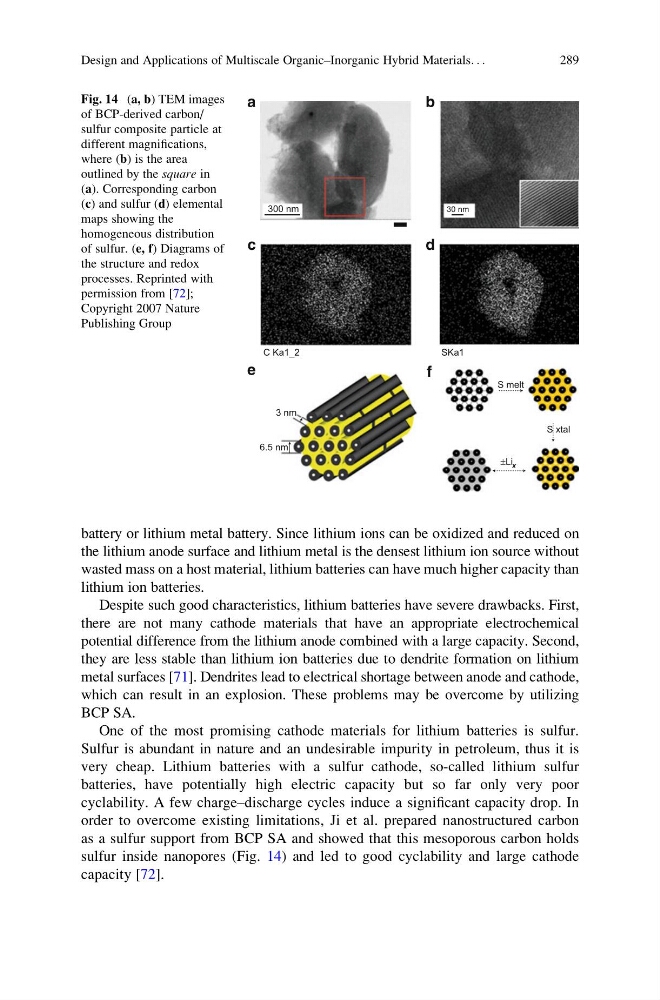
order to overcome existing limitations, Ji et al. prepared nanostructured carbon
as a sulfur support from BCP SA and showed that this mesoporous carbon holds
sulfur inside nanopores (Fig. 14) and led to good cyclability and large cathode
capacity [72].
3 nm
6.5 nm
SKa1
C Ka1_2
S melt
S xtal
±Li x
b
a
d
c
e
f
HD-2000 200 kV 100 k TE
300 nm
30 nm
Fig. 14 (a, b) TEM images
of BCP-derived carbon/
sulfur composite particle at
different magnifications,
where (b) is the area
outlined by the square in
(a). Corresponding carbon
(c) and sulfur (d) elemental
maps showing the
homogeneous distribution
of sulfur. (e, f) Diagrams of
the structure and redox
processes. Reprinted with
permission from [72];
Copyright 2007 Nature
Publishing Group
Design and Applications of Multiscale Organic–Inorganic Hybrid Materials. . .
289
the lithium anode surface and lithium metal is the densest lithium ion source without
wasted mass on a host material, lithium batteries can have much higher capacity than
lithium ion batteries.
Despite such good characteristics, lithium batteries have severe drawbacks. First,
there are not many cathode materials that have an appropriate electrochemical
potential difference from the lithium anode combined with a large capacity. Second,
they are less stable than lithium ion batteries due to dendrite formation on lithium
metal surfaces [71]. Dendrites lead to electrical shortage between anode and cathode,
which can result in an explosion. These problems may be overcome by utilizing
BCP SA.
One of the most promising cathode materials for lithium batteries is sulfur.
Sulfur is abundant in nature and an undesirable impurity in petroleum, thus it is
very cheap. Lithium batteries with a sulfur cathode, so-called lithium sulfur
batteries, have potentially high electric capacity but so far only very poor
cyclability. A few charge–discharge cycles induce a significant capacity drop. In
order to overcome existing limitations, Ji et al. prepared nanostructured carbon
as a sulfur support from BCP SA and showed that this mesoporous carbon holds
sulfur inside nanopores (Fig. 14) and led to good cyclability and large cathode
capacity [72].
3 nm
6.5 nm
SKa1
C Ka1_2
S melt
S xtal
±Li x
b
a
d
c
e
f
HD-2000 200 kV 100 k TE
300 nm
30 nm
Fig. 14 (a, b) TEM images
of BCP-derived carbon/
sulfur composite particle at
different magnifications,
where (b) is the area
outlined by the square in
(a). Corresponding carbon
(c) and sulfur (d) elemental
maps showing the
homogeneous distribution
of sulfur. (e, f) Diagrams of
the structure and redox
processes. Reprinted with
permission from [72];
Copyright 2007 Nature
Publishing Group
Design and Applications of Multiscale Organic–Inorganic Hybrid Materials. . .
289