

6.1 Fuel Cells
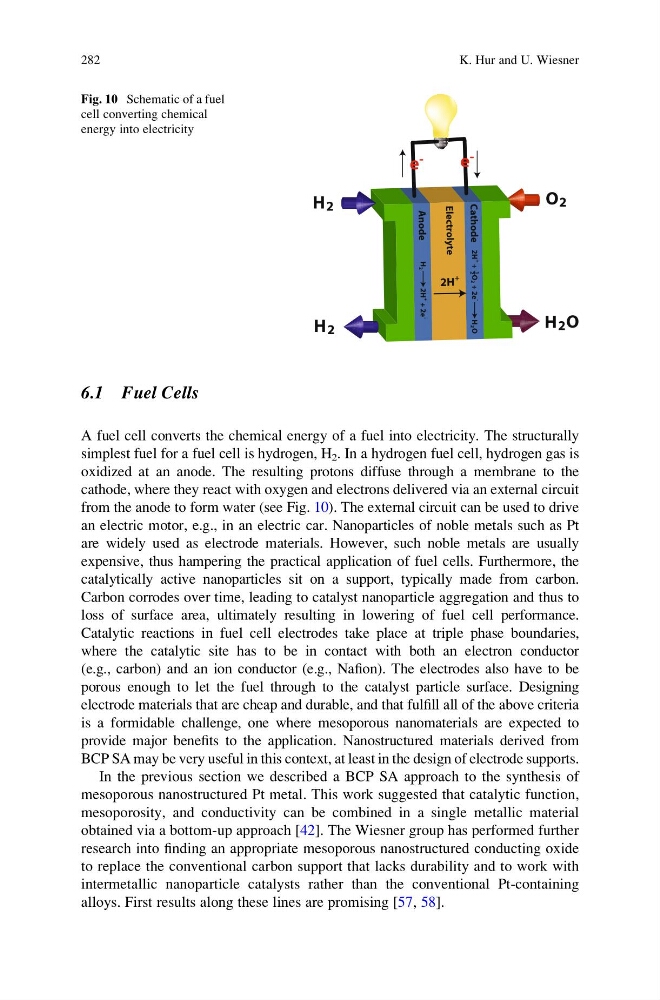
A fuel cell converts the chemical energy of a fuel into electricity. The structurally
simplest fuel for a fuel cell is hydrogen, H 2 . In a hydrogen fuel cell, hydrogen gas is
oxidized at an anode. The resulting protons diffuse through a membrane to the
cathode, where they react with oxygen and electrons delivered via an external circuit
from the anode to form water (see Fig. 10). The external circuit can be used to drive
an electric motor, e.g., in an electric car. Nanoparticles of noble metals such as Pt
are widely used as electrode materials. However, such noble metals are usually
expensive, thus hampering the practical application of fuel cells. Furthermore, the
catalytically active nanoparticles sit on a support, typically made from carbon.
Carbon corrodes over time, leading to catalyst nanoparticle aggregation and thus to
loss of surface area, ultimately resulting in lowering of fuel cell performance.
Catalytic reactions in fuel cell electrodes take place at triple phase boundaries,
where the catalytic site has to be in contact with both an electron conductor
(e.g., carbon) and an ion conductor (e.g., Nafion). The electrodes also have to be
porous enough to let the fuel through to the catalyst particle surface. Designing
electrode materials that are cheap and durable, and that fulfill all of the above criteria
is a formidable challenge, one where mesoporous nanomaterials are expected to
provide major benefits to the application. Nanostructured materials derived from
BCP SA may be very useful in this context, at least in the design of electrode supports.
In the previous section we described a BCP SA approach to the synthesis of
mesoporous nanostructured Pt metal. This work suggested that catalytic function,
mesoporosity, and conductivity can be combined in a single metallic material
obtained via a bottom-up approach [42]. The Wiesner group has performed further
research into finding an appropriate mesoporous nanostructured conducting oxide
to replace the conventional carbon support that lacks durability and to work with
intermetallic nanoparticle catalysts rather than the conventional Pt-containing
alloys. First results along these lines are promising [57, 58].
Electrolyte
Cathode
Anode
H 2
H 2
O 2
H 2 O
e -
e -
H
2H + 2e
2
-
+
2H
+
H
2H + O + 2e
2
2
+
2
1
O
-
Fig. 10 Schematic of a fuel
cell converting chemical
energy into electricity
282
K. Hur and U. Wiesner
A fuel cell converts the chemical energy of a fuel into electricity. The structurally
simplest fuel for a fuel cell is hydrogen, H 2 . In a hydrogen fuel cell, hydrogen gas is
oxidized at an anode. The resulting protons diffuse through a membrane to the
cathode, where they react with oxygen and electrons delivered via an external circuit
from the anode to form water (see Fig. 10). The external circuit can be used to drive
an electric motor, e.g., in an electric car. Nanoparticles of noble metals such as Pt
are widely used as electrode materials. However, such noble metals are usually
expensive, thus hampering the practical application of fuel cells. Furthermore, the
catalytically active nanoparticles sit on a support, typically made from carbon.
Carbon corrodes over time, leading to catalyst nanoparticle aggregation and thus to
loss of surface area, ultimately resulting in lowering of fuel cell performance.
Catalytic reactions in fuel cell electrodes take place at triple phase boundaries,
where the catalytic site has to be in contact with both an electron conductor
(e.g., carbon) and an ion conductor (e.g., Nafion). The electrodes also have to be
porous enough to let the fuel through to the catalyst particle surface. Designing
electrode materials that are cheap and durable, and that fulfill all of the above criteria
is a formidable challenge, one where mesoporous nanomaterials are expected to
provide major benefits to the application. Nanostructured materials derived from
BCP SA may be very useful in this context, at least in the design of electrode supports.
In the previous section we described a BCP SA approach to the synthesis of
mesoporous nanostructured Pt metal. This work suggested that catalytic function,
mesoporosity, and conductivity can be combined in a single metallic material
obtained via a bottom-up approach [42]. The Wiesner group has performed further
research into finding an appropriate mesoporous nanostructured conducting oxide
to replace the conventional carbon support that lacks durability and to work with
intermetallic nanoparticle catalysts rather than the conventional Pt-containing
alloys. First results along these lines are promising [57, 58].
Electrolyte
Cathode
Anode
H 2
H 2
O 2
H 2 O
e -
e -
H
2H + 2e
2
-
+
2H
+
H
2H + O + 2e
2
2
+
2
1
O
-
Fig. 10 Schematic of a fuel
cell converting chemical
energy into electricity
282
K. Hur and U. Wiesner