

of nanoparticles, including semiconducting nanoparticles and quantum dots, thus
providing a generalized platform for the generation of periodically ordered
mesoporous functional materials [55].
Another strategy is chemical reduction of metal ions on a BCP-derived porous
template in a metal salt solution, whereby reduced metals precipitate into the
nanopores. The reduction can be achieved by electrodeposition, i.e., by applying
an electric potential to a conductive substrate with a nanoporous film in a metal salt
solution. As a metamaterial, nanostructured gyroidal gold was fabricated by a
combination of BCP SA, ozonolysis, and electrodeposition of gold [38]. To that
end, triblock terpolymer PI-b-PS-b-PEO solution was spun-cast onto a transparent
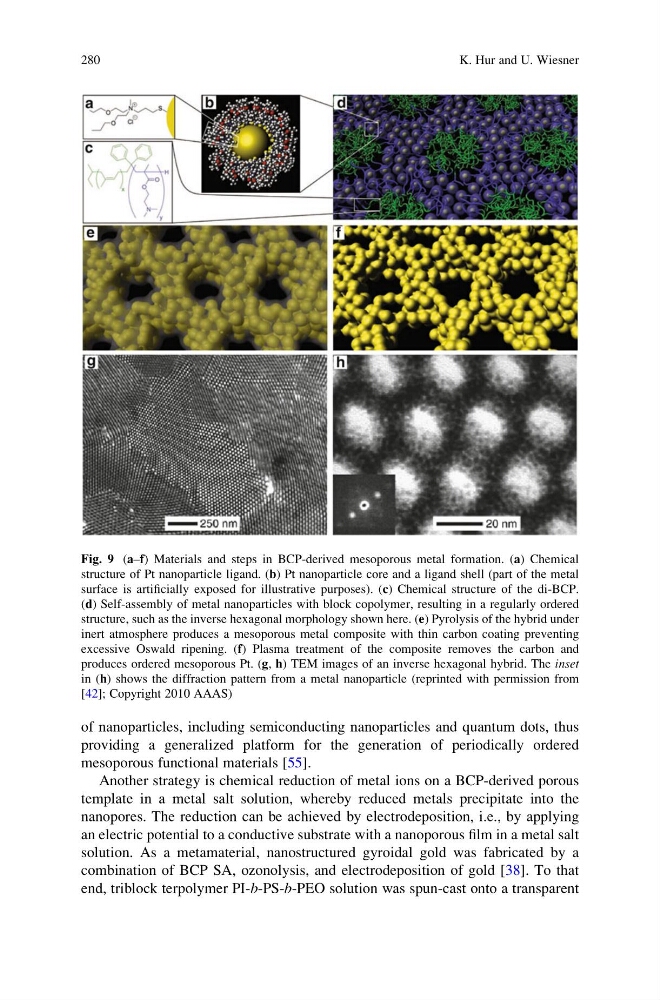
Fig. 9 (a–f) Materials and steps in BCP-derived mesoporous metal formation. (a) Chemical
structure of Pt nanoparticle ligand. (b) Pt nanoparticle core and a ligand shell (part of the metal
surface is artificially exposed for illustrative purposes). (c) Chemical structure of the di-BCP.
(d) Self-assembly of metal nanoparticles with block copolymer, resulting in a regularly ordered
structure, such as the inverse hexagonal morphology shown here. (e) Pyrolysis of the hybrid under
inert atmosphere produces a mesoporous metal composite with thin carbon coating preventing
excessive Oswald ripening. (f) Plasma treatment of the composite removes the carbon and
produces ordered mesoporous Pt. (g, h) TEM images of an inverse hexagonal hybrid. The inset
in (h) shows the diffraction pattern from a metal nanoparticle (reprinted with permission from
[42]; Copyright 2010 AAAS)
280
K. Hur and U. Wiesner
providing a generalized platform for the generation of periodically ordered
mesoporous functional materials [55].
Another strategy is chemical reduction of metal ions on a BCP-derived porous
template in a metal salt solution, whereby reduced metals precipitate into the
nanopores. The reduction can be achieved by electrodeposition, i.e., by applying
an electric potential to a conductive substrate with a nanoporous film in a metal salt
solution. As a metamaterial, nanostructured gyroidal gold was fabricated by a
combination of BCP SA, ozonolysis, and electrodeposition of gold [38]. To that
end, triblock terpolymer PI-b-PS-b-PEO solution was spun-cast onto a transparent
Fig. 9 (a–f) Materials and steps in BCP-derived mesoporous metal formation. (a) Chemical
structure of Pt nanoparticle ligand. (b) Pt nanoparticle core and a ligand shell (part of the metal
surface is artificially exposed for illustrative purposes). (c) Chemical structure of the di-BCP.
(d) Self-assembly of metal nanoparticles with block copolymer, resulting in a regularly ordered
structure, such as the inverse hexagonal morphology shown here. (e) Pyrolysis of the hybrid under
inert atmosphere produces a mesoporous metal composite with thin carbon coating preventing
excessive Oswald ripening. (f) Plasma treatment of the composite removes the carbon and
produces ordered mesoporous Pt. (g, h) TEM images of an inverse hexagonal hybrid. The inset
in (h) shows the diffraction pattern from a metal nanoparticle (reprinted with permission from
[42]; Copyright 2010 AAAS)
280
K. Hur and U. Wiesner