

long relaxation times characteristic for macromolecular systems. However, kinetic
control can offer a route to completely novel structures not achievable from purely
equilibrium thermodynamic considerations.
Pinemann et al. for the first time combined BCP SA and nonsolvent-induced
phase separation (NIPS), resulting in asymmetric hierarchically structured porous
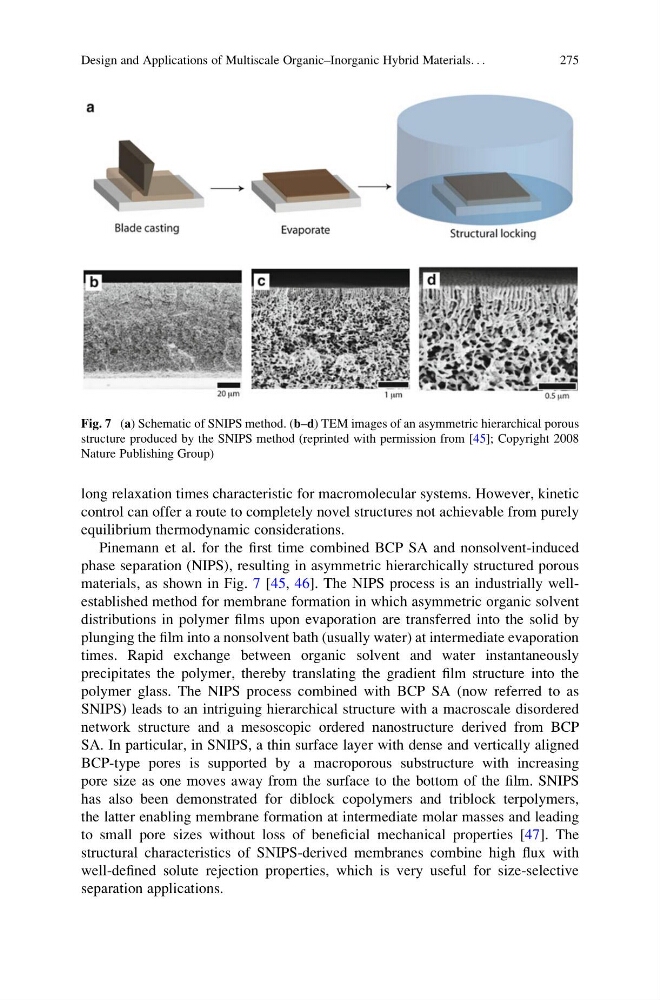
materials, as shown in Fig. 7 [45, 46]. The NIPS process is an industrially wellestablished method for membrane formation in which asymmetric organic solvent
distributions in polymer films upon evaporation are transferred into the solid by
plunging the film into a nonsolvent bath (usually water) at intermediate evaporation
times. Rapid exchange between organic solvent and water instantaneously
precipitates the polymer, thereby translating the gradient film structure into the
polymer glass. The NIPS process combined with BCP SA (now referred to as
SNIPS) leads to an intriguing hierarchical structure with a macroscale disordered
network structure and a mesoscopic ordered nanostructure derived from BCP
SA. In particular, in SNIPS, a thin surface layer with dense and vertically aligned
BCP-type pores is supported by a macroporous substructure with increasing
pore size as one moves away from the surface to the bottom of the film. SNIPS
has also been demonstrated for diblock copolymers and triblock terpolymers,
the latter enabling membrane formation at intermediate molar masses and leading
to small pore sizes without loss of beneficial mechanical properties [47]. The
structural characteristics of SNIPS-derived membranes combine high flux with
well-defined solute rejection properties, which is very useful for size-selective
separation applications.
Fig. 7 (a) Schematic of SNIPS method. (b–d) TEM images of an asymmetric hierarchical porous
structure produced by the SNIPS method (reprinted with permission from [45]; Copyright 2008
Nature Publishing Group)
Design and Applications of Multiscale Organic–Inorganic Hybrid Materials. . .
275
control can offer a route to completely novel structures not achievable from purely
equilibrium thermodynamic considerations.
Pinemann et al. for the first time combined BCP SA and nonsolvent-induced
phase separation (NIPS), resulting in asymmetric hierarchically structured porous
materials, as shown in Fig. 7 [45, 46]. The NIPS process is an industrially wellestablished method for membrane formation in which asymmetric organic solvent
distributions in polymer films upon evaporation are transferred into the solid by
plunging the film into a nonsolvent bath (usually water) at intermediate evaporation
times. Rapid exchange between organic solvent and water instantaneously
precipitates the polymer, thereby translating the gradient film structure into the
polymer glass. The NIPS process combined with BCP SA (now referred to as
SNIPS) leads to an intriguing hierarchical structure with a macroscale disordered
network structure and a mesoscopic ordered nanostructure derived from BCP
SA. In particular, in SNIPS, a thin surface layer with dense and vertically aligned
BCP-type pores is supported by a macroporous substructure with increasing
pore size as one moves away from the surface to the bottom of the film. SNIPS
has also been demonstrated for diblock copolymers and triblock terpolymers,
the latter enabling membrane formation at intermediate molar masses and leading
to small pore sizes without loss of beneficial mechanical properties [47]. The
structural characteristics of SNIPS-derived membranes combine high flux with
well-defined solute rejection properties, which is very useful for size-selective
separation applications.
Fig. 7 (a) Schematic of SNIPS method. (b–d) TEM images of an asymmetric hierarchical porous
structure produced by the SNIPS method (reprinted with permission from [45]; Copyright 2008
Nature Publishing Group)
Design and Applications of Multiscale Organic–Inorganic Hybrid Materials. . .
275