

approaches such as extreme ultra-violet (EUV) and e-beam lithography when
attempting to attain sub-10 nm line patterns.
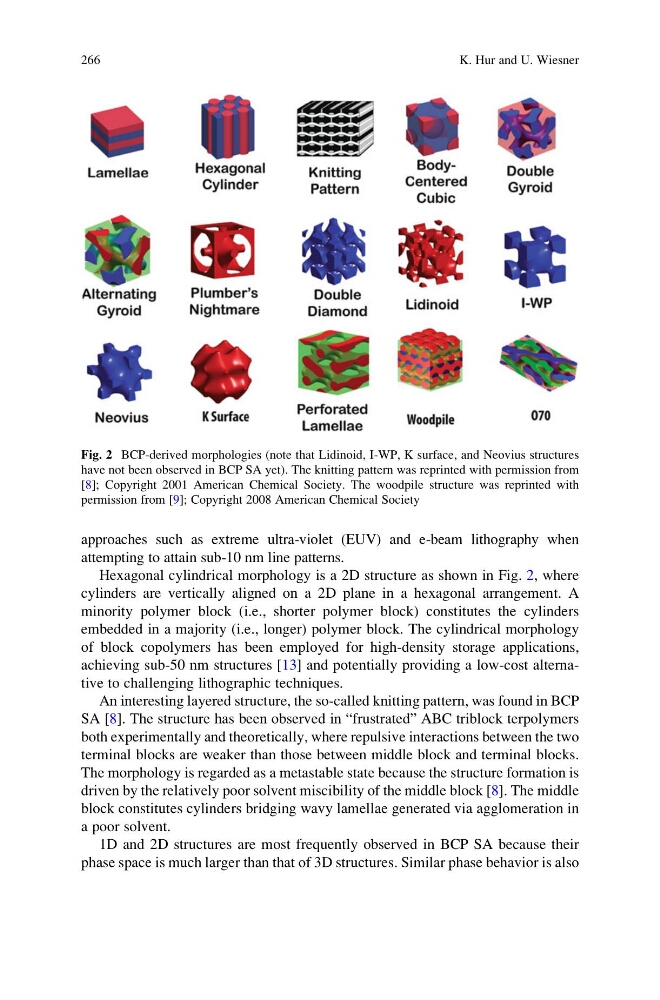
Hexagonal cylindrical morphology is a 2D structure as shown in Fig. 2, where
cylinders are vertically aligned on a 2D plane in a hexagonal arrangement. A
minority polymer block (i.e., shorter polymer block) constitutes the cylinders
embedded in a majority (i.e., longer) polymer block. The cylindrical morphology
of block copolymers has been employed for high-density storage applications,
achieving sub-50 nm structures [13] and potentially providing a low-cost alternative to challenging lithographic techniques.
An interesting layered structure, the so-called knitting pattern, was found in BCP
SA [8]. The structure has been observed in “frustrated” ABC triblock terpolymers
both experimentally and theoretically, where repulsive interactions between the two
terminal blocks are weaker than those between middle block and terminal blocks.
The morphology is regarded as a metastable state because the structure formation is
driven by the relatively poor solvent miscibility of the middle block [8]. The middle
block constitutes cylinders bridging wavy lamellae generated via agglomeration in
a poor solvent.
1D and 2D structures are most frequently observed in BCP SA because their
phase space is much larger than that of 3D structures. Similar phase behavior is also
Fig. 2 BCP-derived morphologies (note that Lidinoid, I-WP, K surface, and Neovius structures
have not been observed in BCP SA yet). The knitting pattern was reprinted with permission from
[8]; Copyright 2001 American Chemical Society. The woodpile structure was reprinted with
permission from [9]; Copyright 2008 American Chemical Society
266
K. Hur and U. Wiesner
attempting to attain sub-10 nm line patterns.
Hexagonal cylindrical morphology is a 2D structure as shown in Fig. 2, where
cylinders are vertically aligned on a 2D plane in a hexagonal arrangement. A
minority polymer block (i.e., shorter polymer block) constitutes the cylinders
embedded in a majority (i.e., longer) polymer block. The cylindrical morphology
of block copolymers has been employed for high-density storage applications,
achieving sub-50 nm structures [13] and potentially providing a low-cost alternative to challenging lithographic techniques.
An interesting layered structure, the so-called knitting pattern, was found in BCP
SA [8]. The structure has been observed in “frustrated” ABC triblock terpolymers
both experimentally and theoretically, where repulsive interactions between the two
terminal blocks are weaker than those between middle block and terminal blocks.
The morphology is regarded as a metastable state because the structure formation is
driven by the relatively poor solvent miscibility of the middle block [8]. The middle
block constitutes cylinders bridging wavy lamellae generated via agglomeration in
a poor solvent.
1D and 2D structures are most frequently observed in BCP SA because their
phase space is much larger than that of 3D structures. Similar phase behavior is also
Fig. 2 BCP-derived morphologies (note that Lidinoid, I-WP, K surface, and Neovius structures
have not been observed in BCP SA yet). The knitting pattern was reprinted with permission from
[8]; Copyright 2001 American Chemical Society. The woodpile structure was reprinted with
permission from [9]; Copyright 2008 American Chemical Society
266
K. Hur and U. Wiesner