

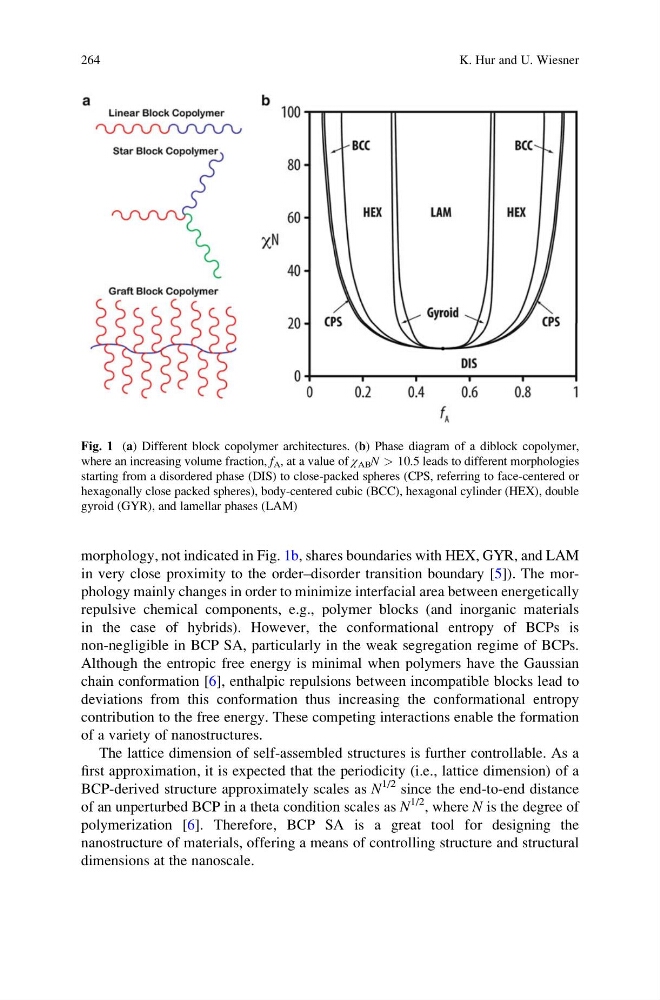
morphology, not indicated in Fig. 1b, shares boundaries with HEX, GYR, and LAM
in very close proximity to the order–disorder transition boundary [5]). The morphology mainly changes in order to minimize interfacial area between energetically
repulsive chemical components, e.g., polymer blocks (and inorganic materials
in the case of hybrids). However, the conformational entropy of BCPs is
non-negligible in BCP SA, particularly in the weak segregation regime of BCPs.
Although the entropic free energy is minimal when polymers have the Gaussian
chain conformation [6], enthalpic repulsions between incompatible blocks lead to
deviations from this conformation thus increasing the conformational entropy
contribution to the free energy. These competing interactions enable the formation
of a variety of nanostructures.
The lattice dimension of self-assembled structures is further controllable. As a
first approximation, it is expected that the periodicity (i.e., lattice dimension) of a
BCP-derived structure approximately scales as N
1/2 since the end-to-end distance
of an unperturbed BCP in a theta condition scales as N
1/2 , where N is the degree of
polymerization [6]. Therefore, BCP SA is a great tool for designing the
nanostructure of materials, offering a means of controlling structure and structural
dimensions at the nanoscale.
Fig. 1 (a) Different block copolymer architectures. (b) Phase diagram of a diblock copolymer,
where an increasing volume fraction, f A , at a value of χ AB N > 10.5 leads to different morphologies
starting from a disordered phase (DIS) to close-packed spheres (CPS, referring to face-centered or
hexagonally close packed spheres), body-centered cubic (BCC), hexagonal cylinder (HEX), double
gyroid (GYR), and lamellar phases (LAM)
264
K. Hur and U. Wiesner
in very close proximity to the order–disorder transition boundary [5]). The morphology mainly changes in order to minimize interfacial area between energetically
repulsive chemical components, e.g., polymer blocks (and inorganic materials
in the case of hybrids). However, the conformational entropy of BCPs is
non-negligible in BCP SA, particularly in the weak segregation regime of BCPs.
Although the entropic free energy is minimal when polymers have the Gaussian
chain conformation [6], enthalpic repulsions between incompatible blocks lead to
deviations from this conformation thus increasing the conformational entropy
contribution to the free energy. These competing interactions enable the formation
of a variety of nanostructures.
The lattice dimension of self-assembled structures is further controllable. As a
first approximation, it is expected that the periodicity (i.e., lattice dimension) of a
BCP-derived structure approximately scales as N
1/2 since the end-to-end distance
of an unperturbed BCP in a theta condition scales as N
1/2 , where N is the degree of
polymerization [6]. Therefore, BCP SA is a great tool for designing the
nanostructure of materials, offering a means of controlling structure and structural
dimensions at the nanoscale.
Fig. 1 (a) Different block copolymer architectures. (b) Phase diagram of a diblock copolymer,
where an increasing volume fraction, f A , at a value of χ AB N > 10.5 leads to different morphologies
starting from a disordered phase (DIS) to close-packed spheres (CPS, referring to face-centered or
hexagonally close packed spheres), body-centered cubic (BCC), hexagonal cylinder (HEX), double
gyroid (GYR), and lamellar phases (LAM)
264
K. Hur and U. Wiesner