

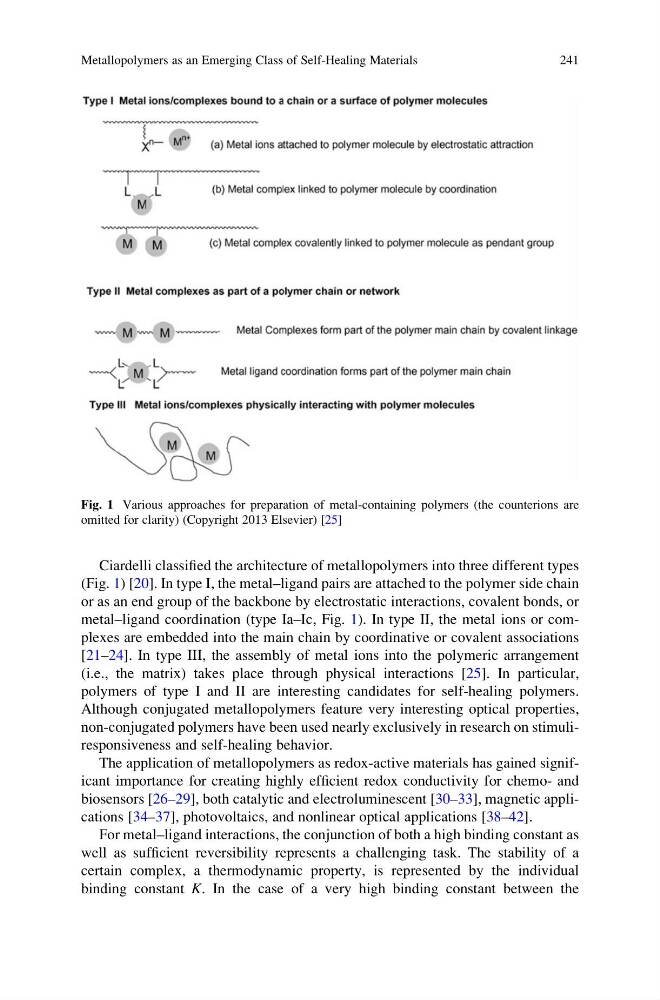
Ciardelli classified the architecture of metallopolymers into three different types
(Fig. 1) [20]. In type I, the metal–ligand pairs are attached to the polymer side chain
or as an end group of the backbone by electrostatic interactions, covalent bonds, or
metal–ligand coordination (type Ia–Ic, Fig. 1). In type II, the metal ions or complexes are embedded into the main chain by coordinative or covalent associations
[21–24]. In type III, the assembly of metal ions into the polymeric arrangement
(i.e., the matrix) takes place through physical interactions [25]. In particular,
polymers of type I and II are interesting candidates for self-healing polymers.
Although conjugated metallopolymers feature very interesting optical properties,
non-conjugated polymers have been used nearly exclusively in research on stimuliresponsiveness and self-healing behavior.
The application of metallopolymers as redox-active materials has gained significant importance for creating highly efficient redox conductivity for chemo- and
biosensors [26–29], both catalytic and electroluminescent [30–33], magnetic applications [34–37], photovoltaics, and nonlinear optical applications [38–42].
For metal–ligand interactions, the conjunction of both a high binding constant as
well as sufficient reversibility represents a challenging task. The stability of a
certain complex, a thermodynamic property, is represented by the individual
binding constant K. In the case of a very high binding constant between the
Fig. 1 Various approaches for preparation of metal-containing polymers (the counterions are
omitted for clarity) (Copyright 2013 Elsevier) [25]
Metallopolymers as an Emerging Class of Self-Healing Materials
241
(Fig. 1) [20]. In type I, the metal–ligand pairs are attached to the polymer side chain
or as an end group of the backbone by electrostatic interactions, covalent bonds, or
metal–ligand coordination (type Ia–Ic, Fig. 1). In type II, the metal ions or complexes are embedded into the main chain by coordinative or covalent associations
[21–24]. In type III, the assembly of metal ions into the polymeric arrangement
(i.e., the matrix) takes place through physical interactions [25]. In particular,
polymers of type I and II are interesting candidates for self-healing polymers.
Although conjugated metallopolymers feature very interesting optical properties,
non-conjugated polymers have been used nearly exclusively in research on stimuliresponsiveness and self-healing behavior.
The application of metallopolymers as redox-active materials has gained significant importance for creating highly efficient redox conductivity for chemo- and
biosensors [26–29], both catalytic and electroluminescent [30–33], magnetic applications [34–37], photovoltaics, and nonlinear optical applications [38–42].
For metal–ligand interactions, the conjunction of both a high binding constant as
well as sufficient reversibility represents a challenging task. The stability of a
certain complex, a thermodynamic property, is represented by the individual
binding constant K. In the case of a very high binding constant between the
Fig. 1 Various approaches for preparation of metal-containing polymers (the counterions are
omitted for clarity) (Copyright 2013 Elsevier) [25]
Metallopolymers as an Emerging Class of Self-Healing Materials
241