

Furthermore, (AB) 3 -type star block copolymer was also prepared using ATRP,
CGCP, and a click reaction (Scheme 33) [74]. ATRP of styrene was carried out in
the presence of 2,4,6-tris(bromomethyl)mesitylene as a trifunctional initiator, and
then the terminal bromines of the polymer were transformed to azide groups with
NaN 3 . The azide-terminated polystyrene was then used for click reaction with
alkyne-terminated aromatic polyether, obtained by CGCP with an initiator bearing
an acetylene unit. Excess alkyne-terminated aromatic polyether was removed
from the crude product by means of preparative high-performance liquid chromatography (HPLC) to yield the (AB) 3 -type star block copolymer.
The morphologies of star copolymers AB 2 , A 2 B, and (AB) 3 and linear block
copolymer AB, which were annealed under vacuum at 150
C for 2 days, were
observed by means of transmission electron microscopy (TEM) (Fig. 4). In the case
of a sample of AB-type diblock copolymer, lamellar morphology consisting of
alternating dark polystyrene and bright aromatic polyether regions was observed
(Fig. 4a). On the other hand, samples of AB 2 , A 2 B, and (AB) 3 star copolymers
showed spherical or plate-like morphology (Fig. 4b–d). Such unexpected and novel
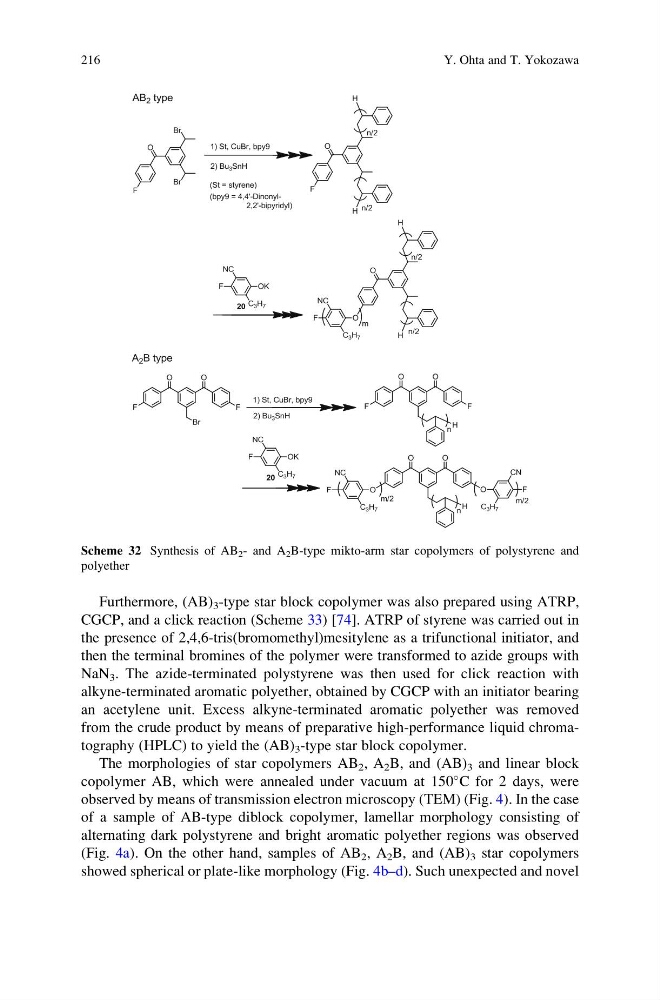
Scheme 32 Synthesis of AB 2 - and A 2 B-type mikto-arm star copolymers of polystyrene and
polyether
216
Y. Ohta and T. Yokozawa
CGCP, and a click reaction (Scheme 33) [74]. ATRP of styrene was carried out in
the presence of 2,4,6-tris(bromomethyl)mesitylene as a trifunctional initiator, and
then the terminal bromines of the polymer were transformed to azide groups with
NaN 3 . The azide-terminated polystyrene was then used for click reaction with
alkyne-terminated aromatic polyether, obtained by CGCP with an initiator bearing
an acetylene unit. Excess alkyne-terminated aromatic polyether was removed
from the crude product by means of preparative high-performance liquid chromatography (HPLC) to yield the (AB) 3 -type star block copolymer.
The morphologies of star copolymers AB 2 , A 2 B, and (AB) 3 and linear block
copolymer AB, which were annealed under vacuum at 150
C for 2 days, were
observed by means of transmission electron microscopy (TEM) (Fig. 4). In the case
of a sample of AB-type diblock copolymer, lamellar morphology consisting of
alternating dark polystyrene and bright aromatic polyether regions was observed
(Fig. 4a). On the other hand, samples of AB 2 , A 2 B, and (AB) 3 star copolymers
showed spherical or plate-like morphology (Fig. 4b–d). Such unexpected and novel
Scheme 32 Synthesis of AB 2 - and A 2 B-type mikto-arm star copolymers of polystyrene and
polyether
216
Y. Ohta and T. Yokozawa