

around 2,000 g mol
À1
. At 37
C and pH 5.5, 65% of all ketal groups of G7 were
degraded in 80 h, whereas the cleavage of 90% took one week. Of course, the
shortcoming of these remarkable and promising structures is their time-consuming
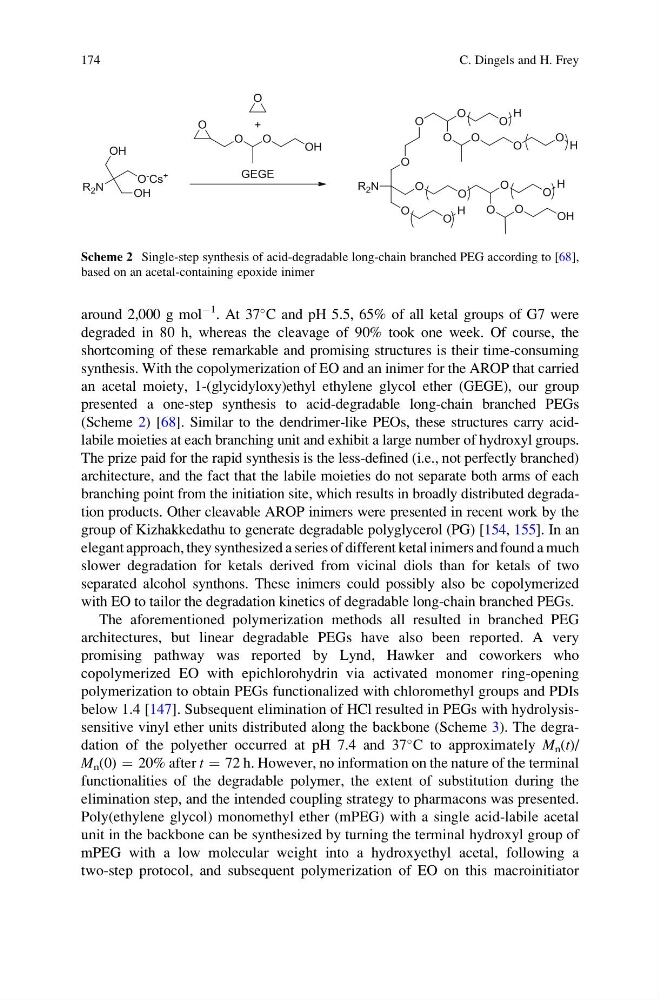
synthesis. With the copolymerization of EO and an inimer for the AROP that carried
an acetal moiety, 1-(glycidyloxy)ethyl ethylene glycol ether (GEGE), our group
presented a one-step synthesis to acid-degradable long-chain branched PEGs
(Scheme 2) [68]. Similar to the dendrimer-like PEOs, these structures carry acidlabile moieties at each branching unit and exhibit a large number of hydroxyl groups.
The prize paid for the rapid synthesis is the less-defined (i.e., not perfectly branched)
architecture, and the fact that the labile moieties do not separate both arms of each
branching point from the initiation site, which results in broadly distributed degradation products. Other cleavable AROP inimers were presented in recent work by the
group of Kizhakkedathu to generate degradable polyglycerol (PG) [154, 155]. In an
elegant approach, they synthesized a series of different ketal inimers and found a much
slower degradation for ketals derived from vicinal diols than for ketals of two
separated alcohol synthons. These inimers could possibly also be copolymerized
with EO to tailor the degradation kinetics of degradable long-chain branched PEGs.
The aforementioned polymerization methods all resulted in branched PEG
architectures, but linear degradable PEGs have also been reported. A very
promising pathway was reported by Lynd, Hawker and coworkers who
copolymerized EO with epichlorohydrin via activated monomer ring-opening
polymerization to obtain PEGs functionalized with chloromethyl groups and PDIs
below 1.4 [147]. Subsequent elimination of HCl resulted in PEGs with hydrolysissensitive vinyl ether units distributed along the backbone (Scheme 3). The degradation of the polyether occurred at pH 7.4 and 37
C to approximately M n (t)/
M n (0) ¼ 20% after t ¼ 72 h. However, no information on the nature of the terminal
functionalities of the degradable polymer, the extent of substitution during the
elimination step, and the intended coupling strategy to pharmacons was presented.
Poly(ethylene glycol) monomethyl ether (mPEG) with a single acid-labile acetal
unit in the backbone can be synthesized by turning the terminal hydroxyl group of
mPEG with a low molecular weight into a hydroxyethyl acetal, following a
two-step protocol, and subsequent polymerization of EO on this macroinitiator
Scheme 2 Single-step synthesis of acid-degradable long-chain branched PEG according to [68],
based on an acetal-containing epoxide inimer
174
C. Dingels and H. Frey
À1
. At 37
C and pH 5.5, 65% of all ketal groups of G7 were
degraded in 80 h, whereas the cleavage of 90% took one week. Of course, the
shortcoming of these remarkable and promising structures is their time-consuming
synthesis. With the copolymerization of EO and an inimer for the AROP that carried
an acetal moiety, 1-(glycidyloxy)ethyl ethylene glycol ether (GEGE), our group
presented a one-step synthesis to acid-degradable long-chain branched PEGs
(Scheme 2) [68]. Similar to the dendrimer-like PEOs, these structures carry acidlabile moieties at each branching unit and exhibit a large number of hydroxyl groups.
The prize paid for the rapid synthesis is the less-defined (i.e., not perfectly branched)
architecture, and the fact that the labile moieties do not separate both arms of each
branching point from the initiation site, which results in broadly distributed degradation products. Other cleavable AROP inimers were presented in recent work by the
group of Kizhakkedathu to generate degradable polyglycerol (PG) [154, 155]. In an
elegant approach, they synthesized a series of different ketal inimers and found a much
slower degradation for ketals derived from vicinal diols than for ketals of two
separated alcohol synthons. These inimers could possibly also be copolymerized
with EO to tailor the degradation kinetics of degradable long-chain branched PEGs.
The aforementioned polymerization methods all resulted in branched PEG
architectures, but linear degradable PEGs have also been reported. A very
promising pathway was reported by Lynd, Hawker and coworkers who
copolymerized EO with epichlorohydrin via activated monomer ring-opening
polymerization to obtain PEGs functionalized with chloromethyl groups and PDIs
below 1.4 [147]. Subsequent elimination of HCl resulted in PEGs with hydrolysissensitive vinyl ether units distributed along the backbone (Scheme 3). The degradation of the polyether occurred at pH 7.4 and 37
C to approximately M n (t)/
M n (0) ¼ 20% after t ¼ 72 h. However, no information on the nature of the terminal
functionalities of the degradable polymer, the extent of substitution during the
elimination step, and the intended coupling strategy to pharmacons was presented.
Poly(ethylene glycol) monomethyl ether (mPEG) with a single acid-labile acetal
unit in the backbone can be synthesized by turning the terminal hydroxyl group of
mPEG with a low molecular weight into a hydroxyethyl acetal, following a
two-step protocol, and subsequent polymerization of EO on this macroinitiator
Scheme 2 Single-step synthesis of acid-degradable long-chain branched PEG according to [68],
based on an acetal-containing epoxide inimer
174
C. Dingels and H. Frey