

2 Synthetic Approaches
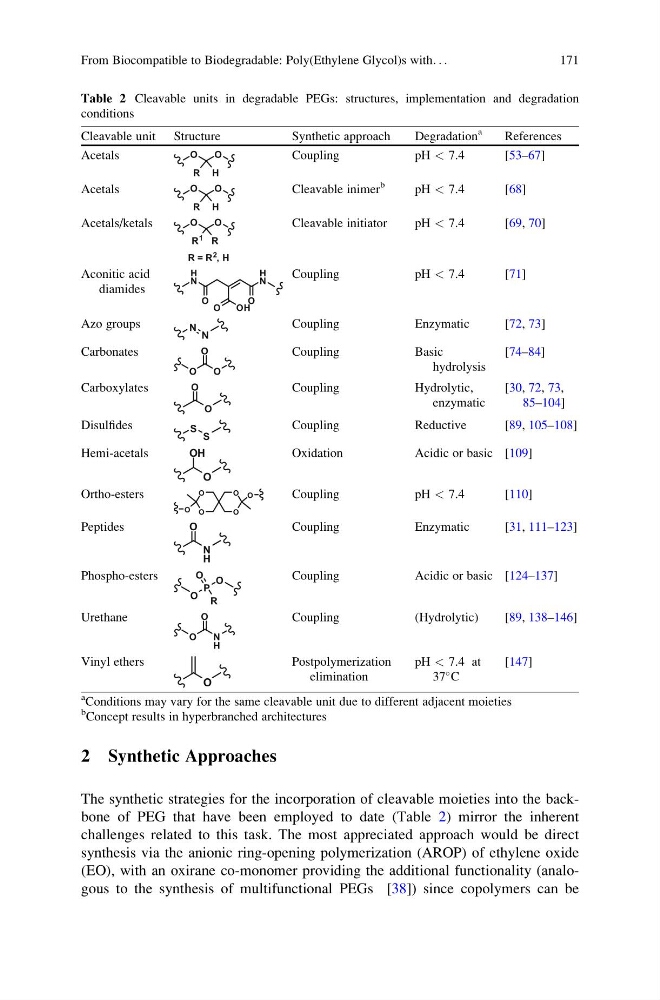
The synthetic strategies for the incorporation of cleavable moieties into the backbone of PEG that have been employed to date (Table 2) mirror the inherent
challenges related to this task. The most appreciated approach would be direct
synthesis via the anionic ring-opening polymerization (AROP) of ethylene oxide
(EO), with an oxirane co-monomer providing the additional functionality (analogous to the synthesis of multifunctional PEGs [38]) since copolymers can be
Table 2 Cleavable units in degradable PEGs: structures, implementation and degradation
conditions
Cleavable unit Structure
Synthetic approach
Degradation
a
References
Acetals
O
O
R H
Coupling
pH < 7.4
[53–67]
Acetals
O
O
R H
Cleavable inimer
b
pH < 7.4
[68]
Acetals/ketals
O
O
R 1 R
R = R 2 , H
Cleavable initiator
pH < 7.4
[69, 70]
Aconitic acid
diamides
H
N
H
N
O
O
OH
O
Coupling
pH < 7.4
[71]
Azo groups
N N
Coupling
Enzymatic
[72, 73]
Carbonates
O
O
O
Coupling
Basic
hydrolysis
[74–84]
Carboxylates
O
O
Coupling
Hydrolytic,
enzymatic
[30, 72, 73,
85–104]
Disulfides
S S
Coupling
Reductive
[89, 105–108]
Hemi-acetals
O
OH
Oxidation
Acidic or basic [109]
Ortho-esters
O
O
O
O
O
O
Coupling
pH < 7.4
[110]
Peptides
N
H
O
Coupling
Enzymatic
[31, 111–123]
Phospho-esters
O
P
O
R
O
Coupling
Acidic or basic [124–137]
Urethane
O
N
H
O
Coupling
(Hydrolytic)
[89, 138–146]
Vinyl ethers
O
Postpolymerization
elimination
pH < 7.4 at
37
C
[147]
a
Conditions may vary for the same cleavable unit due to different adjacent moieties
b
Concept results in hyperbranched architectures
From Biocompatible to Biodegradable: Poly(Ethylene Glycol)s with. . .
171
The synthetic strategies for the incorporation of cleavable moieties into the backbone of PEG that have been employed to date (Table 2) mirror the inherent
challenges related to this task. The most appreciated approach would be direct
synthesis via the anionic ring-opening polymerization (AROP) of ethylene oxide
(EO), with an oxirane co-monomer providing the additional functionality (analogous to the synthesis of multifunctional PEGs [38]) since copolymers can be
Table 2 Cleavable units in degradable PEGs: structures, implementation and degradation
conditions
Cleavable unit Structure
Synthetic approach
Degradation
a
References
Acetals
O
O
R H
Coupling
pH < 7.4
[53–67]
Acetals
O
O
R H
Cleavable inimer
b
pH < 7.4
[68]
Acetals/ketals
O
O
R 1 R
R = R 2 , H
Cleavable initiator
pH < 7.4
[69, 70]
Aconitic acid
diamides
H
N
H
N
O
O
OH
O
Coupling
pH < 7.4
[71]
Azo groups
N N
Coupling
Enzymatic
[72, 73]
Carbonates
O
O
O
Coupling
Basic
hydrolysis
[74–84]
Carboxylates
O
O
Coupling
Hydrolytic,
enzymatic
[30, 72, 73,
85–104]
Disulfides
S S
Coupling
Reductive
[89, 105–108]
Hemi-acetals
O
OH
Oxidation
Acidic or basic [109]
Ortho-esters
O
O
O
O
O
O
Coupling
pH < 7.4
[110]
Peptides
N
H
O
Coupling
Enzymatic
[31, 111–123]
Phospho-esters
O
P
O
R
O
Coupling
Acidic or basic [124–137]
Urethane
O
N
H
O
Coupling
(Hydrolytic)
[89, 138–146]
Vinyl ethers
O
Postpolymerization
elimination
pH < 7.4 at
37
C
[147]
a
Conditions may vary for the same cleavable unit due to different adjacent moieties
b
Concept results in hyperbranched architectures
From Biocompatible to Biodegradable: Poly(Ethylene Glycol)s with. . .
171