

mostly non-immunogenic, and chemically inert [6]. Staudinger was not surprised
by its excellent water solubility [2], although this property is not obvious to the
common chemist and has been subject to several theoretical studies [7]. PEG is
inexpensive and can be produced in a wide range of molecular weights in a welldefined manner with very low polydispersity indices (PDI, M w /M n ) via oxyanionic
polymerization. The polyether is soluble in a variety of organic solvents, which
gives access to a vast variety of chemical transformations of its terminal hydroxyl
groups. Hence, its functionalities can easily be adjusted to the purpose of its
application [8–10]. This versatility in combination with its biocompatibility rendered PEG an important component in everyday products, such as cosmetics,
edibles, and some functional textiles, but also in laxatives and drug delivery
systems [11].
Several different PEG-based drug delivery systems are subject to current pharmaceutical research, the most prominent being protein PEGylation (the covalent
attachment of PEG to a protein) [6, 12–16], stealth liposomes [17], and PEG-based
polymeric carriers for low molecular weight drugs [13, 16, 18]. Although all of
these methods use PEG, they are based on very different concepts.
Since the late 1970s, when Davis and coworkers covalently attached PEG to
bovine proteins [19, 20], PEGylation became one of the most important methods for
dealing with the inherent difficulties of protein therapeutics: Proteins undergo fast
proteolytic degradation and are often immunogenic, which results in very short
body-residence times and a fast decrease below the effective concentration.
PEGylation leads to decreased renal elimination, lowered enzymatic degradation
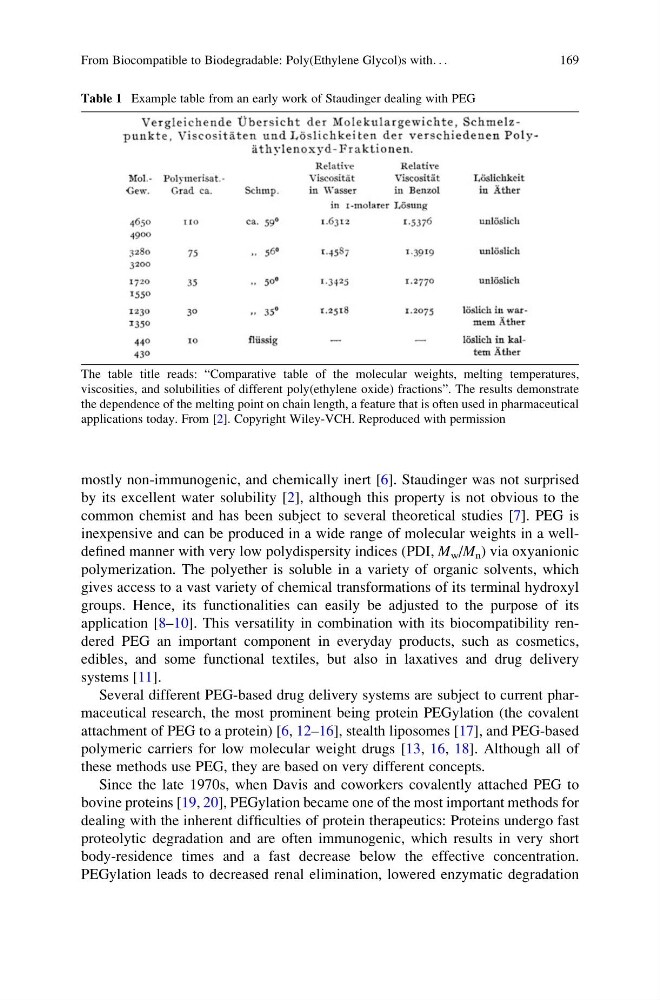
Table 1 Example table from an early work of Staudinger dealing with PEG
The table title reads: “Comparative table of the molecular weights, melting temperatures,
viscosities, and solubilities of different poly(ethylene oxide) fractions”. The results demonstrate
the dependence of the melting point on chain length, a feature that is often used in pharmaceutical
applications today. From [2]. Copyright Wiley-VCH. Reproduced with permission
From Biocompatible to Biodegradable: Poly(Ethylene Glycol)s with. . .
169
by its excellent water solubility [2], although this property is not obvious to the
common chemist and has been subject to several theoretical studies [7]. PEG is
inexpensive and can be produced in a wide range of molecular weights in a welldefined manner with very low polydispersity indices (PDI, M w /M n ) via oxyanionic
polymerization. The polyether is soluble in a variety of organic solvents, which
gives access to a vast variety of chemical transformations of its terminal hydroxyl
groups. Hence, its functionalities can easily be adjusted to the purpose of its
application [8–10]. This versatility in combination with its biocompatibility rendered PEG an important component in everyday products, such as cosmetics,
edibles, and some functional textiles, but also in laxatives and drug delivery
systems [11].
Several different PEG-based drug delivery systems are subject to current pharmaceutical research, the most prominent being protein PEGylation (the covalent
attachment of PEG to a protein) [6, 12–16], stealth liposomes [17], and PEG-based
polymeric carriers for low molecular weight drugs [13, 16, 18]. Although all of
these methods use PEG, they are based on very different concepts.
Since the late 1970s, when Davis and coworkers covalently attached PEG to
bovine proteins [19, 20], PEGylation became one of the most important methods for
dealing with the inherent difficulties of protein therapeutics: Proteins undergo fast
proteolytic degradation and are often immunogenic, which results in very short
body-residence times and a fast decrease below the effective concentration.
PEGylation leads to decreased renal elimination, lowered enzymatic degradation
Table 1 Example table from an early work of Staudinger dealing with PEG
The table title reads: “Comparative table of the molecular weights, melting temperatures,
viscosities, and solubilities of different poly(ethylene oxide) fractions”. The results demonstrate
the dependence of the melting point on chain length, a feature that is often used in pharmaceutical
applications today. From [2]. Copyright Wiley-VCH. Reproduced with permission
From Biocompatible to Biodegradable: Poly(Ethylene Glycol)s with. . .
169