

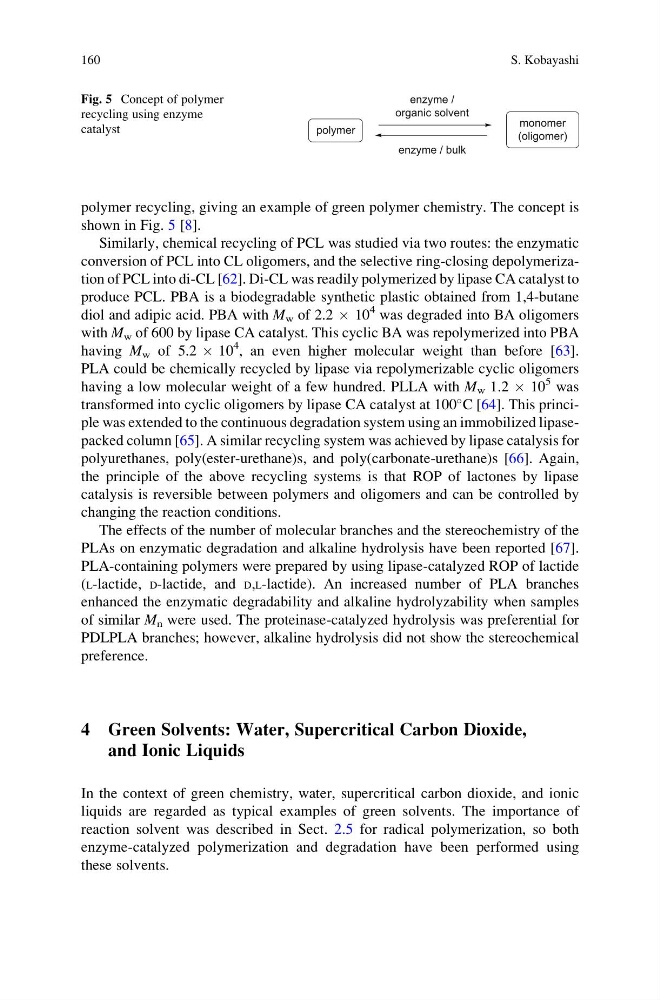
polymer recycling, giving an example of green polymer chemistry. The concept is
shown in Fig. 5 [8].
Similarly, chemical recycling of PCL was studied via two routes: the enzymatic
conversion of PCL into CL oligomers, and the selective ring-closing depolymerization of PCL into di-CL [62]. Di-CL was readily polymerized by lipase CA catalyst to
produce PCL. PBA is a biodegradable synthetic plastic obtained from 1,4-butane
diol and adipic acid. PBA with M w of 2.2 Â 10
4 was degraded into BA oligomers
with M w of 600 by lipase CA catalyst. This cyclic BA was repolymerized into PBA
having M w of 5.2 Â 10
4 , an even higher molecular weight than before [63].
PLA could be chemically recycled by lipase via repolymerizable cyclic oligomers
having a low molecular weight of a few hundred. PLLA with M w 1.2 Â 10
5 was
transformed into cyclic oligomers by lipase CA catalyst at 100
C [64]. This principle was extended to the continuous degradation system using an immobilized lipasepacked column [65]. A similar recycling system was achieved by lipase catalysis for
polyurethanes, poly(ester-urethane)s, and poly(carbonate-urethane)s [66]. Again,
the principle of the above recycling systems is that ROP of lactones by lipase
catalysis is reversible between polymers and oligomers and can be controlled by
changing the reaction conditions.
The effects of the number of molecular branches and the stereochemistry of the
PLAs on enzymatic degradation and alkaline hydrolysis have been reported [67].
PLA-containing polymers were prepared by using lipase-catalyzed ROP of lactide
(L-lactide, D-lactide, and D,L-lactide). An increased number of PLA branches
enhanced the enzymatic degradability and alkaline hydrolyzability when samples
of similar M n were used. The proteinase-catalyzed hydrolysis was preferential for
PDLPLA branches; however, alkaline hydrolysis did not show the stereochemical
preference.
4 Green Solvents: Water, Supercritical Carbon Dioxide,
and Ionic Liquids
In the context of green chemistry, water, supercritical carbon dioxide, and ionic
liquids are regarded as typical examples of green solvents. The importance of
reaction solvent was described in Sect. 2.5 for radical polymerization, so both
enzyme-catalyzed polymerization and degradation have been performed using
these solvents.
polymer
monomer
(oligomer)
enzyme /
organic solvent
enzyme / bulk
Fig. 5 Concept of polymer
recycling using enzyme
catalyst
160
S. Kobayashi
shown in Fig. 5 [8].
Similarly, chemical recycling of PCL was studied via two routes: the enzymatic
conversion of PCL into CL oligomers, and the selective ring-closing depolymerization of PCL into di-CL [62]. Di-CL was readily polymerized by lipase CA catalyst to
produce PCL. PBA is a biodegradable synthetic plastic obtained from 1,4-butane
diol and adipic acid. PBA with M w of 2.2 Â 10
4 was degraded into BA oligomers
with M w of 600 by lipase CA catalyst. This cyclic BA was repolymerized into PBA
having M w of 5.2 Â 10
4 , an even higher molecular weight than before [63].
PLA could be chemically recycled by lipase via repolymerizable cyclic oligomers
having a low molecular weight of a few hundred. PLLA with M w 1.2 Â 10
5 was
transformed into cyclic oligomers by lipase CA catalyst at 100
C [64]. This principle was extended to the continuous degradation system using an immobilized lipasepacked column [65]. A similar recycling system was achieved by lipase catalysis for
polyurethanes, poly(ester-urethane)s, and poly(carbonate-urethane)s [66]. Again,
the principle of the above recycling systems is that ROP of lactones by lipase
catalysis is reversible between polymers and oligomers and can be controlled by
changing the reaction conditions.
The effects of the number of molecular branches and the stereochemistry of the
PLAs on enzymatic degradation and alkaline hydrolysis have been reported [67].
PLA-containing polymers were prepared by using lipase-catalyzed ROP of lactide
(L-lactide, D-lactide, and D,L-lactide). An increased number of PLA branches
enhanced the enzymatic degradability and alkaline hydrolyzability when samples
of similar M n were used. The proteinase-catalyzed hydrolysis was preferential for
PDLPLA branches; however, alkaline hydrolysis did not show the stereochemical
preference.
4 Green Solvents: Water, Supercritical Carbon Dioxide,
and Ionic Liquids
In the context of green chemistry, water, supercritical carbon dioxide, and ionic
liquids are regarded as typical examples of green solvents. The importance of
reaction solvent was described in Sect. 2.5 for radical polymerization, so both
enzyme-catalyzed polymerization and degradation have been performed using
these solvents.
polymer
monomer
(oligomer)
enzyme /
organic solvent
enzyme / bulk
Fig. 5 Concept of polymer
recycling using enzyme
catalyst
160
S. Kobayashi